
The Christchurch wool sale this week did nothing to dispel the gloom that hangs over the industry. While the South Island generally achieves slightly higher returns for its coarse wool than the North Island, prices for both selling centres are languishing around the 185 -190 cents per kg clean.
Fine wool also has reduced by about -35% since the start of the wool season (12 months ago). But it is a mistake to always assume that what impacts on one class of wool has the same impact on the other.
The fine wool clip, coming from merinos and other breeds with a merino influence being used largely for apparel, while coarse wool is used in carpets, although course wool has found other less prestigious roles in the last couple of years such as insulation and for mopping up oil spills.
This report focuses on the coarse or strong wool trade.
Coarse wool has in real terms declined in price for over 50 years with its moment of glory being when the Korean war was underway. Prices were driven up when the USA brought up large volumes to clothe its army through the Korean winters of 1950 and 1951. However, a year later prices fell -53% back to 1950 levels. By 1966 prices were struggling against the competition provided by synthetics which could be manufactured far cheaper.
Since then while there was a period through the 1970’s and 80’s of higher prices they were largely the result of inflationary forces rather than a real demand for the product. The Soviet Union was also a regular supporter at auctions and its demise in the late 80’s also added to the reduced demand.
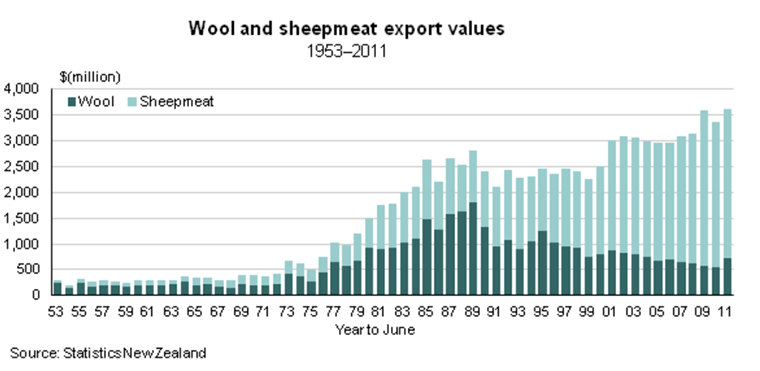
The graph below shows the relativity of wool against sheep meat over time and the later years not shown only exaggerate the gap even further. Bear in mind the steep growth in the late 70’s and 80’s were driven by leaps in inflation that were curtailed in 1991 by the Reserve Bank Act.
In the last 40 or so years there has been a lot of anguish over how to lift returns of wool, with farmers and industry people alike having the attitude “after all it is such a great product why doesn’t the world want it”.
There have been times when growers have hoped that the consumers supposed move away from plastics to things more natural would drive a return to wool. However, despite a lot of analysis and shuffling of the deck chairs wool has lost its place.
One thing that cannot be disputed is the passion that many sheep farmers have for wool and they are driven to try and find new solutions to lift its value.
The latest report published in July 2020 which came out of the 2018 Wool Summit makes the statement “However, we believe we are on the cusp of a natural fibre renaissance led by more environmentally and socially conscious consumers and that a new approach is needed”. No doubt this is correct, up to a point, unfortunately technology has not only created synthetic fibres which can capture many of the attributes that wool has but now there are plant based fibres being used which are very difficult to distinguish from wool so even the ‘unsustainable waste’ tag levelled at synthetic yarns cannot be used.
I can recall quite a few years ago being told that New Zealand wool (i.e. carpets) wouldn’t be able to supply enough to meet the demand of carpet for all the hotels going up in China. And yet demand for the product was falling.
The reason I was given at the time was that building project managers are driven by meeting budget deadlines and regardless of whether wool was or was not the best product and whether it would or would not wear out in 5 years, the project manager would be gone after the building is signed off and had met his budget. (Wool is rarely the cheapest option). I suspect the same occurs today and the competition has only got stronger.
Latterly of course the COVID-19 shut down of factories, buildings and economies in general has meant wool prices have hit rock bottom (we hope). When any upturn occurs is beyond my crystal ball but prices were heading down for coarse wool before the virus turned up.
The apparel trade has had the additional complication of the USA and China stoush with the USA putting tariffs on apparel coming into the States from China, where a large percentage are made.
The report from the Wool Industry Project Action Group (July 2020) has come up with three recommendations:
- Partner with in-market global experts to develop a market-focused investment case and strategic roadmap for the strong wool sector.
- Establish the capability necessary to get the sector match-fit and ready for the opportunities ahead.
- Establish a strong wool sector governance and coordination group to develop and implement the investment case and strategic roadmap and oversee the executive officer.
The concerns I have is that if this was/is the solution why wasn’t it done before as there have been numerous opportunities. Back in 2006 the Wool Industry Network received $2 million in government funding over three years as a Major Regional Initiative (MRI). The funding was to be matched by $3.175 million in funding from Meat and Wool New Zealand over the same time.
Then in 2014 dissatisfied with any progress being made with wool, a referendum of the 12,000 sheep farmers voted to discontinue with the wool levy. The levy was costing a farmer with 2,000 sheep approximately $297 per year. So hardly an onerous amount but more likely reflected the frustration of numerous attempts to crank up wool demand which have been unable gain any traction. Also, with a 47% voter turn-out comments at the time congratulated farmers on the high response.
As a farmer still with sheep and getting wool carpets in (hopefully before Christmas) I believe this latest report is yet another misguided attempt by passionate folk, supported by Government ,to try and show they care but will go nowhere. If I’m wrong, great but….
A footnote to this is if anyone has any doubts about why wool is struggling to compete, go to the Wool Industry Working Group report as their graphs show what the problem is.
We welcome your comments below. If you are not already registered, please register to comment
Remember we welcome robust, respectful and insightful debate. We don't welcome abusive or defamatory comments and will de-register those repeatedly making such comments. Our current comment policy is here.