

Along with the lift in the latest Global Dairy Trade (GDT) results which was largely supported by China, a recent summary viewed of the details of the Australian versus China stoush brought home the precariousness of trade with China.
New Zealand is managing to negotiate its way through trade politics successfully and our looser relationship with the USA probably counts in our favour for a change, at least until Trump gets pushed aside. One thing New Zealand seems to be good at is not letting inflated egos get in the road of good sense.
China certainly seems to have one along with the USA, and arguably the same could be said regarding Australia.
If anyone is wondering why this impasse might be considered important, these are our two largest trading partners and Australia is (still) our closest neighbour in all senses of the word. Also if Australia gets increasingly shut out of China then it will be forced to move products into other markets and potentially upset the advantages that may exist for New Zealand exporters who are already there, although it may further reveal opportunities in China.
The risk is however, that it may put yet more ‘apples into the one basket’.
The latest move between Australia and China, is China telling the Aussie government that it considers Australia to blame for the deterioration in relations, and it expects Australia to make the first move in repairing the situation. Unfortunately, such a move from Australia appears unlikely at the moment, given the reportedly strong anti-China sentiment that exists in Australia.
Below is a timeline (compliments of the South China Morning Post).
• 3 February, 2020 The Australian Dumping Commission assesses a possible continuation of dumping duties on Chinese aluminium extrusions
• 17 February, 2020 The commission initiates anti-dumping investigation against China, looking at the sales of aluminium micro-extrusions, which are used for domestic window flyscreens and television aerials, made by Chinese companies Guangdong Jiangshen Aluminium and Guangdong Zhongya Aluminium
• 28 February, 2020 Australian concludes, following a review, it will continue to impose anti-dumping duties on Chinese deep drawn stainless steel sinks
• 31 March, 2020 Australia initiates anti-dumping investigation into cheap precision pipe and tube steel from China, South Korea, Taiwan and Vietnam
• 16 April, 2020 The commission initiates another anti-dumping investigation into A4 copy paper exported by China, Brazil, Indonesia and Thailand
• 21 April, 2020 Australian Prime Minister Scott Morrison discusses a probe into the origins of the coronavirus with world leaders, including US President Donald Trump, German Chancellor Angela Merkel and French President Emmanuel Macron
• 11 May, 2020 China bans imports from four major Australian meat processing plants
• 13 May, 2020 Australian Dumping Commission concludes, following a review, it will continue to impose anti-dumping duties on Chinese silicon metal
• 18 May, 2020 China confirms 80.5% tariff on Australian barley exports following the conclusion of its anti-dumping investigations
• 27 May, 2020 Australian initiates an anti-dumping investigation into painted steel strapping from China and Vietnam
• 30 June, 2020 Anti-dumping investigation widens to include aluminium zinc coated steel from China and Vietnam
• 10 July, 2020 Dumping commission assesses possible continuation of duties on Chinese steel reinforcing bars
• 13 July, 2020 Australia initiates an anti-dumping investigation into copper tubes from China and South Korea
• 27 July, 2020 Australia Dumping Commission assesses possible continuation of dumping duties on Chinese hot-rolled rods in coils of steel
• 18 August, 2020 China’s Ministry of Commerce confirms it has started an anti-dumping investigation into Australian wine imports following a complaint from the China Alcoholic Drinks Association
• 25 August, 2020 China Mengniu Dairy confirms it will not acquire Japanese drinks company Kirin Holding’s Australia-based asset Lion Dairy & Drinks after failing to get approval from the Australian government
• 31 August, 2020 China announces a countervailing investigation into subsidised Australian wine imports
• 31 August, 2020 China halts barley imports from Australia’s CBH Grain, the country’s biggest grain shipping company, because harmful weeds were found in the cargoes
• 12 October, 2020 China verbally bans Australian thermal and coking coal imports
• 16 October, 2020 China “discouraging” its spinning mills from using Australian cotton
• 30 October, 2020 China customs bans imports of log timber from Queensland and grain imports from Emerald Grain, while it also delays imports of Australian lobster
• 6 November, 2020 Australian coal, barley, log timber, lobster, wine, copper, sugar faces blocks at Chinese ports due to verbal bans
• 11 November, 2020 China customs bans imports of log timber from Victoria.
Given the length of grievances alleged by both parties and the lack of any progress the utilisation of a third party to bring a more dispassionate approach to resolving the issues would seem appropriate. The recently signed RCEP by both parties (and 13 others including New Zealand) which is a rule based approach to trading may be useful but given the length of time involved getting to this stage in the RCEP and no real improvement between Australia and China this is unlikely.
The WTO is meant to be the organisation setup to settle exactly these sorts of problems, but with Trump’s undermining of it, the WTO is unlikely to have the credibility or horsepower to sort things out.
How Australia extracts itself out of the situation and not loses face is difficult to see. But sense would say that the Aussies need China more than China needs them, so the ball is definitely in their court.
New Zealand meat exporters to China should also be getting a little concerned. As can be seen below, the price of pork in China has plummeted back to pre ASF levels due to record imports and the (slow) recovery of the domestic pig herd.
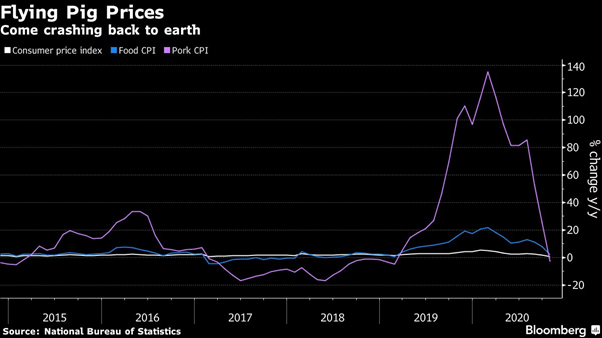
This is likely to put downward pressure on the pork substitutes that has been one of the reasons for New Zealand farmers sheep and beef prices maintaining reasonable levels.
At the moment sheep schedules are holding and only prime beef is on a downward trend. Venison has been the biggest loser with some heavy trimming of the schedule over the last month to the point where it is considerably below lamb on a per kg basis but this is more due to the European situation rather than China which takes small amounts.
We welcome your comments below. If you are not already registered, please register to comment
Remember we welcome robust, respectful and insightful debate. We don't welcome abusive or defamatory comments and will de-register those repeatedly making such comments. Our current comment policy is here.