
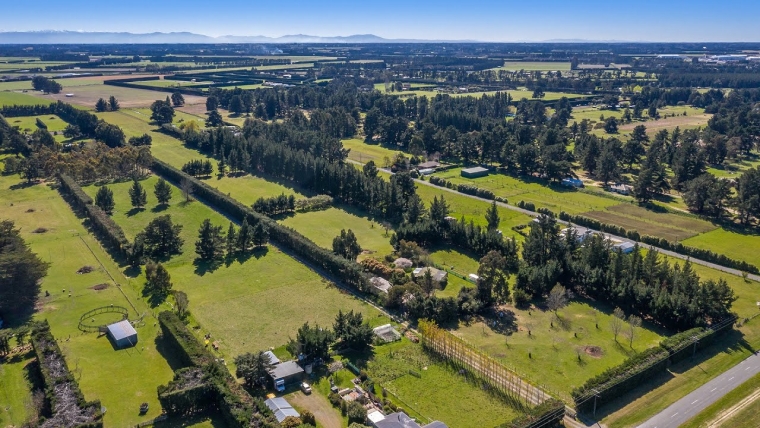
The Ministry for the Environment and Statistics NZ recently released a report looking at land use and the state of the environment in recent decades. Titled “Our Land 2021” one of the focuses has been on the encroachment of urban sprawl onto productive land.
This has been a topic of conversation for decades, and the fact it is still an issue points to a failure of both central and local governments.
The report points out that between 2002 and 2019 urban land area increased by 31% onto land that was potentially available for agriculture. South Auckland has both historically and currently been a problem area for urban encroachment and moving onto highly productive soils. Unfortunately, there has been an ongoing conflict between land for food supply and land for housing and both have legitimate claims.
The matter is compounded by most major cities being developed where the good soils are. While no declining or improving trend of soil quality was able to be quantified, the report did highlight that much of the land monitored had microporosity issues i.e. a lack of pore spaces in the soil, possibly due to being over worked or pugging by livestock.
It also recorded that Olsen P levels (phosphate in soil) ‘were above recommended levels’ in 65 percent of dairy farming sites, 48 percent of drystock (beef, sheep, and deer) farming sites, and 46 percent of orchard/vineyard sites sampled between 2014 and 2018 and this trend did appear to be increasing.
One fact that did surprise me was that the report stated that irrigated land had “significantly less soil carbon and nitrogen than non-irrigated pastures.” This fact (to me) seemed counter intuitive as if more plant life is grown then I have always assumed there would be a benefit to the soil via more organic matter etc. Doing a little digging I found a recent piece of research which does indeed support what the report says, in fact I suspect it is what lead the writers to their position. A pity really, as it was one of the supposed benefits of irrigation and potential carbon mitigation. But, it at least until proved otherwise it appears the reverse is true.
I listened to a couple of the interviews on RNZ on the report and while the general gist of the discussion appeared sound there were a couple of things that did grate. One of the areas singled out for targeting was the growth of lifestyle blocks.
Fortunately going into the report some defining of what makes up a lifestyle block was provided - a land area normally between 2-8 hectares. However, when in academia colleagues and I often had discussions on the relative merits or otherwise of lifestyle blocks. The criticism in the report was that lifestyle block fragmented the landscape and made food production more difficult and were by implication themselves generally unproductive. This may be the case but as a wiser head than mine often quoted “in God we trust, but everyone else show me the evidence”.
While the OM loss under irrigation did show me that my gut is not always correct, many lifestyle blocks I see have greatly improved both production and the environment than the surrounding farmland. I accept that it is always possible to seize examples to support an argument but in my vicinity there are blocks under 10 hectares which are viable nut producing orchards, vineyards areas of established mixed trees, saffron farms etc etc. when the general trend has been to cut most the trees down.
On the other hand, there are plenty of examples of large farms which in anything other than in benign climate years, show little profit and could be considered to be lifestyle blocks, just large ones. It wasn’t that many years ago when that could have been applied to large swathes of New Zealand farmland.
It appears, judging by the amount of infrastructure many lifestyle blocks have on them, they are major contributors to the local economy and keeping rural commerce ticking over, especially when prices or conditions are less than ideal for ‘commercial’ farmers.
The other comment that irritated and perhaps more than it should have was that Canterbury didn’t have enough water for irrigation. Canterbury has plenty of water, what it lacks is storage. My recollection is that it only takes a day or two's water flow of when one or more of the Canterbury rivers is in flood to provide enough water to irrigate the bulk of the plains for the whole season. It may not be a sensible thing to try and do at the moment, but lack of water is not a problem.
Both the water issue and lifestyle blocks were raised by a head of a Centre of Excellence who presumably advises Government. In this case it sounded like personal biases were interposing among the facts.
A perhaps worrying trend the report raised was the population will reach 6.8 million by 2073 of which 87% will reside in urban areas and which is where 80% of the population increase occurs. Given that agriculture is likely to intensify in some form or fashion and with the current reluctance of workers to go onto the land having a few more lifestyle blocks interspersing larger blocks may not be such a bad thing. Going back a few generations, large landowners used to provide cheap land grants of small blocks to potential workers to help ensure they had a ready source of labour, so not a new concept.
33 Comments
I would agree Guy, plenty of productive small blocks abound. But also plenty of mcmansions in the Waikato. Massive houses with the tennis courts, pools (both empty) and acres of lawn for the ride on mower.
The gentry having no interests in farming, just status and weekends spent at Pauanaui.
Let those in Hamilton live in s##t boxes all jammed in...we here in Tamahere deserve big open spaces (as we wait to subdivide for tax free gains).
A 10 acre lifestyle block is pretty rare around here these days (North Waikato, within striking distance of Auckland). Mostly they are far smaller, and that's what is popular. Enough room for a good size house and shed, a big garden for the kids and dogs, a country lifestyle and much less work than trying to farm on a small scale.
The lifestyle blocks on the downs west of Timaru are all hobby farms. Doubt if there is 1 that actually produces enough to pay the rates. Possibly if there was a reliable source of water, they could intensify, if the will was there. As it stands, they would have definitely replaced productive farmland. Dryland grain crops and livestock. Anything bigger than 10 acres is a hard sell and tends to sit while smaller blocks are snapped up. It may have something to do with the fact bigger blocks are viewed differently by banks for mortgages and may need a larger deposit? I'm not sure 10 acres of dry grazing land offers anything more than 5 anyhow, except maybe another few metres away from the neighbours?
I was trying to sell an 8 ha block with an old house at one time but the tenant who was interested in buying said the bank was reluctant to give him a loan as it was too big for a housing loan. Funny because the extra acres would have bought in a good income with cropping etc.
Quite often shopping around different lenders or using a mortgage broker will fix that kind of nonsense, provided the buyer otherwise qualifies with income and deposit.
It's kinda a vicious cycle. The banks probably regard the bigger block as a higher risk as more difficult to sell, but then they demand a higher deposit and higher interest rates on farm land which makes it more difficult to sell.
Anything 25 acres plus you pay rural interest rates. Which might be .8% to a whole lot more. Thats my bank. Perhaps the others sit at 10 acres.
I have a 10 acre block , and generally raise 8-12 calves , from 4 day old , to killing age in good years, in bad years may sell some off before . How that compares to a full isze beef unit , per acre, i do not know.
Just ban horses.
Many lifestyle blocks in the Franklin area (especially Karaka) are a fantastic waste of productive land. All for some horses to ruin the pasture. They probably don't even get sent to the works for dog meat when they die.
What about the carbon storage in their $ 300 per metre post and rail fences?
It's not true storage as they will be replaced. And chewed by horses. And require paint or motor oil to preserve them
Maybe we're not typical lifestylers but here's our story.
I fly a desk for a living, making a decent wage. We have a little over 8Ha of moderately run-down land and a very run-down house and assorted buildings. My job doesn't give me a huge amount of time to be out on the land, so for things I can't get to myself I hire a range of workers - fencing and drainage are the two biggies but there's also call for plumbers, electricians and so on. We're spending a reasonable amount on building supplies to try and bring the buildings up to a vaguely livable standard, and will for many years to come. In the past couple of years we've bought vehicles, a tractor and implements, a mower, sprayer, tools, and so on, all required to develop and maintain the property.
The land itself is leased out to a good local cropper during the warmer months, and to a farmer for winter grazing. Soil samples are taken to ensure it remains as healthy as possible, and we're regularly in contact with rural consultants to ensure we're doing all we can to keep it that way. We may even leave it fallow every few years, the leasing income isn't so much that we'd miss it that much and it would give the land time to recover.
On the more "greenie" side, we've also spent a bit of money rescuing native trees that were going to be cut down by a neighbour, and relocated them to our land. We're in touch with the council about riparian planting along a large flood drain (that rarely has water in it) we have onsite that we would like to turn into a small lake with some riparian planting to encourage more wildlife into the area. To their credit they are very supportive.
Over time we intend to be able to use one of the paddocks, which is flat and square, to host small events for locals to enjoy and connect with one another. We don't expect to make any profit from this at all.
If we were farmers with just the income off the land to sustain ourselves little of this would be possible, but my income from being a corporate drone in Sector 7G enables us to put far more into the land, as well as supporting the local economy.
The proliferation of 0.4-1Ha LSBs in my area is quite depressing as this isn't enough land on which to be productive so removes that land from productive use. They always strike me as being for people who want to project an image of wealth and success while still being able to hear their neighbours flush the toilet.
/novel
Your life: how we are planning ours to head within the next year. Initially we intended to purchase a 4-5ha block just for us, but as time and plans have evolved we now hope to find more than 10ha, preferably 20ha+. Our vision is to eventually develop an intentional community. We hope to support people who struggle to get into home ownership in the current financial system by using a rent to buy where possible. We are not spiritual or even remotely hippies, we just feel good about the concept of direct democracy and home based cooperatives in a community setting, yes...with an eco friendly bent because...well why not get it right environmentally if your starting from scratch.
Above in the comments, some were saying it's harder to sell larger lifestyle blocks/small farms in the size we are looking for. I laugh at this. I've been looking all over for something that might meet all our requirements in the short and long term. Admittedly I'm picky, as our requirements have to suit us into old age and through coming climate issues. I've even focussed in quieter, less likely to be of interest, or unlikely to drastically expand areas for 2+ years, and meanwhile rural prices have skyrocketed. Land owners have been having no difficulty selling large blocks except commercial farms, but even those haven't seemed to have had difficulty finding investors to buy them up and land bank them. Rural RV values, which would have been reasonable two years ago, are nothing to judge prices by now. If I find one I am interested in, either its already under contract and that's wasn't mentioned online, it sells within days of me first seeing it, the price is unreasonably exorbitant against it's RV, the agent tries to convince me I'm in a bidding war, the vendor is a dodgy developer trying to convince us to subdivide the advertised parcel during the purchase so we can hand back to them any future rezoned land so they can sit then capitalise on it as soon as possible or the additional level of funds required to make it liveable for us is out of bounds. I'm hoping like hell the bottom drops out now that the government appears to be attempting to make quick & big capital returns more difficult for speculators, but I don't hold out much hope while QE and interest rates are continuing to feed the land banking beasts.
While there maybe some production inefficiencies involved in having LSBs, surely there are some benefits in having more people with a bit of know how in how to produce food? Plus some environmental/social benefits if they're not as profit driven as the corporations that own the massive farms? (Although obviously those don't apply to the tennis court brigade)
Has anyone ever done any reserach on how much LSBs produce?
We leased out 6.3Ha of our land over Summer, and the crop was described to us as "average" despite the drought, suggesting somewhere over 60 tons of squash were harvested. Last Winter we grazed 70 calves on that same land, although they arrived in batches. Obviously the land couldn't support that sort of stock count year-round.
If life is all about productivity then what's the benefit of being human?
That is the benefit of being human. We can use our intellect to be more productive, so we can produce more goods from the same amount of resouces and time, so that we can have a higher quality of living and more spare time to do things.
That's what Technology is supposed to do anyway, but when governments have a currency that loses its value every year these technological savings are just removed/negated.
Good article.
In terms of bio-diversity, self-sufficiency and future-proofing, lifestyle-size blocks will hands down.
What doesn't, post fossil energy, is crammed urban dwelling or tract housing with no yard.
Which begs the question of that stupid population projection. Post fossil energy, that goes out the window. Try googling: World3 graph there are any number of copies, and comment to go with.
but isn't the carbon footprint of the average lifestyle block household much larger than that of a city dweller?
Not necessarily. Depends on the block and on the city, but not necessarily.
Most folk don't understand that cities are just giant heat-engines. The laws of thermodynamics apply - including entropy. They require vast amounts of imported energy and processed resources. They require it all to be taken away, as contaminated liquid, contaminated gases, or solid wastes. I live on a block, planted own forest, run 50% own food, all own energy, heat etc. And the soil is improving, bought it as a piece of run-down (acidic) farm.
Many greenies miss this city-demand thing completely, as they do the finite nature of the one-off energy bonanza called fossil fuels. Beyond them, I wouldn't live in a city if you paid me. Which, beyond them, you couldn't. No city, ex fossil fuels, even got beyond 1 million, and only got there by churn. There are a lot which are simply unsustainable (in the unmaintainable sense).
There's a spectrum of lifestylers, but plenty live just as they would in town but use more fossil fuel for the longer commute and ride-on mower. The WFH trend might help.
The extra people do help to keep rural communities alive.
You are correct, about the footprint. Of course there is a spectrum, but driving the kids into rugby practice, ballet and goodness knows what, mean country roads have lots of shiny SUVs constantly swerving, trying to get past when moving gear. The low energy practice of moving stock on roadways, has long disappeared in favour of stock trucks.
Electrified tramways, trains and the modern bicycle were the driving force of urban expansion for many cities from 1890 to 1940 before the widespread car ownership era - it pushed some cities like Tokyo far beyond 1 million. In my opinion cities will adapt quicker to a post fossil fuels/ sustainable era than the countryside will.
https://www.worldfuturecouncil.org/wp-content/uploads/2016/01/WFC_2010_…
Read it ALL, Brendon. All.
as for Japan:
Electricity fired by what? Coal? Oil?
Trains were coal.
Bikes are great, but hardly count at this scale.
Most of the fossil energy was still in the ground, the EROEI was still high, the planetary population was south of 2 billion.
Yet they need to attempt the Greater Co-prosperity Sphere, even back then. Ask yourself why? (you'll avoid, is my guess - too uncomfortable). It was exactly Belt and Road - so ask why that, too.
Cities require food (which requires external acreage - or are you one who thinks you can create food in a lab with no energy-input and no feedstock?) and materials in, wastes out. Rural living does not. And without fossil energy, that margin is huge. Your denial (that the human irruption is 6-7 billion overshot) drives your denial of other stuff. Over half of those people are crammed into cities, often crammed 'up' (a sure sign of overshoot vis-a-vis supporting acreage) and dependent on fossil-fertilised, fssil processed, fossil delivered food. And on aquifer depletion, phosphate depletion, topsoil loss (all invisible to a city-dweller).
Remember - read ALL of the Girardet piece. If I have you right, you will find reasons not to - too busy, don't need to know. Please get past that, eh? It'll make you posits more reality-based.
And note the date, and progress since..... We aren't going there and we're out of time.
Can we electrify rail and expand it? Of course - I've argued that for 30+ years. Does that solve the city problem? No. Only a drastic reduction in consumption (and if that hurts, per-head, a reduction in consumer numbers
Read your reference and it's very good, but noted thinking many of these figures can't be right? It's over a decade old and the issues it raises are all MUCH WORSE NOW!
agreed.
That's why I wrote: "And note the date, and progress since..... We aren't going there and we're out of time."
We've added more humans to the total since 2010, than the whole global population was in the year1800. And every one of them wants to consume 'more'.
crammed up leave more acerage for nature or food production
You complain, without evidence, that report reflects the personal bias of the authors, then counter that with a personal annecdote about 10 lifestyle blocks around you?
To that i say, “in God we trust, but everyone else show me the evidence”.
Where is Andrewj these days?
Remember Alice?
He went the same way.....
I think his homophobic , religious ravings may have contributed to his disappearance . pity , because his farming posts were informative.
We all have our bad moments. I recall naming G Robertson twinkletoes. I never read anything nasty from Aj though. Not seeing his posts is probably why I dont hang here much.
I havn't been here much lately, but I am starting to realise he is missing. I hope all is well with Aj.
We welcome your comments below. If you are not already registered, please register to comment
Remember we welcome robust, respectful and insightful debate. We don't welcome abusive or defamatory comments and will de-register those repeatedly making such comments. Our current comment policy is here.