

Having read the Lawyers for Climate Action NZ Inc submission, and tried to gain the gist of their complaint seeking judicial review of the Climate Change Commission’s advice to Minister for Climate Change James Shaw, I suspect this case may gain considerable more ‘airtime’ before it's over.
I should say that given some of the complexities of the submission readers need to provide me some latitude in my interpretations, and I advise them to also go into some of the links when seeking further elucidation, as it does get complex.
The ‘group’ of lawyers are a well organised collection of lawyers (300 has been mentioned) who operate under the name of “Lawyers for Climate Action New Zealand Inc” (LCANZI). The group has been in operation for at least 2 years (first AGM June 2019). They appear to be a ‘concerned’ group who are operating as watchdogs on the Government’s actions in regards to meeting New Zealand’s Paris Climate Change Agreements, among other issues.
They have put forward a number of submissions to both the Government and the Climate Change Commission, on issues like support for the clauses 22 and 23 of the Dairy Industry Restructuring Amendment Bill. These give Fonterra more ability to not pick up milk from new or expanding dairy farms and also farms that are not meeting their terms of supply, in particular around environmental issues (October 2019).
They have also thrown their support behind the Government’s moves to introduce new regulations to improve the nations freshwater quality.
However, as with the latest submission, they also take both national and local bodies to task. Auckland Transport copped their ire with their plans to further invest in infrastructure which would add to the cities GHG emissions, and targeted the Government with their policy to invest in “shovel ready” projects which largely involved spending on transport which again did little to steer the country down an energy lowering future.
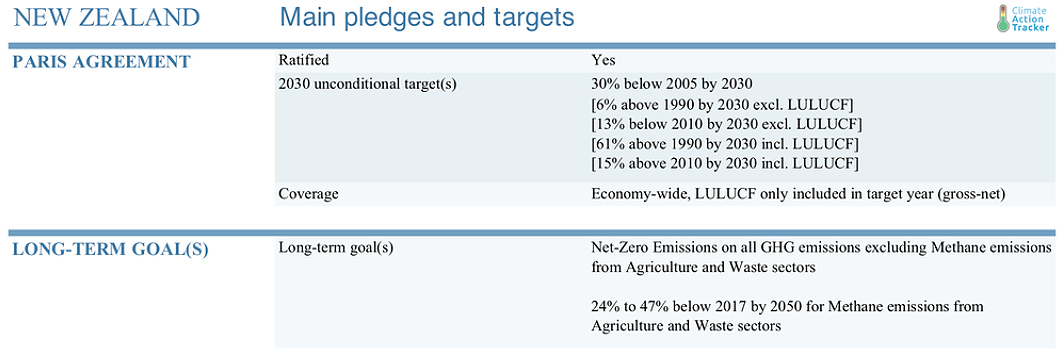
The latest submission, which has turned into a decision to sue the Climate Change Commission, is quite a step further than LCANZI has gone in the past. It stems from the fact that they put a submission forward to the Climate Change Commission back in April pointing out (and with numbers to back their view) that what the Commission was proposing (and eventually put forward to Government in June), was not going to put New Zealand in a position to meet its Paris Agreement reductions, and was based upon flawed reasoning.
The figures for New Zealand to base its future reductions in CO2e are below. The accepted historic figures for are in bold and underlined and on the right (Clauses taken from the LCANZI submission) and progressively increase each year. While the CCC modified approach are on the left and show a reducing trend.
69. While the actual level of historic net emissions has not changed, the figures calculated by the Commission for each of the three previous decades using the modified activity-based approach are significantly higher than the actual level of net emissions as reported in the GHGI:
a. 682 Mt CO2-e for 1991-2000 (cf 448 Mt CO2-e);
b. 701 Mt CO2-e for 2001-2010 (cf 537 Mt CO2-e); and
c. 652 Mt CO2-e for 2011-2020 (cf 543 Mt CO2-e).
The new modified numbers would mean that New Zealand would have a far easier task in meeting the reduction numbers but if these numbers were accepted by the government, it would be unlawful in the eyes of LCANZI. In summary taken from the LCANZI submission.
101. The Act mandates use of the GHGI net emissions accounting approach for setting emissions budgets and measuring performance under s 5Q(1)(a) and s 5X(4).
102. The Commission has erred in law by adopting the modified activity-based approach rather than the mandated GHGI approach.
103. The two measures are materially different for the reasons pleaded at paragraphs 66 to 71 above.
110. The Commission erred in law in:
a. failing to recommend emissions budgets that included projected offshore mitigation that formed part of its NDC analysis; and
b. failing to apply the Act’s restrictions on the use of offshore mitigation.
111. As a result of the error the Commission:
a. proposed emissions budgets which did not match its advice on the NDC;
5. On that approach, the figure for Aotearoa New Zealand for the period 2021-30 should be less than:
a. 568 Mt CO2-e (based on the Commission’s calculation); or
b. 484 Mt CO2-e (based on the corrected calculation pleaded in paragraphs 81-89 above).
116. In addition, Aotearoa New Zealand’s ‘fair share’ of the global carbon budget, as a substantial past emitter and as a developed country, requires a more ambitious target than 568 / 484 Mt CO2-e.
117. The Commission correctly concluded that an NDC which allowed emissions of 596 Mt CO2-e between 2021 and 2030 was not compatible with contributing to global efforts to limit warming to 1.5°C.
118. Setting emissions budgets that would allow 648 Mt CO2-e of net emissions over this period is inconsistent with the Commission’s analysis of the NDC and inconsistent with the purpose of the Act.
119. A reasonable decision-maker would have recommended 2021-2030 emissions budgets and a 2030 NDC allowing net emissions of no more than 400 Mt CO2-e.
120. In recommending emissions budgets that are inconsistent with the purpose of the Act and with subpart 3 of Part 1B of the Act the Commission has acted outside its legal powers.
LCANZI expect to be in court before the end of the year. Unfortunately there are no winners in this case (not even the lawyers this time unless they choose to pay themselves) as if LCANZI prove their case then New Zealand is on a more difficult and presumably expensive pathway to achieving its Paris Agreement targets. Agriculture may well come back into the ‘firing zone’ if this is the case. If the Commission and or government ‘wins’ then it probably means reductions are open to ‘interpretation’ and therefore may be highly variable between countries responses, which may mean the globe exceeding the 1.5oC increase in global temperatures.
Neither option looks great. We can only hope that the correct decision is made (whatever that is) and maybe enjoy the sideshow in the meantime.
No chart with that title exists.
We welcome your comments below. If you are not already registered, please register to comment
Remember we welcome robust, respectful and insightful debate. We don't welcome abusive or defamatory comments and will de-register those repeatedly making such comments. Our current comment policy is here.