
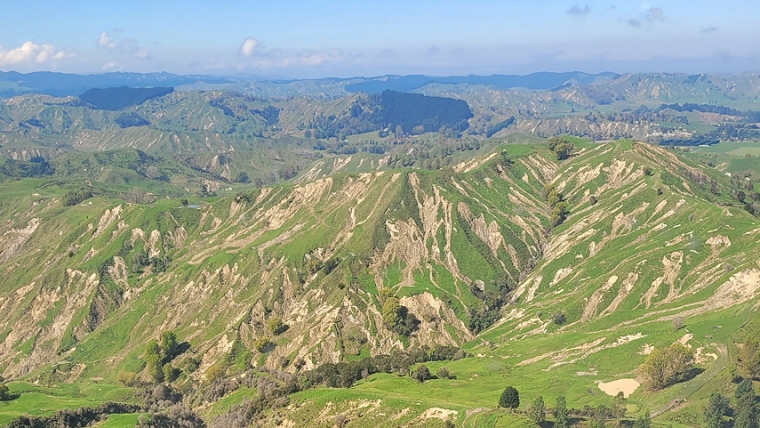
Right now, there is a fervent debate underway as to where pine trees fit within our future landscape. On one side stand Forestry Minister Stuart Nash and Climate Change Minister James Shaw. They are proposing that existing legislation should be reversed so that pine trees would only be for production forestry and not so-called permanent forests.
Minister Nash has recently come to a position that only native forests should be permanent, and he is supported by many who hold strong environmental values. Dame Anne Salmond is one of the leaders in that camp.
In contrast, Minister Shaw is concerned that if permanent pine forests are allowed, then too much carbon will be stored in this way and urban people will no longer be forced to modify their carbon emitting behaviours. There are some huge ironies there.
On the other side stand iwi groups who own large areas of steep erodible land, often far from ports, for which permanent pine forests linked to carbon farming are by far the best income earning opportunities. These forests are also an excellent solution to the erosion problems.
Alongside these iwi groups, but perhaps not generally as well organised, are many pakeha sheep and beef farmers who also own areas of steep erodible land. If either economics or minimising soil erosion is the goal, then permanent non-harvested pine forests on this class of land are the obvious answer. Somewhat ironically, their industry organisation Beef+Lamb does not seem to support them.
This overview might seem to describe a complex situation. Dig a little deeper and everything gets even more complex and confusing. Who is right and who is wrong?
As always in this world that we now live in, there is both information and misinformation. And some of the fervent believers do not understand when they are on shaky ground.
Both native and exotic forestry lie right at the limit of my former professional knowledge, which focuses primarily on agrifood systems. So, learning about forest ecology has been a journey of discovery. But having an education in agricultural science has meant that I do have some prior knowledge about the disciplines of soils, botany, chemistry and physics that underpin forestry. Having studied economics through to post-graduate level also helps.
As for broader ecology, that too lies at the limits of my knowledge, although I did study some ecology a very long time ago. I also had opportunities a long time ago to learn some more ecology in the field as a Board Member for several years of Westland National Park. I have also been lucky to spend multiple years wandering and working in mountain areas across the world, observing nature in its many forms. All of this has been helpful in trying to put together the forestry jigsaw.
Here I want to focus on some fundamentals of introduced versus native forests, and perhaps dispel some myths as I do so.
The starting point lies many millions of years ago when New Zealand broke away from Gondwanaland to go its own way. For a long time, it went close to sinking into the ocean, but did manage to keep afloat as a subtropical outpost with vegetation that aligned to that environment.
Then more recently New Zealand became a land uplifted high by tectonic forces, with the vegetation evolving with that change. But plants evolve only slowly. Hence, we have no native pines nor do we have eucalypts. Rather, our dominant forest natives are podocarps and various species of beech (Nothofagus sp.).
Accordingly, in contrast to the Northern Hemisphere, our range of forest species is constrained in terms of resilience to diverse conditions. In the Northern Hemisphere, tree species have been able to march north and south across the land as the climate changed over millions of years. In contrast, New Zealand’s biota is restricted to what could first survive on a low-lying island outpost and then survive and evolve on a land uplifted high.
Outside of New Zealand, forests evolved in environments where there were many mammalian pests. In contrast, New Zealand’s native forests have been exposed to mammal pests only within the last 1000 years, and primarily within the last 200 years.
To cut to the chase, New Zealand’s native forest trees are not well suited to colonising steep eroded lands that lost their original forest cover between 100 and 1000 years ago and are now covered in rundown pasture and sometimes scrub, and which provide a home for introduced rodents and possums. Newly planted native forests need lots of tender loving care if they are to survive, combined with deep pockets of money to make it happen. Even then, they establish and grow very slowly, with lots of failures.
My forester and ecologist friends tell me that outside of natural regeneration, we would be lucky in the last 100 years to have established 5000 hectares of native forest across all of New Zealand. Where natural regeneration has occurred, it has been a slow process, defined by surviving seed banks, and often going through scrub phases before genuine forest species take over.
Fortunately, there are indeed many hundred thousand hectares of regenerating native forests, in contrast to the paucity of planted hectares. These are largely long-abandoned back-country farmlands with legacy native seeds, where nature has been left to do its own thing for much of the last 100 years . But if the criterion is carbon sequestration, or even protection of steep eroding land, then none of those regenerating hectares have been getting there quickly. Even where seed banks are available, sequestration would be less than one quarter of what occurs in introduced forests. And none of those regenerating hectares are anywhere near back to ‘old man’ forest.
Currently, in New Zealand we have approximately one million hectares, or perhaps a little more, of pastoral land that is seriously eroding. That makes up about 10 percent of the total pastoral land in New Zealand. Putting a focus specifically on North Island sheep and beef land, then it might get closer to 20 percent.
Quite simply, if we want to protect that land and do it without sending the country broke, then pine forests of one type or another are the only way to do it.
If we planted out one million hectares of steep eroding land that has low farming value, then it would sequester well over 20 million tonnes of carbon per annum for the next 80 years and would still be growing strong at that time. At current costs, it would cost about $3 billion to plant, but it would then return, once again at current prices, a carbon value of more than $1.5 billion per year.
Note also that the price of carbon is expected to rise, with the Climate Change Commission suggesting a price of about $140 is needed by 2030, and then heading on from there to $250 per tonne. So, why would we not do it?
The answer coming back from the ‘anti-lobby’ is that pine forests are ‘bad’. But are they really so bad if properly managed?
One of the myths is that pines are short-lived species. Well, we have only had them in New Zealand for about 160 years but trees planted at that time are still going strong. The natural life of radiata pines is about 300 years and for redwood it is even longer.
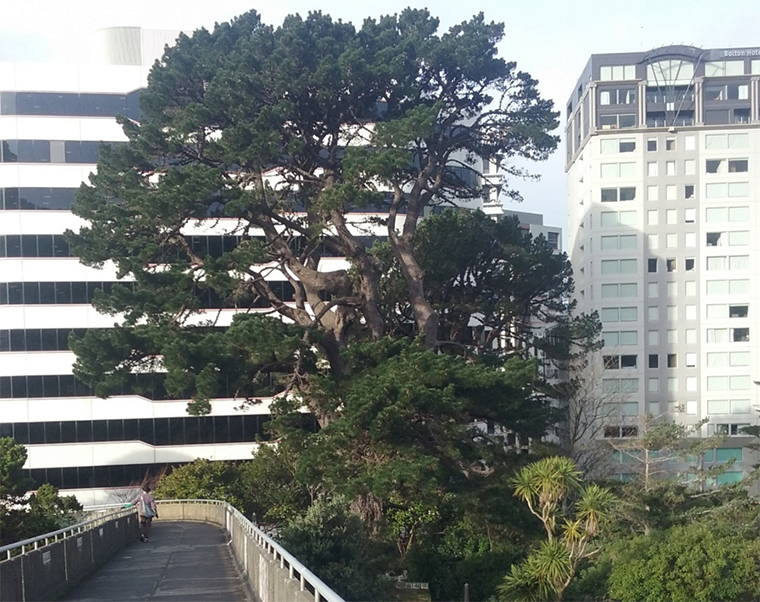
Another issue is fire risk. Yes, that is correct, but non-contiguous plantings are one solution and there are other management strategies.
Actually, native forests also burn. That is how Maori first started the process of deforesting so much of New Zealand, continued by European settlers.
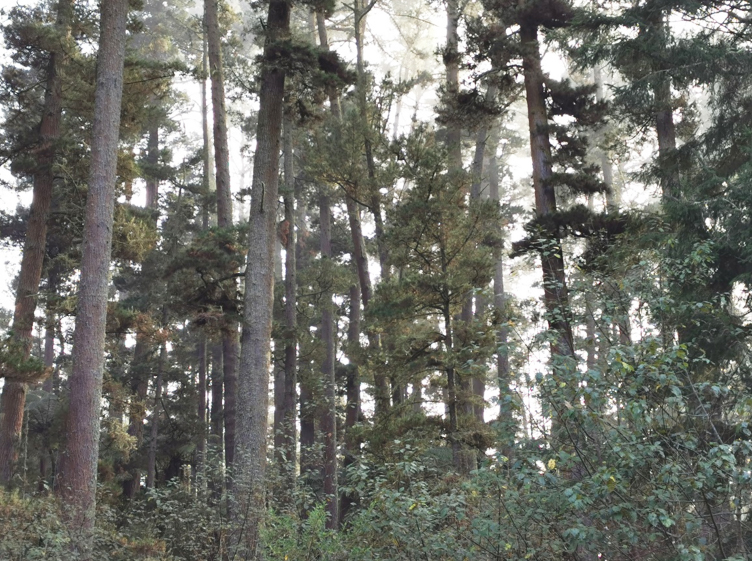
What about windfall? Yes, that too can be an issue. The correct planting rate is a key part of the solution, and some places like the shallow-soil Canterbury plains are not the right place. However, some windfall is a natural process and part of the way that forests regenerate.
There are indeed some horrendous examples of what can happen when storms descend on pine-forest land that has recently been clear-felled, but that is not what happens in permanent forests.
What about wildings? Yes, in some areas that too can be an issue. However, radiata often gets the blame when the real culprits are the lodgepole Pinus contorta and Douglas fir.
I often say in relation to complex environmental issues, that if people think there are simple solutions, then that is because they don’t understand the problem. However, one thing that is clear to me is that among my network of experienced foresters, who do understand both native and introduced species, there is universal acknowledgement that permanent non-harvested pine forests are indeed a key part of the solution.
This is very different than what the key Government Ministers are currently saying. That raises questions as to who they are listening to for their advice.
*Keith Woodford was Professor of Farm Management and Agribusiness at Lincoln University for 15 years through to 2015. He is now Principal Consultant at AgriFood Systems Ltd. You can contact him directly here.


We welcome your comments below. If you are not already registered, please register to comment
Remember we welcome robust, respectful and insightful debate. We don't welcome abusive or defamatory comments and will de-register those repeatedly making such comments. Our current comment policy is here.