
By Murray Grimwood*
We had evolved into societies so large and complex that they required quantities of energy too vast to be supplied by contemporary crops of organic fuel. We allowed ourselves to become so numerous that we could not really grow the food we needed without enormous “energy subsidies,” (William Catton 1982, Overshoot, p134)
Earlier this week I listened to Kathryn Ryan (RNZ, Nine to Noon) interviewing Agriculture Minister Damien O’Connor, which I would describe as: Well-meaning ignorance interviewing well-meaning ignorance. An analogy? Perhaps a Radio Titanic interview of the Purser, about the lower-deck rabble seeking to occupy our upper-deck staterooms. While ignoring the sinking…
Perspective is everything; the more we have, the less chance ignorance has to take hold. If we back off fully, perspective boils down to the sunlit acre. The definitive graphic has been around a long time:
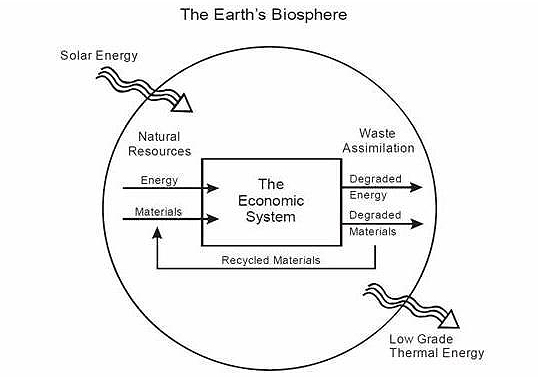
All life-forms require energy, and at some point in the feeding-hierarchy, must tap into the solar-energy input (top-left in the diagram). Some have adapted to seasonal solar-energy surplus/deficit cycles; fat-accumulation, hibernation and leaf-shedding being classic examples. Their lesson to us, is that at some marginal graph-cross, dormancy trumps exuberance as a strategy. Europe, barring a mild winter, is about to find this out the hard way.
Life is energy-dissipative (it depletes food-sources while excreting wastes). So the only long-term-form life could take is a complementary and self-regulating food/waste yin/yang; in Earth’s case a CO2/O2 and nutrient-based circulation between plants and animals; with solar energy in at one end; low grade energy out the other. Within this system species compete, and when species are successful enough to overpopulate, they internally compete.
But the system is regulated - dispassionately - by the amount of solar energy that is captured, degraded as it migrates (across the diagram from left to right) through the food-web, and away.
The big problem comes if a species levers beyond real-time solar input. One example would be lions devouring a herd of Zebra in quick-time. The Zebra represent many years of grazed savannah-acreage; the lions are now overpoulated and – long term – underfooded. Another example is an overstocked paddock; grass (solar energy in its earliest-captured stage) eaten to a point where it is less-available than last season, and has trouble re-growing for the next. The paddock is now underfooded, thus overstocked.
We have levered historical solar acreage to a degree no other species has ever attained, or ever can again (this is, therefore, a one-off moment in global history). Over millions of years, some energy got trapped in the biosphere and didn’t make it directly to the exit-arrow (Low Grade Thermal Energy, bottom right). Unsurprisingly, the energy had entered the food-web, so the store can be traced to dead animals and plants. Oil, coal, and gas are, in the truest sense, fossil energy. The total evolution of our species has happened while that stock of energy – in carbon-bond form - was trapped underground. All other species currently present, have obviously adapted to the same above-ground tonnage of carbon circling the yin/yang. What we have done recently, is ADDED the stored carbon, plus the heat energy released in the burn – to the above-ground equation.
So this is not just a Climate Change issue (sorry, Green New Dealers). This is a: we’re overpopulated now issue. This is a: the planet can no longer underwrite our forward bets issue. But mostly, this is an issue of our pending impossible demand on real-time solar acreage. Because food (remembering food is energy) production is orders-of-magnitude dependent on fossil energy; on millions of buried solar acres. And this is where the Ryan/O’Connor interchange falls short. By – logically enough – some orders of magnitude.
Solar-drenched food-production acres are already being encroached on by our (over) population and already being nutrient-depleted, or lost to desertification. The effort to increase them, had crashed into the carbon yang-to-our-yin; forests. Rainforest to palm kernel to milk powder, being a classic example. Yet without a yang, there is no yin; we evolved co-dependently.
Also, we’ve displaced a mind-boggling amount of other biodiversity, without which – irrespective of emotions like arrogance or optimism – there will be no yin, either. It is reasonable to assume that the pre-human animal biomass was as much as could be carried on real-time, solar inputted, plant caught, eaten energy. Not only do we and our attendant animals now outweigh wild animal biomass by 97/3 relatively – a near-total displacement – but the total mass if now more that the historic baseline. There only one factor causing that increase: our addition of fossilised sunlight to food-production. It is an artificial, temporary imbalance.
The fossil energy we lever, magnifies our labour hundreds of times (try pushing your car home, or doing the work of a 12-ton digger with your shovel). So we irrupted; exponentially increased our population and exponentially increased our collection of energy-requiring infrastructure. The problem was as predictable as the results of overstocking a paddock are; we have overshot. There is not enough stored solar energy, to maintain the current level of activity. Nor, ultimately, to maintain the current human population.
Looking ahead, an equilibrium will be reached, with or without without our help. We would be better landing that plane as gently as possible, rather than waiting for it to crash.
We are blind to the magnitude of the fossil acre / real solar acre ratio, but are attempting to do all things with just the above-ground real-time ones. No wonder James Shaw succumbs to off loding carbon sequestration onto offshore acres. No wonder offshore folk want to plant on ‘our’ acres, doing their own (entirely understandable) offshoring. Meantime, in an effort to feed too-many people (globally; New Zealand probably has a chance to self-feed while lowering to a long-term-maintainable non-fossil-acreage food system) the farming system pushes other limits - water-quality, nitrogen, phosphorous, ecological resilience – in a short-term demand-response. No wonder farmers are worried.
There are not enough real-time solar acres to support as many humans as there are now, doing as much as they are currently doing. Mentioning ‘money’, or the word ‘financial’ (an apparent default-setting for Ryan?) is pointless in the face of that dilemma – which is entirely a question of energy-physics. Even biology is a subsequent topic; life depends on energy; energy doesn not depend on life. And money is so distantly-subsequent as to be a complete red herring.
So now we see the problem; the one the RNZ interview ignored (or at least, addressed in twinned ignorance). We are going to have to ration solar-acre use. And there isn’t going to be enough to go around. By some orders of magnitude. And some folk are going to be unhappy. Very. And they may not be compensatable in currently-understood terms, given the combined energy-reduction dilemma.
This requires a proper discussion across society. Good political leadership. A Systems-meshed Academia. A wider-scoping MBIE. Good investigative journalism. And we needed all that yesterday. Every now and then, as through a glass darkly, we glimpse understanding; Rod Carr saying ‘we need a 30-year energy plan’, being a fairly lonely example.
Initiation of an unwelcome discussion, is difficult. Helen Clark ran ‘sustainability’ up the flagpole, and as rapidly – presumably poll-influenced – ran it back down. Politicians typically follow, rather than lead. Academics are hamstrung by the need for debt-funded bums-on-seats, and by the siloing effect. That leaves – we mavericks aside – the media; and public media do not have a need to please advertisers (unless, of course, their ghost advertisers turn out to be agenda-driven politicians – something I’m sure RNZ are awoke to).
I look forward to a reenactment of that Ryan/O’Connor interview, discussing the coming competition for solar acreage. Without a bagful of assumptions clouding the issue.
Murray Grimwood comments on interest.co.nz as powerdownkiwi, or PDK
We welcome your comments below. If you are not already registered, please register to comment
Remember we welcome robust, respectful and insightful debate. We don't welcome abusive or defamatory comments and will de-register those repeatedly making such comments. Our current comment policy is here.