
If you have been pondering upon “what has happened to Synlait” you won’t be alone. Back in February they announced that they were “emerging from Covid’s long shadow” but since then, as the graph below shows, there has been a downhill slide.
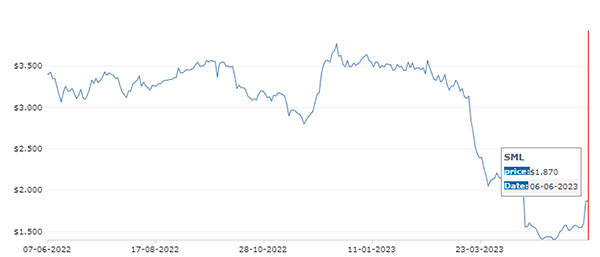
Source: NZX Synlait.
There was some better news this week with Synlait’s application to keep being allowed to export its a2 infant milk powder into China. The announcement which will allow it to manufacture from the Canterbury Dunsandel plant and export this product for the China market until September 2027 is no doubt responsible for the recent lift, be it from a very low base.
Synlait’s lack of recent profitability and associated weak share price can be put down to a number of issues, which individually may not have harmed the firm but collectively they have snowballed to create a substantial headwind. The problems likely go back to when the a2 Milk Company, who own a minority stake in Synlait of approaching 20%, decided to set up their own processing plant with the purchasing of the Mataura Valley Milk plant in Southland, presumably reducing the a2 volumes going through the Dunsandel plant. a2 Milk were seen as a cornerstone consumer/partner of Synlait.
Also, at around this time Synlait went into expansionary mode. Additional processing capacity was developed in Auckland (2017), the Pokeno plant in Northern Waikato developed (2018/19), Talbot’s cheese making plant in Temuka bought (2019) as was Dairyworks (2020) in Christchurch.
At the same time Fonterra finally realised the value of a2 and Synlait no longer had the field, or more importantly market to itself, with Fonterra having the right to supply a2 Milk outside of China and Australasia. And of course, everything was compounded by Covid. a2 exports into China, which relied on the informal Daigou channels, was affected to greater levels than other exporters with personal travel more greatly constrained than formal routes and a slower to return.
The expansions undertaken by Synlait, which have been reported as costing around $555 million, coinciding with the Covid induced downturn produced a perfect storm for Synlait. At the same time there were changes in senior management which may have also resulted in their collective eyes not being on the ball.
Leap forward to the present and Synlait now have the Temuka cheese making plant and Dairyworks (also an adding value processor) on the market with an expected $150 mln to be recouped. In some respects, a similar story to Fonterra, aggressive expansionary mode, bad timing or management and then a retraction. Hopefully the news Synlait's plant can export its a2 component into China and by more conventional means will put Synlait back on the road to profitability as the company has always shown itself to be a leader in multiple fields in the way it operates.
As with most things in New Zealand agriculture the returning of China to the table will be a major component of Synlait’s future success. At the end of April in its 2023 full year forecasts Synlait only predicted a -$5 to a +$5m profit well down on its $38m profit of year ending June 2022, but looks positively rosy compared to the -$28m loss the previous year. In September last year Synlait announced that it was pursuing opportunities in plant based products, it expected to start distributing the plant-based product in Southeast Asia from near the end of 2022 and to Australia and New Zealand by the end of the 2023 calendar year. To date not much further has been heard.
The latest GDT results this week unfortunately did nothing to show that China is beginning to lift its purchasing. Overall, the latest result was -0.9% down led by WMP.
- Butter index up 0.5%, average price US$5,088/MT
- Cheddar index up 7.4%, average price US$4,668/MT
- SMP index unchanged, average price US$2,755/M
- WMP index down 3.0%, average price US$3,173/MT
That cheese is in such strong positive territory shows that the fast food trade is flourishing, at least in some parts of the world. There is a theory that in times of recession the fast food industry does not suffer the same as some other retail outlets as consumers forgo luxuries but consider burgers and pizzas etc as staples and they continue to trade well when other hospitality outlets fail.
The Westpac dairy report goes into some detail around the demand for cheese and ponders upon the opportunity for processors to switch WMP production thereby increasing returns for WMP (less supply) but eventually lowering cheese production (oversupply).
Westpac appear to have given up on waiting for China also, and have reduced their forecast for the farmgate milk price for the 2023/24 season to $8.90. Still considerably above Fonterra’s mid-range however.
Despite China’s keeping a tight rein on spending of food products, within China there is still plenty of evidence that Gen-Z at least see dairy products as an essential component of their diet. Since the COVID-19 pandemic, Chinese consumers have shown higher health awareness and have consumed more dairy products to enhance their immunity. Chinese adults have been recommended to consume 500 grams of milk or equivalent dairy products daily, according to the latest Chinese Dietary Guidelines. This ‘healthy’ trend is also spilling over into the grass fed beef supply with perceptions moving away from it being an inferior product to becoming to be seen as more healthy. Hopefully this attitude is also benefiting sheep meat.
We welcome your comments below. If you are not already registered, please register to comment
Remember we welcome robust, respectful and insightful debate. We don't welcome abusive or defamatory comments and will de-register those repeatedly making such comments. Our current comment policy is here.