
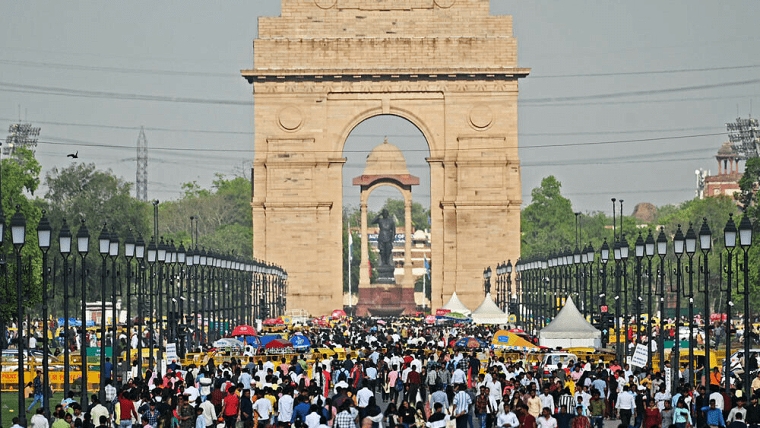
One of the things the Labour government was criticised for while in power was the lack of progress being made on obtaining a free trade agreement (FTA) with India. This gathered more heat once Australia managed to negotiate one and also on the back of reduced returns coming out of China for our primary produce.
Unfortunately, with its broad mineral base of exports Australia is seen as a more attractive partner than New Zealand, which would be seen as potentially competing with Indian farmers.
Prior to the FTA, India’s exports to Australia in 2020-21 were valued at $4 billion, while imports from the country were at $8.5 billion. India was Australia’s seventh-largest trading partner and sixth-largest export market in 2020, driven by coal and international education, according to the Australian government.
New Zealand exports to India are worth NZ$1.1 billion (NZ$467 million in goods, NZ$633 million in services, likely education) with imports worth NZ$1 billion (NZ$878 million in goods, NZ$202 million in services). Considerably less than Australia. Our key exports to India include logs and wood products, fruit and nuts, and education services. Prior to COVID-19, this also included travel and education services (pre-COVID, India was New Zealand’s second largest source of international students and a significant tourism market). Neither country has exported much in the way of dairy products and sheep meats.
So, as a bit of a delve into the potential of India, it has been compared to being the next China. This is not a surprising claim given that India is now the most populous nation on the planet and has now surpassed China. (graph below is two years out of date).
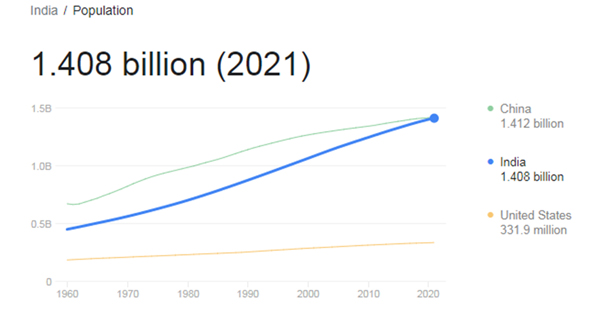
However, population alone is a poor measure of a country’s ability to consume. The USA’s position on the graph clearly shows that population can be disconnected from consumption and purchasing power. As China has shown the size and habits of the middle class (and higher) are of a greater influence when it comes to purchasing products.
At the moment India is all about future potential; when it comes to ‘purchasing power’ it is still considerably behind where China both is and has been for some time. As the graph below shows India, based upon Gross National Income (GNI), is lagging well behind its other BRICS counterparts and not showing much chance of catching up in the medium term, with the possible exception of Russia.
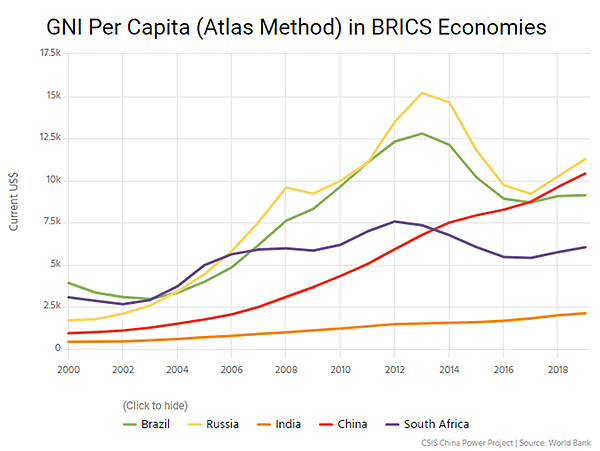
Source: China Power
Defining what constitutes the ‘middle class' is a little fraught as there are a number of definitions but the easiest, although perhaps not the fairest, is by basing income upon daily US$ income per day. However, as a comparison to its BRICS counterparts, India does not look great.
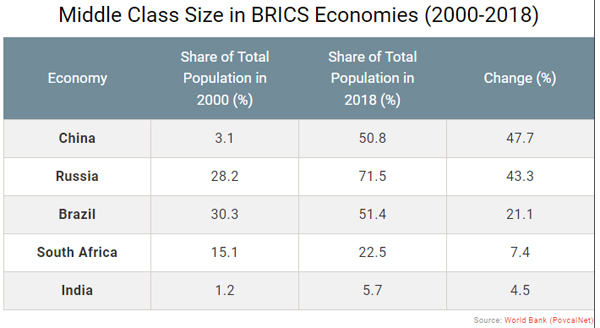
So, when being compared to China, there is no comparison. However, when a country has over 1.4 billion as a population the,n even 6% is a sizeable number. Progress seems to be being achieved and quite rapidly by the figures. According to the India Economic Times it now sits at around 31% and at least prior to the latest global slowdown was growing at around 6.3% per year. Although if a broader view of income earnings is examined these positive numbers may be distorted somewhat by the “super rich” growth. Also, there is acknowledgement that among the 31% (as with the 50% in China) a large percent of the Middle Class still languish at the lower end.
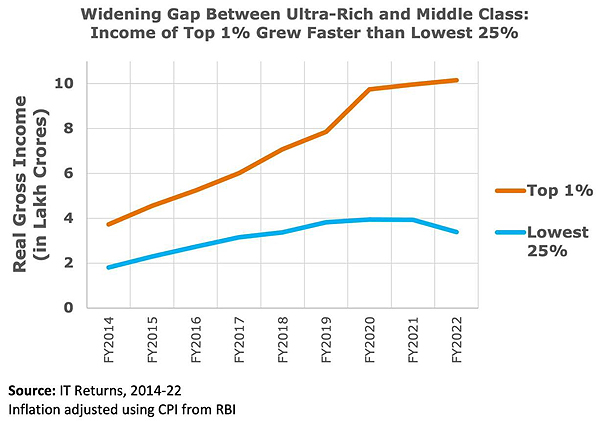
So, while any trade deals with any country are to be welcomed and reductions in tariffs for Australia with its already large export sector to India will be of real benefit, comparing their situation to New Zealand is not really relevant.
The biggest impediment for achieving an FTA deal with New Zealand is dairy. India has the largest dairy herd globally, although very little is exported, and it has perhaps the smallest average herd size. The Indian government is very protective of its farming sector who have a history of strong protests when upset. More than 60 percent of India’s 1.4 billion people still depend primarily on agriculture for their livelihood, though the sector accounts for only about 15 percent of the country’s economic output. That is not to say India does not import food with Indonesia being the top supplier of agricultural products to India, representing 17% of all imported agricultural products. Malaysia, the second-largest exporter, has 14% percent import market share.
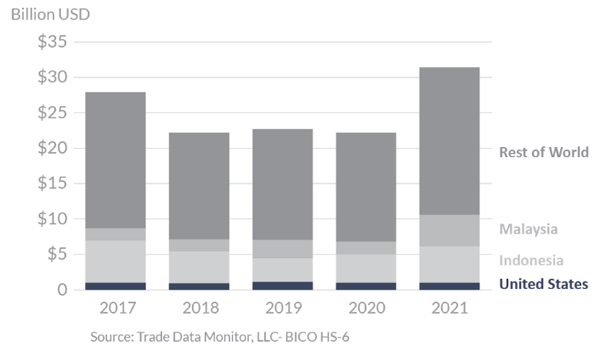
Most of these imports come in the form of grains and soybeans. An area where there have also been imports and which should interest New Zealand exporters and trade negotiators is horticulture. This seems to be an area where there already trade occurring with other countries (including Australia) and does not appear to incur the same protectionist fears as dairy and sheep meats raise.
Damien O’Connor when Trade Minister is on record as saying he was not prepared to negotiate any form of FTA if dairy was not included. This attitude does seem a bit of a home goal given the attitude of the Indian government to dairy.
Sheep meat has made more forays and utilised the help of past New Zealand crickets who have a positive profile in India. There have been limited successes but nothing to replace China.
As of 2022 New Zealand red meat exports into India was $71 mln and sits at 15th as a meat export destination. There are projections that by 2030, India will be the third largest global economy and is projected to have the world’s largest middle class. So, if even close to being correct a worthwhile target but in the meantime Asia has a lot of potential in other places and for other products than dairy that are worthy of pursuit.
We welcome your comments below. If you are not already registered, please register to comment
Remember we welcome robust, respectful and insightful debate. We don't welcome abusive or defamatory comments and will de-register those repeatedly making such comments. Our current comment policy is here.