
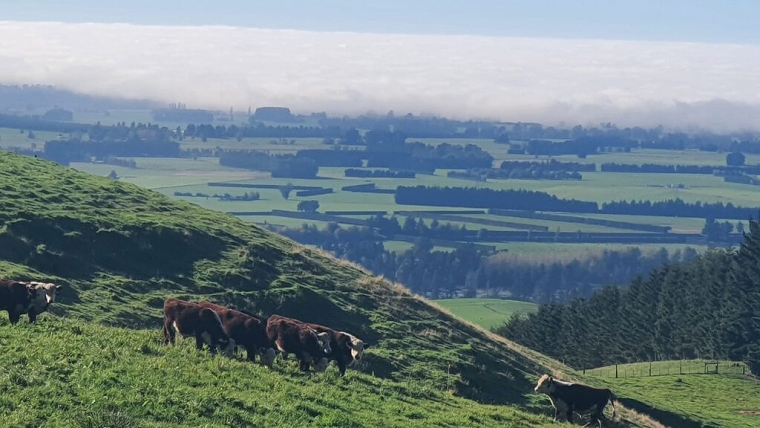
Robert Peacock farms at Orari Gorge Station, which is in the South Canterbury foothills just near Geraldine. It’s mostly Hill Country about 10% flat 15% rolling and 75% tussock country. It has a pretty steep rise from 700 feet up to about 3,500 feet. They are farming 50% sheep 25% cattle and 25% deer. I was keen to get Robert’s thoughts on some of the challenges facing farmers currently, one of which is emissions. What does he as a farmer think of on farm emissions and mitigation tools being developed.
“In a word farming at the moment is tough, it’s very difficult we're all in the same boat, rising costs, soft commodity prices. You could argue how much of that's the market’s fault or the marketer’s fault. But it is what it is. And on top of that obviously the last few years we've had rising regulations either being forced upon us or at least talked about and threatened, and then obviously the emissions on top of that, I think it's a really tricky area.”
“Whether you believe in global warming or manmade climate change or not, the science behind the emissions is quite different depending on which sort of school of thought you want to listen to. And if farmers do need to calculate their own emissions, it's just going to be very generic calculations. I mean it really comes down to number of sheep equals kilos of carbon, we're not feeding our sheep and our cows in a pastoral farming system, so we can't feed them the additives that people are touting as being game changers for carbon reduction. Dairy farmers do have that option, potentially, but again not cheap and not necessarily for everyone and not all year round. Obviously there is the genetic option, we are involved with sheep breeding and cattle breeding, so we have been measuring our sheep for methane emissions and there is a definite difference there genetically.”
“But it's not a free lunch it is it is still strongly linked to intake, and some sheep can emit less carbon and still be good producers. But there are some general trends where that's not the case. And on a general scale if you're going to select for less carbon, without really digging into the breeding values properly, you're going to lower the intake and therefore lower the production. And you've got to be careful that you're not just selecting for a slower growing animal. If they eat less they grow slower, and therefore they're around longer. And therefore, they end up emitting the same amount of carbon or methane.”
“Genetics is definitely an option, AgResearch has done a great job with developing their methane measuring. It's a real thing when you see the results, the difference between individual animals is quite large. And when you put it into different sire lines, there's definite differences. But it's really difficult. We're already breeding for 10 or 15 different traits and you're just adding another trait on, hard to be going forwards in everything.”
Another challenge this country faces in terms of preserving food production and export revenue, is the continuation of sheep and beef farms being converted into pine trees by international corporations to offset 100% of their emissions, what does Peacock make of this?
“I think that the sale of wholesale farms into pine trees by New Zealanders is marginal enough, by overseas buyers I think is just outright criminal that they've been allowed to do that. If they want to buy a farm to farm it, it’s very hard for them to get through the Overseas Investment Office. But if they want to put it in trees, they just get green flagged and away they go, you see farms, beautiful farms, well farmed, well maintained, good food producers and their advert in the sales brochure is 40 minutes from Napier port or something like that, just because that's where the logs are going to go. It's just ridiculous. No other country allows the percentage of offsets as we do. In most countries if you're emitting carbon through your industry, you can plant trees to offset maybe five or 10% of your emissions, if you want to do better than that you actually have to reduce emissions. Whereas in New Zealand you can plant trees to offset 100% of your emissions.”
“So there's no incentive for them to actually reduce their emissions, they're just going to plant their way out of it. In the Paris accord it was quite firmly stated that countries needed to do what they could do but not at the expense of food production, and not at the expense of local economy. So to take whole farms out of food production into trees goes dead against the Paris accord. There are some communities where you just take one farm out of farming and put it into trees, and that can completely wreck the whole community. You might have had a farm with an owner and two shepherds, which might have meant there was three kids at the local school, possibly a teacher, one or two people working off farm in the local town. You take that farm out of the equation it changes everything, it can send a school under they can drop from a two teacher school down to a one teacher school, things like that.”
“So I'm all in favour of farmers being allowed to plant trees, but it comes down to right tree right place. We've got trees in our place but they're all in areas that weren't very productive at all, our least productive land went into pine trees. That blanket planting should just be made criminal in my opinion. And the other thing is that it's all based on 1991. If you had trees in 1990 they don't count, and then when you harvest and replant them you still can't claim on them, which is ridiculous. So if you raped and pillaged your land and did everything wrong, and then all of a sudden you had a cheque book waved in front of you and say, Oh that looks good I'll plant some trees you get rewarded. But if you've been looking after your native bush and planting a few trees in the right place, before 1990, you're struggling to get anything out of it.”
Have a listen to the podcast to hear the full story.
Angus Kebbell is the Producer at Tailwind Media. You can contact him here.
We welcome your comments below. If you are not already registered, please register to comment
Remember we welcome robust, respectful and insightful debate. We don't welcome abusive or defamatory comments and will de-register those repeatedly making such comments. Our current comment policy is here.