
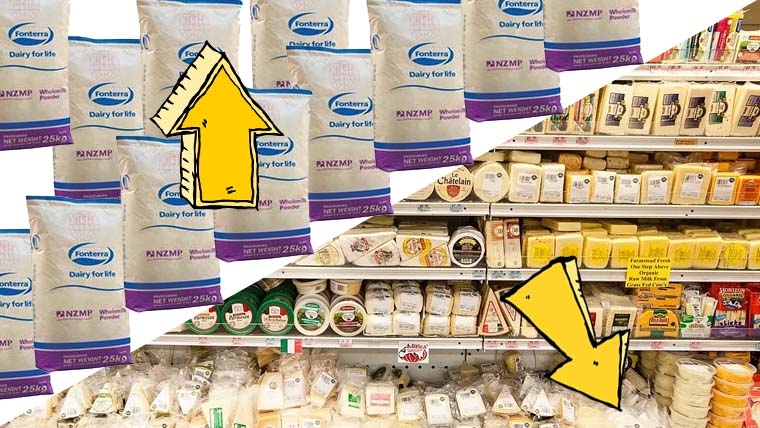
On 16 May, Fonterra announced a proposal to divest itself of all production and marketing of consumer goods. This took most people linked to the dairy industry, including me, by surprise.
If the proposal is fully implemented, then Fonterra will in future only produce ingredients. Some of these ingredients will be sold to food-service entities and the rest will be sold as commodities.
In marketing language, Fonterra will be exclusively a B2B (business to business) entity with nothing that is consumer-facing. Fonterra calls it a step-change but it is more than that. It is a U-turn.
All of Fonterra’s brands would be divested.
Fonterra’s New Zealand and international brands include Anchor, Fernleaf, Mainland, Chesdale, Fresh’n Fruity, De Winkel, Perfect Italiano, Western Star, Anlene, Anmum and others. TipTop used to be Fonterra’s ice-cream brand but that was sold in 2019 at a time when Fonterra had balance-sheet problems.
The proposed divestment also includes the sale of three consumer processing plants in New Zealand, nine processing plants in Australia and five plants in South East Asia.
Fonterra has laid out what it calls its ‘in scope’ products that it proposes to divest. Although these are mainly consumer products, the in-scope products also include small quantities of food-service products and commodities that are produced in the processing plants that will be up for sale.
In the first half-year of 2023/24, these in-scope products earned $2.7 billion revenue with EBIT earnings, net of depreciation, at $190 million. Note that these are just half-year returns.
Fonterra estimates the value of the assets associated with in-scope products at $3.4 billion.
Some 15% of Fonterra’s total milk supply is currently allocated to in-scope products. More than half of this milk is sourced in Australia. Australia-sourced milk is particularly valuable for consumer products because it has 12-month supply whereas New Zealand supply is seasonal.
In recent years, Fonterra has been explicit that it was no longer ‘taking on the world’. It therefore divested itself of South American operations in Chile and Brazil where it had been purchasing and processing locally produced milk. It also sold off its China farms plus its part ownership in Beingmate. It also sold off its 50% interest in European company DFE Pharma for $554 million in January 2020.
In 2022, there was even talk within Fonterra about selling its Australian milk supply and milk processing operations. However, Fonterra then reported in September 2022 that not only would Australian assets be retained, but that these Australian operations, using both Australian and New Zealand milk, were of considerable importance in achieving 2030 targets. It seemed that matter was settled.
Until now, Fonterra’s divestment policies have related primarily reducing the processing of milk produced in other countries. However, Fonterra’s latest plan is to no longer itself convert any of its New Zealand milk into consumer products.
Of course, Fonterra’s milk has to be converted eventually into consumer products, but it will be someone else who does all of this. This ‘someone else’ will purchase at least some Fonterra brands and processing plants, which will then be owned by that ‘someone else’.
The reason that Fonterra is now taking a U-turn is linked to a change in thinking within the Board. This change of philosophy first took root back in 2018. Prior to that the Board had been fractured between those who thought Fonterra should ‘stick to its knitting’ and those who thought Fonterra should ‘take on the world’.
By 2018 it had become obvious that, in trying to take on the world, Fonterra, was making many mistakes. Farmers were unhappy.
Between 2014 and 2017, Leonie Guiney was an outspoken director advocating a change of strategy but she was out-manoeuvred by the majority of the Board, whose support she needed to be re-elected. Then, in 2018 after a year in the Fonterra wilderness, Guiney was re-elected by farmers in preference to Board-nominated directors. That sent a very powerful message to the Board from farmer shareholders.
2018 was also when Peter McBride came on to the Fonterra Board following five years as Zespri Chairman, where he had received praise for his ability to bring that industry together through some rocky times.
With Fonterra Chair John Wilson retiring on account of ill health in late 2018, and John Monaghan taking on the role in what he always said would be a short-term commitment, the path was clear for McBride to take over as Wilson’s long-term successor in 2020.
There is no doubt that under McBride, the Board has come together as a cohesive governance group which had not been the case previously. There is also no doubt that Fonterra has regained the support of its farmer shareholders in a way that had never been evident prior to this.
My assessment is that Fonterra’s farmers will now support Fonterra’s latest strategic plan to divest itself of consumer-focused operations, based largely on the credibility of Peter McBride, plus enthusiasm for capital disbursements.
However, I am not convinced that the full implications have been recognised. There is a possibility that the cohesiveness of the current Board has led to incomplete recognition of long-term risks and counter perspectives.
The starting point is to recognise that Fonterra has struggled mightily throughout its history with the consumer side of its business. The McBride-led Board has been the first one to openly recognise at least the partial source of this weakness.
In its latest announcement, Fonterra opines that “Fonterra is not the highest-value owner of the Consumer and associated businesses in the longer term and a divestment could allow a new owner with the right expertise and resources to unlock their full potential”.
That is a remarkable statement. It is saying that Fonterra itself does not believe that Fonterra has either the right expertise or resources to take the consumer business to its full potential. There is no way the Fonterra of five to ten years ago, with its arrogance, would have made that statement.
This raises the question of why Fonterra could not buy the expertise that it lacked? The answer is that buying the right expertise does not work if the company does not have the right culture to make a particular strategy work. Quite simply, innovative marketers were never going to feel comfortable with the Fonterra corporate culture.
Way back in 2004, Fonterra appointed Sanjay Khosla as Head of Fonterra Brands. Khosla did an amazing job in just over two years in sorting out the plethora of Fonterra’s brands. But that was the last time that Fonterra had a specialist marketer of renown driving the consumer business. Khosla then went on to transform Kraft where the culture aligned much better with marketing of fast-moving-consumer-goods (FMCG).
Some of us realised early on that Fonterra would struggle with being both a manufacturer of ingredients and also an FMCG marketer. Accordingly, dairy farmer and Lincoln colleague Marvin Pangborn and I wrote an article for the Dairy Exporter in 2007 suggesting that the way ahead could be a two-company model.
With this model, consumer goods would be in a separate company, which would have shareholdings held both by Fonterra and external investors, and with a governance team who understood the essence of an fmcg business, and with management structured accordingly.
Fonterra’s directors of that time were not receptive. In my opinion they did not understand the distinct governance and management culture needed for long-term fmcg success.
Then in 2015 I penned another article, published in both the Sunday Times and Stuff, and archived at my own website here, outlining the same concept of a two-company model in which ‘Fonterra Processing’ would hold a shareholding in the second company alongside external investors.
Times have changed again since then, but in a situation where divesting the consumer business is the only option on the table, it does need to be looked at again.
The risk with a 100% B2B focus is that Fonterra becomes dependent on firms that are purchasing its ingredients. That is fine in a static world, but in a changing world, success for Fonterra becomes dependent on the success of firms that buy its ingredients.
There is also a key risk in that Fonterra may react too slowly to changes in consumer markets where its ingredients have to end up, given that it will have no direct sight into those consumer markets.
Perhaps most importantly, once Fonterra focuses only on ingredients and sells its consumer assets, it is a strategy that can never be reversed except at very great cost.
This leaves me attracted to a new version of the two-company model encompassing the current Oceania segment of Fonterra plus existing South East Asian facilities. This second company would probably be best headquartered in Victoria, with shares held by Fonterra and external investors. It would be publicly listed and it would have its own Board. It would draw on both Australian 12-month fresh milk supply plus NZ-sourced ingredients.
There is lots to think about.
*Keith Woodford was Professor of Farm Management and Agribusiness at Lincoln University for 15 years through to 2015. He is now Principal Consultant at AgriFood Systems Ltd. You can contact him directly here.
We welcome your comments below. If you are not already registered, please register to comment
Remember we welcome robust, respectful and insightful debate. We don't welcome abusive or defamatory comments and will de-register those repeatedly making such comments. Our current comment policy is here.