
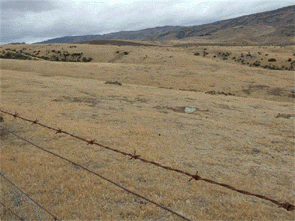
While the rest of the country complains about too much rain over the holiday period, in the south it's just the opposite.
An ironic change in weather patterns has seen Southland and Otago farmers selling stock to Canterbury to finish, a reverse of the norm.
Regional dry area droughts have in the past caused little economic impact other than to the region affected, as stock are regularly moved to areas of feed for finishing.
What must be of concern is the unirrigated freshly converted dairy farms of the south and what this dry spell will be doing to production.
Dairy NZ is running 7 workshops in areas of Southland and South Otago to upskill dairy farmers on milking with a drought. A number of farmers have moved to once a day milking or every 16 hours, as they adapt to lower covers.
It has been reported that there is a shortage of supplementary feed in the region, which is ironic as many farmers further north just want a period of fine days to get it off the paddock!
And the weather pattern that started in late November is predicted by Met service to continue for a while yet. A moderate la Nina weather pattern will bring below normal rain and extended dry periods to Southland right through to February.
Establishing and growing winter feed will be challenging for a province that can often suffer from harsh winter conditions.
Farmers in some parts of Otago are starting to feel the "bite" from dry conditions after parts of the region were among the driest in the country last month, Otago Federated Farmers president Michael Lord said.
This comes as Niwa confirmed Otago and Southland were the regions with the lowest rainfall in the country last month, with Dunedin having its driest December since records began at the Musselburgh site in 1918 reports The ODT.
Mr Lord, who has a dairy farm on the Taieri, said the dry weather in Otago was "definitely starting to bite", particularly for farmers closer to the coast near Dunedin and in the Taieri. Central Otago and North Otago farmers were less affected after going through a relatively wet spring, and there farming systems were geared to dry periods.
Farmers are putting dry-weather action plans in place and selling lambs to Canterbury as the southern sun stunts grass growth reports The Southland Times. Lumsden beef and sheep farmer Glen Mitchell said he was sending 1000 lambs to stores today – 25 per cent of his lamb stock. It was the first time he had sold store lambs.
Mr Mitchell was also killing lambs down to 37kg live weight. Rural livestock Southland stock agent Paul Mavor said Mr Mitchell's lambs were Canterbury-bound."The market has come back. We are [now] selling at $3.50 a kilogram, rather than a bit over $3.80 a kilogram before Christmas," he said.
Owaka PGG Wrightson stock agent Peter Grellet said farmers were selling a sixth of their lambs. "Everything's got to go to Canterbury. There's no feed, so everything is heading north.PGG Wrightson Southland stock agent Andrew Martin said Southland usually took lambs from Canterbury rather than sending them away.
Alliance group chief executive Grant Cuff said lambs, and the resulting profits, were traditionally sent south, but the dry meant the opposite would happen. "We usually have a more consistent rain flow [than Canterbury]," he said. "It will shift some income between provinces."
We welcome your comments below. If you are not already registered, please register to comment
Remember we welcome robust, respectful and insightful debate. We don't welcome abusive or defamatory comments and will de-register those repeatedly making such comments. Our current comment policy is here.