
New Zealand needs to maintain an open and welcoming environment for foreign investment, including investment in rural land, a New Zealand/Australia business forum has concluded.
Further restrictions on foreign investment in land would make it harder to access capital and more difficult to develop business relationships in Asia and other regions, hindering development in New Zealand, it said in the forum's closing remarks.
The issue of foreign ownership of New Zealand land has come to the fore in recent years as the Crafar Farms saga rolls on. A Chinese company, Shanghai Pengxin, has applied to purchase the 16 farms, an application which was initially accepted by the Overseas Investment Office.
But a rival bidder for the farms, a New Zealand consortium led by merchant banker Michael Fay, challenged the OIO's interpretation of the Overseas Investment Act in the High Court, which ruled in their favour, ordering the OIO to reconsider its decision.
The OIO's revised decision, made under a tighter set of economic benefit criteria, has been handed to the government ministers responsible for overseas land purchases. Land Information Minister Maurice Williamson and Associate Finance Minister Jonathan Coleman have sought their own independent legal advice on the OIO's revised decision to see whether it fits with High Court Judge Forrest Miller's interpretation of the Overseas Investment Act.
It is believed Coleman and Williamson will announce their decision by the end of April.
Asia the future
The eighth annual Australia New Zealand Leadership Forum wound up overnight, with co-chair and Fletcher Building CEO Jonathan Ling saying both sides expressed a shared interest in building a future for Australia and New Zealand in Asian markets, underpinned by inward and outward investment, and built on the basis of a strong trans-Tasman single market.
"There was agreement that business needs to step up to articulate this vision more forcefully to domestic stakeholders, to develop new business models connecting with regional supply chains and to work with governments to promote both the development of Asia-relevant skills as well as a range of policy instruments which will foster greater economic integration in the region," Ling said.
'Be open to investment in rural land'
“Chief among these is the need to maintain an open and welcoming environment for foreign investment, including in agricultural land," Ling said.
"Calls for a more restrictive environment for foreign investment can only hinder business development by making it harder to access capital and develop key relationships in Asia and beyond. The cost will be slower economic growth and fewer jobs,” he said.
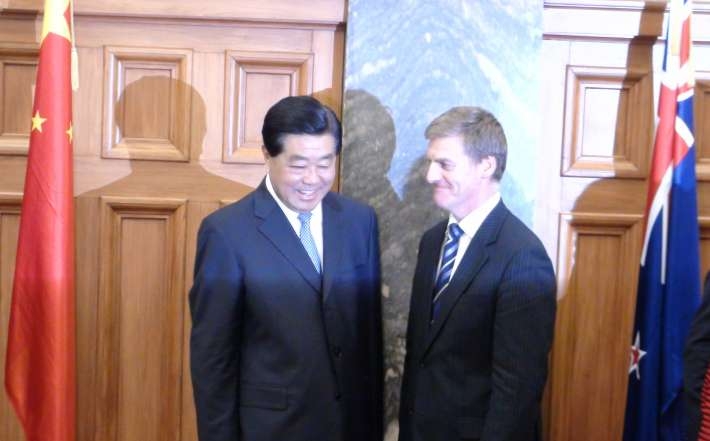
The remarks from the forum come after the fourth-ranked Chinese leader, Jia Qinglin, was hosted in Wellington by Finance Minister Bill English for talks on trade and investment between New Zealand and China.
Speaking to media in Parliament Buildings yesterday, English said discussions were broad natured, and did not touch on specific issues such as the Crafar Farms sale.
Chinese authorities understood concerns in New Zealand about Chinese investment here, were sensitive to those concerns, and wanted to see them resolved, English said.
On course for single economic market
The leadership forum was co-chaired by Ling and Rod McGeoch on the Australian side. It brought together around 100 government, business and community leaders from both countries. Meeting under the theme “Australia and New Zealand – together in the Indo-Pacific century”, the Forum considered the broad strategic context for further expansion of the relationship in the lead up to the celebration of CER’s 30th anniversary in 2013.
“Australia and New Zealand are well on the way to achieving a single economic market,” McGeoch, who is chairman of Sky City Entertainment Group, said.
“The remaining steps require strong leadership. Business has a role to play in ensuring the remaining barriers are removed, including in relation to the movement of capital," McGeoch said.
"Beyond this we see the need for a bold new step to take the relationship to a new level. The forthcoming report of the two Productivity Commissions, as mandated by the two Prime Ministers, will be critical in this regard. Businesses on both sides of the Tasman are resolved to participate the Productivity Commission process,” he said.
Business sessions at the Forum focused on investment, common border and Pacific development.
“Key issues like the mutual recognition of imputation and franking credits, Australian departure taxes, and the prospect of public private partnerships in the Pacific were well articulated and supported by business representatives on both sides. Further work will now be done on these issues particularly in the context of the Productivity Commissions’ report,” McGeoch said.
We welcome your comments below. If you are not already registered, please register to comment
Remember we welcome robust, respectful and insightful debate. We don't welcome abusive or defamatory comments and will de-register those repeatedly making such comments. Our current comment policy is here.