
 I’ll be the first to admit that the frilly, intangible, non-scientific aspects of what and how we produce our agricultural products can be a tricky little number to get your head around.
Much of what we’re good at doing as a nation is hard-edged, ‘proven’ – be it across on and off farm technical performance, engineering disciplines, the All Blacks even – all those things that you can measure and monitor.
But, for a moment let’s just sit and accept these quantifiable aspects.
What else does our agriculture offer?
In a word (and now it may get really uncomfortable) – ROMANCE.
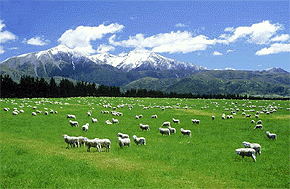
That is, in a world that for most people (especially the ones with discretionary disposable income) is urban, concrete, and pressured, we represent an ideal.
We represent an image that is matched by a reality.
We are both olde world and modern; a ‘place’ where you have to work alongside nature using modern (including digital) tools, that still involves the type of honesty inherent in getting your hands dirty (literally). And, in a modern working world that mostly occurs inside a building, the thought of working outside, producing physical outputs by combining a range of inputs (climatic, prices, scientific, gut-feel) is a wonderfully beguiling thought.
Put another way, (modern, as opposed to peasant) farming, the way we do it, offers a back-story for the piece of meat in a supermarket, that very few other products can.
It is an image and reality that resonates with the heart.
But the fact that we haven’t named this (back) story means we can only deal with the cold, hard facts of matter. That’s all head stuff – and at that level all you’ve got to compete with is price.
My argument is, at an NZ Inc level, the moment we publicly and globally claim the mandate as being the world’s best at responsible pastoralism by naming our story, we provide ourselves with a completely offer to the world.
We would, in fact, step out of where we are now, and like the best movies, offer romance.
That we back this elusive romantic notion with the reassurance of science is totally synergistic, completely non-commodity. But maybe the idea of romance is naïve and unrealistic for our agriculture. Are we therefore doomed to remaining stuck in the mud?
----------------------------------------------------------------------
Peter Kerr is a writer, specialising in simplifying science and technology. He has an agricultural science and industry background. You can contact him here »
This is the eighth in a series about pasture Harmonies.
The first one Branding our pastoral advantage is here »
The second one We're the only protein production systems that can say VISIT is here »
The third one Taking it for granted is costing us is here »
The fourth one Thinking beyond the actuality of how we produce is here »
The fifth one For want of a name ... is here »
The sixth one The way you'd farm if you farmed yourself is here »
The seventh one, more than the sum of its parts is here »
We welcome your comments below. If you are not already registered, please register to comment
Remember we welcome robust, respectful and insightful debate. We don't welcome abusive or defamatory comments and will de-register those repeatedly making such comments. Our current comment policy is here.