
By Lynn Grieveson
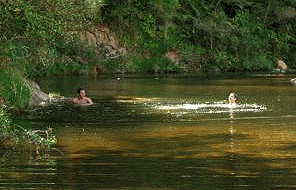
Labour has backed the Green Party call for every river in the country to be "swimmable", saying rivers that are clean enough to swim in are a birthright of New Zealanders, despite claims by Prime Minister John Key that such a policy would "cost billions".
Speaking to reporters outside the Labour party caucus meeting, Labour leader David Cunliffe said a Labour led government would change the National Policy Statement (NPS) for Freshwater Management to make all rivers safe for swimming.
National Environment Minister Amy Adams released the NPS earlier this month that set the minimum standard for rivers at clean enough to wade in or boat on, but not necessarily swim in. Regional Councils can set a higher 'swimmable' standard if they wish, but must consider the economic and social implications. The Green Party released its policy on July 13 that it would implement a standard to make rivers safe for swimming, and not just wading or boating.
"Of course it would take time, but of course that's the aim," Cunliffe said when asked if Labour would change the NPS to make all rivers swimmable.
"I would say that rivers that you can swim in are a birthright for New Zealanders and we aim to have a clean, green economy for all New Zealanders and all rivers," he said.
Earlier Prime Minister John Key, speaking to reporters on his way to the National party caucus meeting, reiterated his belief that the 100% swimmable policy was unaffordable, having already told his post cabinet news conference on Monday that it would "cost billions".
"As I said at my post cabinet presser yesterday, I think it is unrealistic to say that every waterway in New Zealand, 365 days of the year, would be swimmable, " Key said.
"But in reality the ones that aren't swimmable, for the most part, are a small discrete group and it's on certain days. It's not new. It's actually been around for a long period of time."
Key denied that this meant New Zealand had reached a tipping point where it had to accept some level of water pollution in order to keep up the production of dairy produce.
"I don't think we have reached that point," he said.
"I think quite sensibly though, we are recognising that as you intensify farming - particularly dairying - that there are environmental implications for that. And so what's been happening is that the industry itself has been stepping up and taking responsibility. You've seen Fonterra working with its farmers - 22,000 kms now fenced -- the government working through the land and water forum, the National Policy Statement being established and actually Fonterra taking pretty tough actions against farmers that undertake activities that don't meet with proper environmental standards," he said.
"For New Zealand, over half of what we sell to the world is food of some sort and dairy forms a pretty important part of that so it is absolutely critical we get it right in terms of being able to increase our food but having proper, I think, observance of our environmental responsibilites."
Polluter pays?
Pressed on whether he agreed with a "polluter pays" approach, Key said he did "in broad terms", but said dairy farmers were already facing increased costs to meet their environmental responsibilities and pulling them into the Emissions Trading Scheme scheme risked just shifting dairy production offshore.
He said farmers would "certainly not in 2015" have to pay carbon taxes under the ETS under a National led government.
"And the reason for that is I don't think it's realistic just to say to our farmers, 'well, you have to de-stock' on the basis of meeting climate change requirements that other countries around the world aren't doing," Key said.
"I have always thought that New Zealanders will do their bit, and pay their fair share, but getting our farmers way out in front of the rest of the pack doesn't make sense when it reality that production would just shift to another location that wouldn't pay that carbon charge."
Labour, dairying and ETS
Cunliffe, meanwhile, said it was Labour's policy was that the ETS should cover "all gasses, all sectors" and it was "natural that polluters should pay because the market works best when price signals internalise pollution."
"We are not going out to deliberately stunt the dairy industry for goodness sake, no. What we are saying is that that industry, like all others, will have to work within environmental constaints and the smart way to grow value is to add more dollars to every litre of milk."
"Our policy on the ETS is well known. It should be all gasses, all sectors. There may be room for some sort of on-ramp. But that's our approach - something that is comprehensive that uses the market to the best advantage to achieve the objectives that the country needs."
'Too many cows in one basket'
Cunliffe described the recent fall in dairy prices as a "disaster" for New Zealand, proving the economy needed to diversify to be less reliant on the one sector.
"The government has put too much of its faith, too many of its cows in one basket and dairy prices have collapsed 35 percent since February," Cunliffe said.
"Now that's major disaster for New Zealand and I'm advised by Federated Farmers sources that, at NZ$6 a kilogram milk solids payout, about 20 percent of farms could be looking at a debt crisis and that's a very serious situation."
We welcome your comments below. If you are not already registered, please register to comment
Remember we welcome robust, respectful and insightful debate. We don't welcome abusive or defamatory comments and will de-register those repeatedly making such comments. Our current comment policy is here.