But the show was more than theatre. It was a prime-time industrial signal.
Beijing has long used the annual Chinese new year gala to showcase its technological ambitions, with previous shows highlighting drones, robotics and the space program.
This year, the gala put robots front and centre as part of an “AI plus” push.
The timing was important too. China’s “Two Sessions”, the annual parliamentary and advisory meetings, are due in early March. At the meetings, China is expected to approve the 15th five-year plan (2026–30), a policy blueprint that sets strategic targets and steers funding and policy support.
The display also raised some urgent questions for China’s trading partners, including Australian policymakers.
AI that can move in the real world
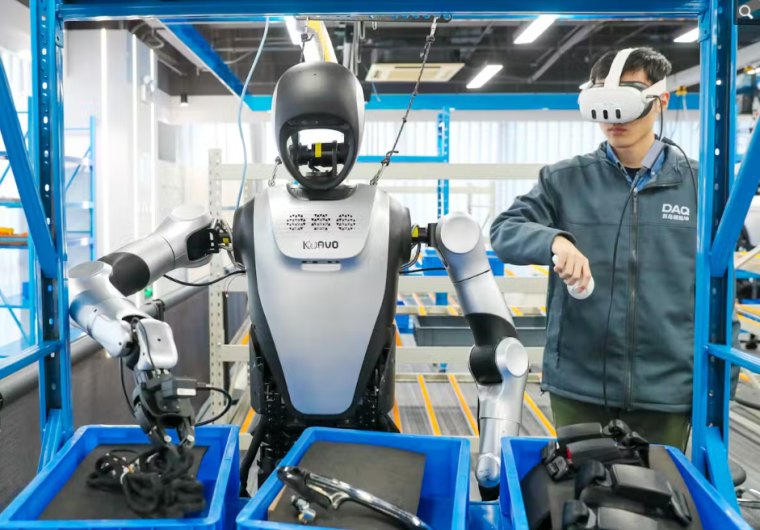
China’s Lunar new year gala is a reminder the artificial intelligence (AI) contest is moving toward embodied intelligence. Embodied intelligence refers to AI-powered robotics, or AI systems built into machines that can move and react in the real world. A robot must balance, manage its power, work safely near people, and recover when something fails.
The Chinese government sees robotics and embodied intelligence as tools to help offset an ageing population and build “new quality productive forces” — its term for productivity gains driven by AI.
China’s strategy is based on engineering efficiency and building at industrial scale, using fast prototyping, reliable hardware, abundant training data covering different scenarios, and factories that can build at volume and speed.
The gala routines were designed to test that. The robots performed coordinated martial arts close to children and human performers, stressing precise movement and safety.
China has built an AI industrial ecosystem
One of the most important details of the night was not the choreography — it was the industrial breadth. Four leading humanoid robotics firms — Unitree, Galbot, Noetix and MagicLab — were showcased.
That points to competition inside a growing ecosystem: more than 150 humanoid robot companies have emerged in China, backed by billions in venture capital and government funding. Official reports say China had a total of 451,700 smart robotics firms in late 2024.
China’s robotics firms are pushing motion control to a new level of precision and agility, and the gap between lab demos and engineered products is narrowing.
But the robots still have limitations. Stage performances can be pre-programmed and rehearsed, but more complex settings require reliability, safety and cost-efficiency.
The founder of Unitree, Wang Xingxing, has been blunt about the gap. He said it is hard to build one “brain” that works in every household because homes vary so much. He expects earlier use in more fixed settings, such as factories and guided tours.
This matters for Australia
In contrast with the robotic might on display in China, Australia’s AI debate is much further behind, still centring on cloud-based large language models such as copilots and chatbots.
Australia already has an edge in using humanoid robots under special conditions. Mining technology companies such as Perth-based IMDEX and Adelaide’s Chrysos Corporation show that special-purpose robots can be used in harsh environments.
Australia should, nevertheless, notice that China is turning robotics into an industrialisation project —and doing so at speed and scale.
For Australia, this matters. Productivity growth has been weak for a decade. It also faces labour shortages in sectors where robots could be most useful: aged care, remote mining and agriculture.
The federal government is working on it. It has published a National AI Plan and a National Robotics Strategy. These are necessary policy foundations, but they are not, on their own, a strategy to build and deploy embodied AI and robotics.
China’s robots expose gaps in Australia’s policy settings
China’s fast move from robot demos to factory-ready machines exposes three policy gaps that now look urgent.
Standards: if Chinese-made robots enter the Australian market at attractive prices, Australia will need clearer rules for autonomous systems in workplaces, homes and public spaces.
Autonomous literally means the machine can act without a person directing every step. That raises basic questions: what counts as safe; who is responsible when something goes wrong; and how do you test systems before they enter industrial and home settings?
Procurement: Australia needs to consider screening guidelines for sensitive suppliers where robots touch data, critical infrastructure or vulnerable people. Screening means checking cyber risk, data practices and supply chain risks before any autonomous machines can be deployed in hospitals, ports or aged care.
Supply chain resilience: Australia has labs that have developed prototypes of advanced humanoid robots, but building them is slow and costly. Heavy reliance on imported parts means long lead times and less control. Australia can reduce risk by diversifying suppliers and building more local capability in key parts and services.
Playing to our strengths
Finally, Australia should choose its battles carefully. Rather than debating whether AI will replace jobs, a smarter strategy is to back specialised robots for tasks where Australia has an edge and clear application scenarios: mining, agriculture, aged care and remote operations.
The stakes are high not only for Australia’s productivity, but also for Australia–China trade relations in the AI age. Safety standards, data rules and supplier screening will become trade issues, not just security issues.
To build robots with embodied intelligence at scale, the scarcest resource is not lithium or computing power. It is time.
*Marina Yue Zhang, Associate Professor, Technology and Innovation, University of Technology Sydney.
This article is republished from The Conversation under a Creative Commons license. Read the original article.
We welcome your comments below. If you are not already registered, please register to comment
Remember we welcome robust, respectful and insightful debate. We don't welcome abusive or defamatory comments and will de-register those repeatedly making such comments. Our current comment policy is here.