
In June the New Zealand China Council partnered with AI Forum New Zealand to lead a New Zealand AI sector visit to four cities in China. Headed by Tech New Zealand CEO Graeme Muller, the group visited some of the big names in China AI including developers, end users, academics and robotics companies. Council executive director Alistair Crozier offers some personal reflections at the end of a busy week. The views in this article are his own.
By Alistair Crozier
On the first morning of our New Zealand AI sector visit to China, I roll over and tell Xiaodu I’m getting up. My lights switch on and my curtains open. She calmly answers my follow-up question about the day’s weather. English can be a problem, but my rusty Chinese gets me by.
Xiaodu is Chinese company Baidu’s AI assistant, available on the bedside console in my hotel room. She can also arrange a top up of room service water, delivered by a chatty robotic concierge which rings my doorbell when it arrives. Fulfilling my Alipay order, a local café’s delivery driver hands the same robot my morning coffee to bring to me as well. (Next year a drone may arrive outside the lobby, for fully automated end-to-end service).
This sci-fi convenience is an entertaining novelty. But in China it’s the tip of the iceberg, not the main event.
The big picture is… really big
After five days of intensive itinerary, our kiwi team was left in no doubt that China has embarked on a massive AI-driven transformation designed to anchor a new era of socio-economic advancement. The government’s ‘AI Plus’ policy is a strategic, long-term effort focused on improving industrial productivity, research and innovation, and personal efficiency across the board.
Government agencies and key economic sectors have all received the memo. They are expected to demonstrate rapid adoption, boosted by both carrots (funding and research) and sticks (directives and compliance obligations).
There was a hint of compliance obligation in some of our discussions with AI end-users. The challenges for non ‘AI natives’ using an emerging and imperfect new tool in the workplace are just as real in China as elsewhere.
And at the consumer level, aspects of the AI push can feel like hype – it’s challenging to see how ‘intelligent’ an AI hair dryer or coffee machine can really be, compared to standard advanced electronics.
But as a kiwi watching AI development from the bleachers, the week definitely convinced me that New Zealand could usefully channel some of China’s urgency and ambition as we work to catch our own next wave of transformation - even if it doesn’t improve our coffee.
US versus them
For now, the United States is viewed by most as the AI world-leader, well ahead of everyone including China. But China is now exploiting ‘second-mover advantage’, to stand on the foundation of what already exists and start pushing boundaries itself. This has led to accusations of copying (or, more technically, ‘knowledge distillation’), which will no doubt become louder as the gap grows narrower. China’s developers would argue they have simply made the most of tools available to them and to others.
China is also following a different, more all-encompassing strategy. The US AI sector has doubled down on large language models (LLMs) like ChatGPT, backed by massive capital investment. (Although Chinese companies like DeepSeek and Z.ai are now close behind, and at much lower cost). China on the other hand has prioritised whole-of-economy adoption, not just software. It is already embedding agentic AI widely in business and social interaction – not just text tools, but ‘brains’ that will increasingly take over analysis and decision-making from humans.
Add to shopping cart
Agent to agent (A2A) e-commerce is an easy example to describe agentic AI transformation at a personal level, and a good example of why New Zealand needs to keep up.
At present when I shop online, I use a search engine to find a range of vendor websites. Then I enter the most promising (or perhaps two or three, to compare), select my chosen supplier and product, click “add to shopping cart” and arrange my credit card payment.
In China, AI ‘agents’ are rapidly taking over both buying and selling.
Consumers request a desired product as an instruction, and AI takes over – comparing multiple suppliers, gathering important transaction information (cost, availability, delivery method and speed), making a final decision and completing the order and payment, all without the user hitting a single further button. Just as importantly, the customer’s agent does this by talking to vendors’ agents (hence ‘A2A’).
An e-commerce expert we met posed the simple question: When a Chinese customer’s AI visits a New Zealand online store in future, who will meet it at the (virtual) door? If there is no 24/7 agent waiting, the consumer’s agent will simply keep ‘walking’ until it finds one.
Data is power
It is well known to the tech sector that data – the experiences and knowledge that are needed to train an AI ‘brain’ – are key to the sector’s continuing advancement. It became abundantly clear during our week that a country the size of China has a lot of it.
We visited a Beijing hospital that conducts 25,000 open heart surgeries a year. Alibaba told us it knows the spending habits of 1.2 billion customers. A large bank we visited has over 13,600 domestic branches.
That’s a lot of training data. To capitalise further, many of China’s developers have adopted an open-source approach, to expand data collection further.
Training robots is harder, because data is usually obtained through physical experiences, not gathered online. But China is tackling those challenges too. Alongside the sheer scale of its start-up robotics sector (see below), it’s now harnessing 3D AI to construct virtual robot training environments. One company we visited is developing advanced agentic software that can be plugged into any robot body – essentially a brain transplant.
More than dancing
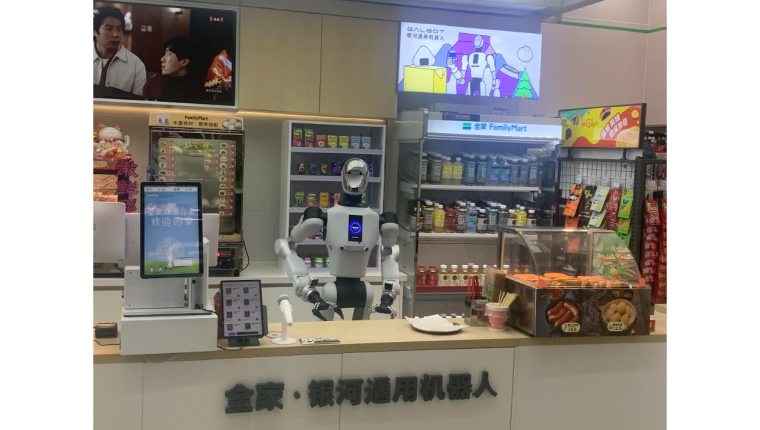
Once you’ve been served a hot sausage by a multilingual robot at a Beijing FamilyMart, you begin to wonder about a very different future world.
Before our visit, looking at Tiktok clips of Chinese robots breakdancing and running marathons, I viewed humanoid robotics as a technology in search of a use. And that’s still my view to some extent. The physical mimicry of humans is impressive, if a little dystopian, but… so what?
It’s clear that the sector has a long journey ahead to fully realise its potential. But our visits to several of China’s leading robotics companies – Galbot, MagicLab, Arkasil, Unitree and DEEP Robotics – demonstrated rapid advances even within the last year. If that momentum can be maintained, then more impactful applications beyond convenience stores and cultural performances will certainly be found, soon.
China’s C3PO-like two-legged robots are arguably the most entertaining, and the least useful. Wheeled robots move at much higher speeds and are being tested (‘trained’) in factories, hotels and entertainment venues. Quadraped models, often referred to as ‘robot dogs’, have been deployed even more widely, monitoring power infrastructure for faults for example, providing perimeter security at airports, and carrying equipment into emergencies.
Robots are particularly useful in uncomfortable or dangerous work environments, whether that be a windowless basement 24/7 pharmacy, an industrial site with hazardous fumes, or a fire.
For now, China’s top strength is robotic hardware – body agility and movement, dexterous hands (a difficult but critical part of the anatomy) and computer vision. Often we saw an engineer maneuvering a jerky prototype with a remote control unit. But once agentic AI allows for self-direction instead of human control, a further frontier will open.
The Chinese government is sending strong signals that ‘embodied intelligence’ like robotics should be a national R&D priority. As for the EV sector, I suspect we will see over-investment across too many start-ups in a short space of time, leading to fast fails, consolidation and involution (i.e. over-competition and a race to the bottom). But at its best, this system has produced world-class and affordable EVs now seen increasingly on roads the world over. Robotics will follow – BYD today, Galbot tomorrow?
I’ll have chips with that
Before our visit, the Chinese AI story I saw most often in western media related to efforts by the United States to restrict supply of powerful memory chips to China (especially Nvidia’s) to stunt its AI development, and China’s acceleration of homegrown alternatives in response. Huawei is mentioned most often as the leading light, but there are others.
China certainly has a lot of ground to make up, by all accounts. It’s throwing its best talent, funding and facilities at the problem. But it is probably the largest barrier to faster progress at present. (Energy supply could loom as another limitation).
The AI sector folk we met did not admit to being worried about lack of access to Nvidia chips. Robotics companies in particular explained that robots require less powerful chips (so far still largely available) than LLMs. When pressed, some confirmed they were exploring local alternatives, and agreed that there could come a day when the Chinese government compelled them to switch. Until then, parts of the sector at least appear to have all the memory capacity they need.
Shared challenges
Given the vastly different scales and socio-economic situations of China and New Zealand, it’s tempting to conclude that our two countries won’t have much in common when it comes to managing the impact of AI. But China, like everywhere else, is grappling with the same deep and complicated shared challenges that others are.
One is in education: Chinese students have as much access to AI to draft essays and complete school projects as their kiwi counterparts. How is China managing this? We had a very open discussion with two academics from Tsinghua University in Beijing, who confirmed that while some educators are seeking to command the tide to stop, others accept not only the existence but also the benefits of AI and are embracing it, within parameters.
As one professor told us, AI can be an extremely useful tool. But he said students must honestly disclose when and how they use it. In this way they are learning, while adapting. Answering our question about future subject choices for Chinese students, our contacts suggested any discipline was fine, as long as the education institution in question embraced AI. Coming from successful top minds produced by a very traditional Confucian education system, this was forward-looking stuff.
The impacts of AI are also being felt in the workplace. Those we spoke to over the week were upbeat about productivity gains, but less transparent about resulting staff reductions and restructures. We know from Chinese news reports, however, that the state is signalling that development of AI should not trigger rampant unemployment. At least two low-level courts in China have recently found that workers laid off when AI took over their usual tasks had been dismissed unjustifiably. In China, such ‘landmark decisions’, and the media coverage they receive, are never random.
We were also told that Chinese people generally feel optimistic rather than nervous about AI in their lives. This is consistent with a latent early-adopter mindset that has seen China embrace mobile devices, super apps like WeChat, e-commerce and other digital advancements over the last 20 years. It’s also possibly due to the state’s full-court press promoting AI’s primacy.
But at the same time, youth unemployment is at a record high in China, and entry-level jobs are amongst the first that can be performed competently by AI agents. And there are plenty of anecdotal reports that AI has in fact taken workers’ jobs.
Final thoughts
We hear very little about Chinese AI in New Zealand, and what we do hear often toggles between its current limitations and concern about its dangers and threats.
I think the real China AI story is a different one. It’s essentially a bold and experimental attempt to lead the fourth industrial revolution – indeed as one contact told us, having missed the last three, China is determined not to miss this one.
All its chips are on the table as the dice are thrown. Whether or not we agree with this decision, wish to emulate it or to collaborate in some areas, New Zealand owes it to ourselves to understand how one of the world’s emerging superpowers is shaping up its future; and to think hard about how we want to position ourselves in response.
We welcome your comments below. If you are not already registered, please register to comment
Remember we welcome robust, respectful and insightful debate. We don't welcome abusive or defamatory comments and will de-register those repeatedly making such comments. Our current comment policy is here.