

The recent run of record results posted by the big four Aussie-owned banks has prompted a chorus of bank-bashing.
The criticism has been bi-partisan, which is a bit surprising because the National Party usually re-runs the Bankers' Association talking points.
The general idea however has been the one articulated by the Prime Minister, that the banks risk compromising their 'social license' by 'extracting high profits'.
For my part, I have been a long-time critic of the leverage banks are allowed to run under Basel III regulation.
However, much of this can be subject to fact-checking. And a debate about bank profits would be better after agreeing some basic facts.
1. How much did the big-four Aussie banks earn in the latest year?
First we should note that they report different 'years'. For ANZ, BNZ and Westpac it is a September year. For ASB it is a June year. But the Reserve Bank's Dashboard reveals a consistent comparison, and that is only out to June so far. The September update is due on November 28.
We can look at these results in their after-tax quantum, and their return on equity. (Banks would like you to look at their return on assets too, because that is a small number, but we will ignore that temptation).
| Year to June 2022 | Year to September 2022 | ||
| Profit | Return | Profit | |
| after tax | on Equity | after tax | |
| $ bln | % pa | $ bln | |
| ANZ | 2.213 | 12.5% | 2.299 |
| ASB | 1.470 | 14.8% | n/a |
| BNZ | 1.430 | 13.4% | 1.414 |
| Westpac | 0.941 | 10.7% | 1.047 |
| --------- | -------- | -------- | |
| All four | $ 6.054 | 12.8% | $ 6.260 |
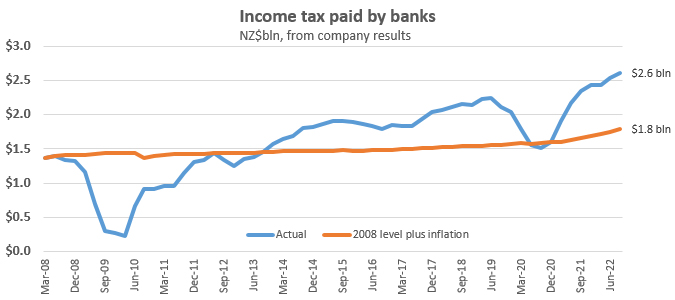
| after tax paid of ... | $ 2.531 | $ 2.606 | |
It is useful to look at the June result, because the Crown Accounts can give a useful perspective, and they were released recently to June 2022.
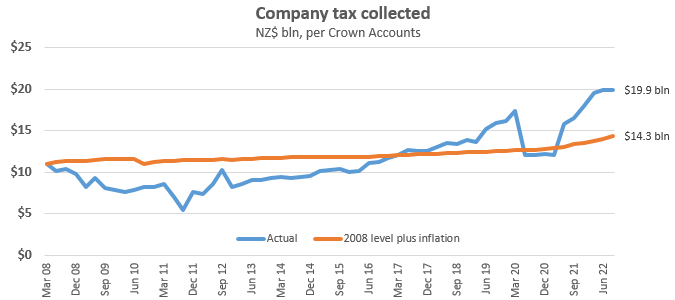
That reveals the total tax paid by all companies in New Zealand, amounting to $19.9 bln. So these four banks paid one eighth (12.7%) of all tax collected. The Government is highly invested in these tax collections.
Unlike other large companies, especially multi-national corporations, our big banks don't fudge the tax. They pay the full rate (after having been beaten by the IRD in some decades-earlier tax court cases).
2. Do banks earn too much?
There will be a lot of politics in how people think about this question. But we will look at it narrowly, in terms of profit growth over a long period (since before the GFC), and how it compares with other large non-bank businesses operating in New Zealand.
It is hard to know what is a sensible base to compare current profits with. One implied criticism is that they "have grown too much."
There is no great rationale to choose a particular base date, but we chose the start of 2008, not only because we have good data from then, but it pre-dates the Global Financial Crisis, and the turmoil it generated subsequently. And we have good comparative data from the Crown Accounts on overall company profitability to compare it with.
In 2008 bank profits were $3.1 bln after paying $1.3 bln in taxes.
If those profits rose at the Consumer Price Index rate subsequently, the level of bank profits would have risen to $4.5 bln after paying $1.75 bln in tax. By that standard, banks would have earned $1.5 bln less in 2022 and paid $780 mln less in tax.
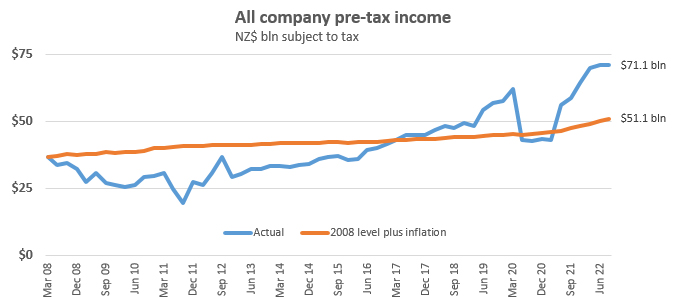
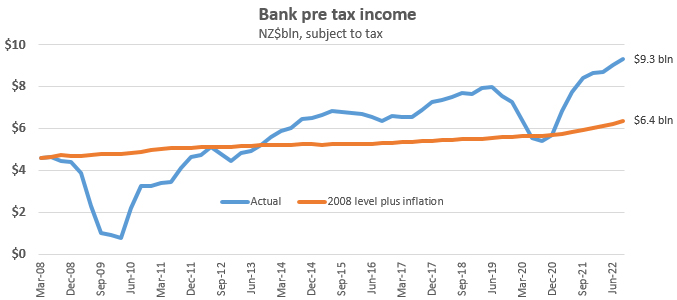
For most companies, there seems to be a bit more under the line than over it. For banks it edges the other way. But over a long period it is hard to make the argument that profits have been materially higher than inflation, for either.
Another way of looking at bank profitability is to challenge the 12.8% return on their shareholders investment.
Perhaps a comparison could be with the ten largest companies listed on the NZX.
| NZX listed | Return on | Shareholders | NPATx | ||
| 2022 | Equity % pa | Funds $ bln | $ bln | ||
| 1 | FPH | F&P Healthcare | 49.2% | 0.766 | 377 |
| 2 | SPK | Spark | 27.7% | 1.480 | 410 |
| 3 | AIA | Auckland Airport | 2.4% | 8.150 | 192 |
| 4 | MFT | Mainfreight | 24.8% | 1.430 | 355 |
| 5 | IFT | Infratil | 24.0% | 5.140 | 1.232 |
| 6 | EBO | EBOS | 9.4% | 2.150 | 202 |
| 7 | CEN | Contact Energy | 6.4% | 2.840 | 182 |
| 8 | MEL | Meridien Energy | 12.0% | 5.520 | 664 |
| 9 | ATM | a2 Milk | 9.6% | 1.200 | 115 |
| 10 | FBU | Fletcher Building | 11.5% | 3.760 | 432 |
| Top 10 | 12.8% | $32.4 | $4.1 |
There are companies in this group who have a very much larger return on their shareholder investment than any bank, and others that have less. But on average, the two sets are very little different. It is hard to sustain an argument that 12.8% is unusual or out of range.
You might argue that banks are protected by regulation. While this might be true, it also limits what they can earn and how they earn it. Those public restrictions come at the 'cost' that shareholders will want a 'fair' return to allocate capital to a highly regulated industry, and a benchmark return like the average of their listed peers doesn't seem unreasonable.
One thing the Reserve Bank has done, and I greatly support, is require these banks to hold more capital. (They just haven't gone far enough in my view). Plus the Reserve Bank sharply restricted what they can remit to their parent owners in terms of dividends during the initial Covid-19 period. It is a fine balance, but shareholders would be naturally reluctant to apply more capital after being restricted to access from dividends. A 'reasonable return' is the quid pro quo. And the NZX comparator makes for a sensible standard.
We welcome your comments below. If you are not already registered, please register to comment
Remember we welcome robust, respectful and insightful debate. We don't welcome abusive or defamatory comments and will de-register those repeatedly making such comments. Our current comment policy is here.