

Our fresh analysis of market share in the home loan market shows whilst changes might be glacial over time, by focusing on banks' share of the quarter-on-quarter changes, there are clear winners and losers.
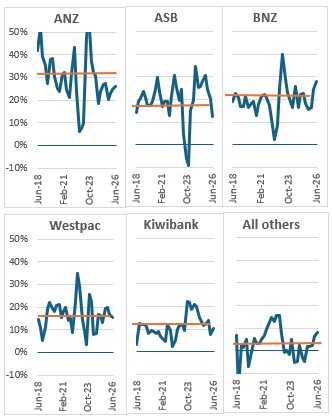
Among the current under-performers are ASB, ANZ and Westpac. Kiwibank is holding its own. BNZ and 'all others' have been winning market share recently. This helps explain why ANZ has been prepared to drive margins lower to recover their share slide, which (pandemic excepted) has slid from about 40% of new business when Reserve Bank Dashboard data first became available, to just over 26% now.
To arrive at these perspectives, we look at the share of the quarterly changes that are revealed in the quarterly Dashboard data. The latest update is for June 2026. The Dashboard data reveals data by individual institution.
But first, this is a summary of the size of each of the major bank's mortgage book as per the Dashboard data from when this first became available in March 2018. It is this data that drives our analysis.
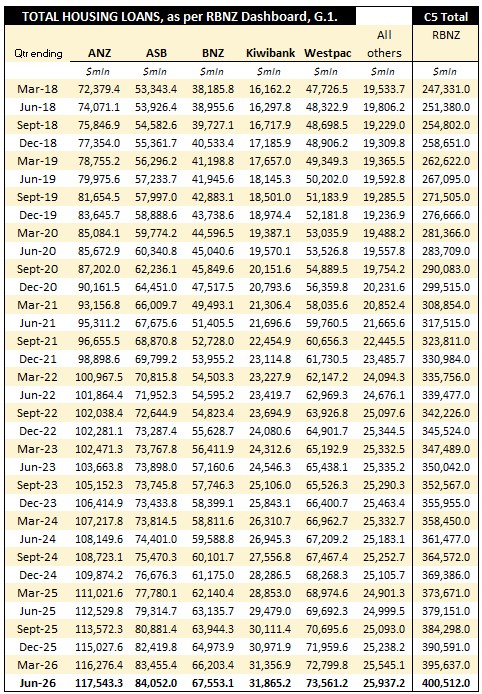
Directly from this we can track overall market share of the home loan market. The total market, including all banks and non-banks, is as consolidated in the Reserve Bank C5 reporting. June 2026 was the first time all lending for housing exceeded $400 billon. It took 10½ years for all home loans to go from $100 bln to $200 bln. The next $100 bln was added in 5¾ years. And this last $100 bln was added in 5½ years. So the rate of expansion in mortgage books is definitely slowing.
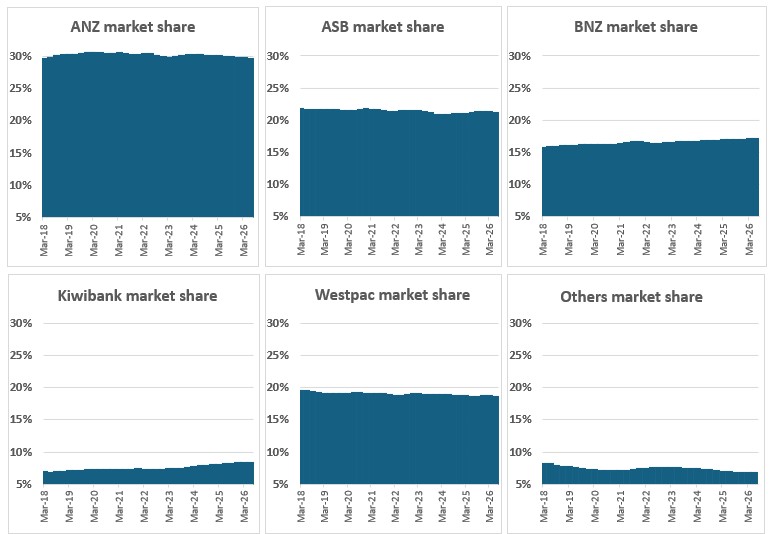
Over that time, overall market share shifts have been glacial.
Currently, Reserve Bank data shows $28.5 bln of home loans switching between banks in the past year. The impediments to shifting are much lower now, but at a 7.5% switching rate, it is still low at one in 13. However, it was 6.0% in the year to June 2025, and 4.1% in the prior year. So there is a clear rising trend of borrowers switching between banks.
Things get interesting when you isolate 'new business' which can crudely be defined as the change in the mortgage book from one quarter to the next. From the table above, we can isolate these changes, by bank, and compare them to the total market change.
This shows who is winning market share and who is losing it.
And from a longer perspective, this shows how the glacier has shifted.
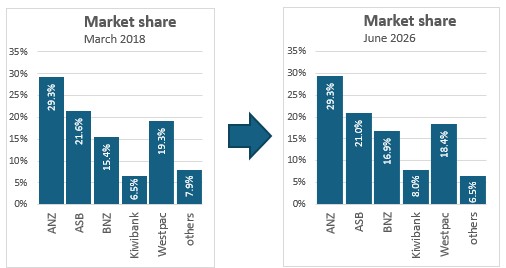
ANZ has been struggling recently. In fact in the June 2026 quarter it won only 26.0% of new business, well below its embedded share of 29.3%. ASB won only 12.2% in the June quarter, an even a larger shortfall from its embedded 21.0% share. BNZ won 27.7% in the June quarter, well above its 16.9% book size and the most of any bank. Kiwibank won 10.4% in the June quarter and also above its 8.0% book share. For Westpac, its June quarter share was 15.6% on a book share of 18.4%, so another under-performer.
Interestingly, the all-other category won 8.0% of the June business growth, on a book that is 6.5% of the market, so a gain for them. We will need to dig in to who in a small corner of this big market is making outsized progress.
Overall, despite the apparent rigid market share base, it is possible to make gains, and it is clearly possible to lose market share. Borrower activity shifting for a better deal is rising too, so the pendulum is starting to swing in favour of consumers.
This may be why we are seeing banks reporting lower profits, lower net interest margins, and bank bosses complaining about 'uncommercial offers'.
We welcome your comments below. If you are not already registered, please register to comment
Remember we welcome robust, respectful and insightful debate. We don't welcome abusive or defamatory comments and will de-register those repeatedly making such comments. Our current comment policy is here.