
By Roger J Kerr

The largest financial/investment market in the world is the US Treasury Bond market and the sell-off in that market over recent weeks has been the largest destruction of value for bond holders since the massive bear markets for bonds in the mid 1990’s.
The spectacular change in US 10-year Treasury Bond yields from 1.60% back in June to 2.60% today is a mind-blowing 62% increase.
Fixed interest investment portfolio managers will be reporting negative returns to their clients as the marked-to-market bond revaluations produce substantial unrealised capital losses.
Any corporate borrower in New Zealand maintaining high levels of floating rate exposures as “inflation is dead and the RBNZ will maintain very low shorter-term rates for ever” has just received a sharp and expensive lesson in interest rate risk management.
Not so many months ago (August) a corporate borrower could have fixed interest rates for 10 years via the swap market at 2.38%. Today those looking to fix for 10 years will pay 3.65%.
For those borrowers who missed the boat at the lower levels and are now belatedly seeking to hedge against market interest rates increases, the answer is that you may be already too late and a fixed rate of 3.65% may not be an economic hedge over coming years.
The 90-day interest rates would need to increase from its current 2.10% to 5.00% over two years to average above a 3.65% interest rate.
Very few interest rate forecasters would be picking 90-day rates to increase by that much over that time period.
The RBNZ’s neutral interest rate estimation is closer to 4.00% these days. Therefore, desperate borrowers who have only just woken up to interest rate risk might be better advised to hedge via purchased interest rate options with a cap at say 4.00%. At least they can participate in the lower floating rates for a while yet as the RBNZ have clearly stated that they will not be increasing the OCR for some time.
The TWI exchange rate index (currently 77.50) would have to fall substantially below the RBNZ assumption of a 74.0 70 76.0 range over the coming 12 to 18 months before the RBNZ would contemplate increasing the OCR.
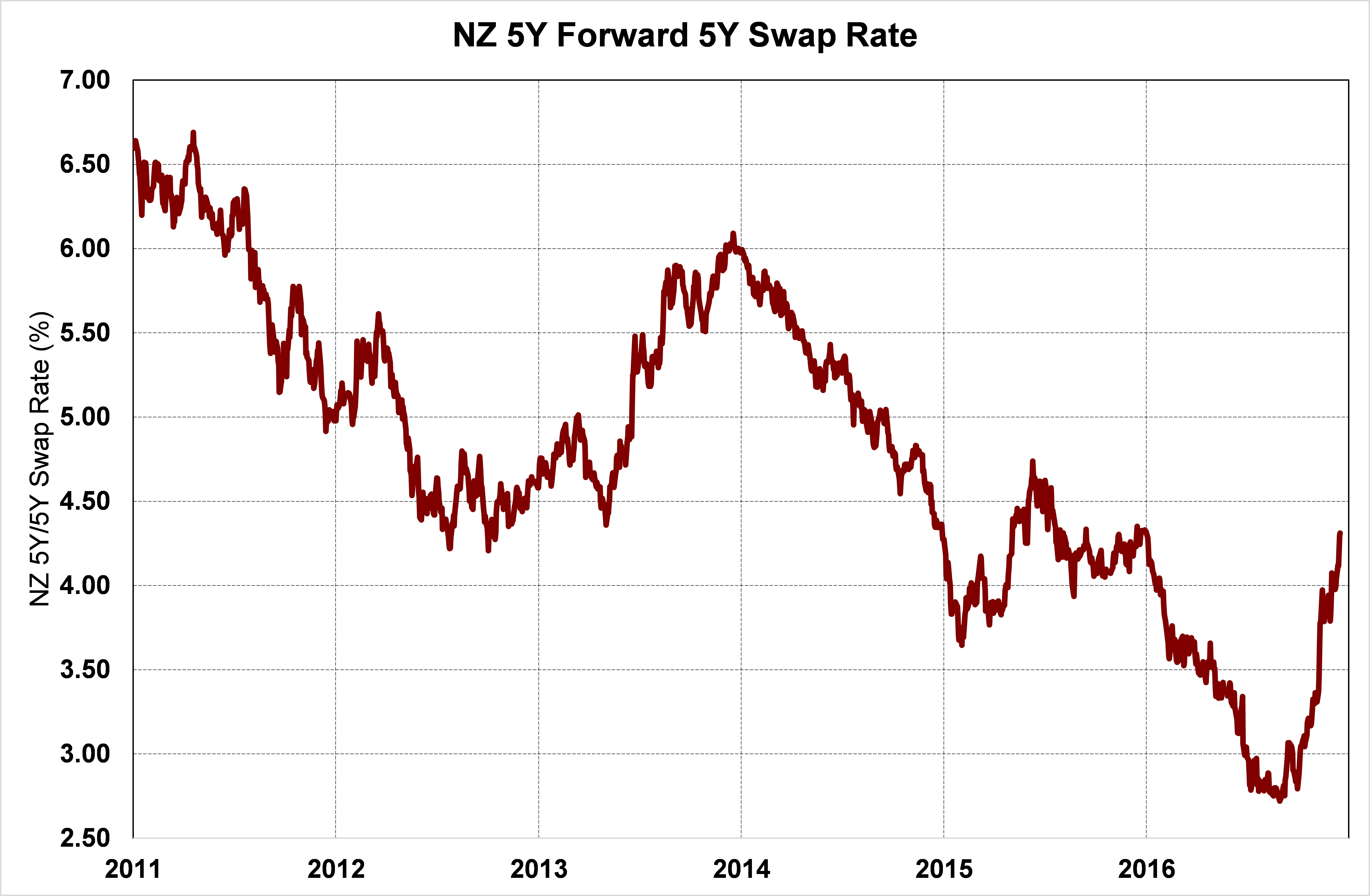
A good forward looking gauge to determine the efficacy of fixing interest rates long term is the forward five year swap rate starting in five years’ time.
The current “five year forward, five year swap” interest rate is 4.30%, well above the RBNZ’s neutral rate of 4.00%, thus it appears to me that the horse has already bolted on fixing long term.
Daily swap rates
Select chart tabs
Roger J Kerr contracts to PwC in the treasury advisory area. He specialises in fixed interest securities and is a commentator on economics and markets. More commentary and useful information on fixed interest investing can be found at rogeradvice.com
We welcome your comments below. If you are not already registered, please register to comment
Remember we welcome robust, respectful and insightful debate. We don't welcome abusive or defamatory comments and will de-register those repeatedly making such comments. Our current comment policy is here.