

By Roger J Kerr

Three dominant variables - as highlighted below - stand out as the determinants of how quickly and how far interest rates increase in NZ in 2017:-
Speed of annual inflation increases:
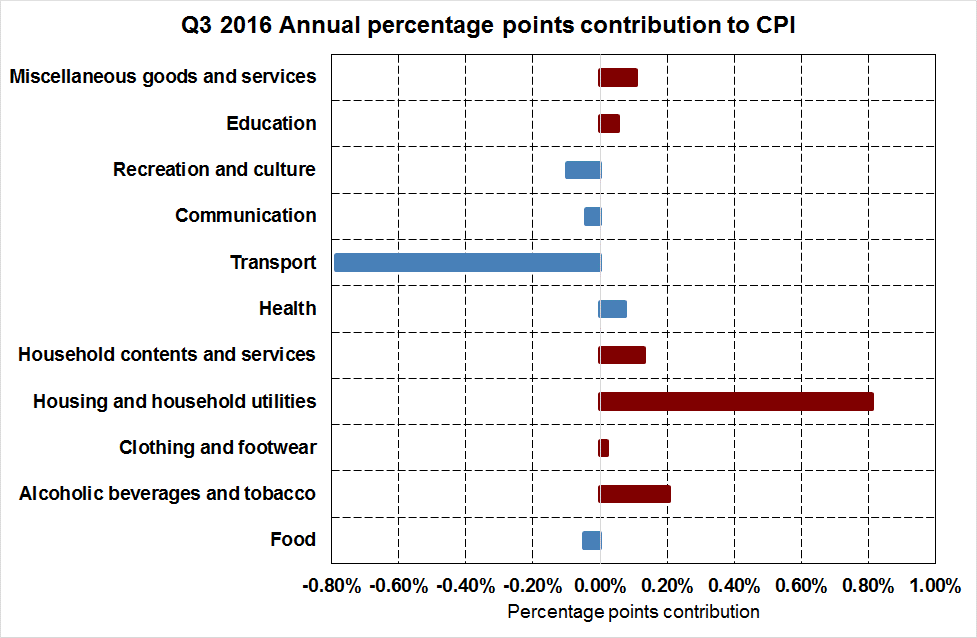
Inflationary pressures in the NZ economy (as measured by the CPI) have been disguised and hidden by the dramatic collapse of oil prices in 2015 and early 2016.
As these price decreases drop out of annual CPI figures over the next 12 months the true colours of other price increases occurring in the economy are going to be more clearly seen.
When the transport component of the CPI (15% weighting) is no longer such a big negative for the overall annual rate, the jump up in annual inflation is spectacular (refer chart below).
Add in house rental prices starting to increase again (mortgage interest rates now rising and maintenance costs also increasing) and the financial markets may not be too surprised to see annual inflation increasing at a faster clip than current RBNZ forecasts for 2017.
The two year wholesale market swap interest rate at 2.50% is already pricing in multiple 0.25% OCR increases in late 2017 and 2018.
NZ currency value - Trade Weighted Index:
Global FX market weakness in the UK Pound, Japanese Yen and Aussie dollar have lifted the NZ dollar cross rates and kept the TWI at the elevated 78.50 level.
Tradable inflation will be kept lower than RBNZ forecasts if the TWI stays at 78.
The NZ dollar remains over-cooked in its value against the AUD with the two key NZD/AUD cross-rate lead indicators, interest rate and commodity price differentials both pointing to a cross-rate below 0.9000 (currently 0.9500).
A drop in the NZD/AUD cross-rate will pull the TWI down and lift tradable inflation.
How far US Treasury Bond interest rates sell off:
On the pre-Christmas Trump rallies in equities and the US dollar the US 10-year bond yields zoomed up from 1.80% to 2.60%. This In turn lifted our term wholesale swap interest rates by 80 basis points.
The 10-year bond yields have since pulled back to 2.39% as question marks arise as to whether President-elect Trump can deliver on his economic promises.
If the November/December Trump rally in markets turns into a Trump Slump the bond yields may edge a little lower in the short term.
However, looking further out into 2017 a strong US economy with associated higher import costs, higher wage costs, higher commodity prices and higher energy costs all point to three Fed Rate increases and rising bond yields to the 3.00% region.
Daily swap rates
Select chart tabs
Roger J Kerr contracts to PwC in the treasury advisory area. He specialises in fixed interest securities and is a commentator on economics and markets. More commentary and useful information on fixed interest investing can be found at rogeradvice.com
We welcome your comments below. If you are not already registered, please register to comment
Remember we welcome robust, respectful and insightful debate. We don't welcome abusive or defamatory comments and will de-register those repeatedly making such comments. Our current comment policy is here.