

Surprisingly weak retail sales figures for the June quarter have raised the possibility that New Zealand went into a technical recession in the first half of the year.
A 'technical' recession is two consecutive quarters of negative GDP growth. In the March quarter the NZ economy shrank by 0.2%. The figures for the June quarter are not released till September 15.
Most economists have been picking a fairly solid pick-up in economic activity for the June quarter as the country enjoyed the impact of getting over the big wave of Omicron that affected the March quarter. Indeed the Reserve Bank has forecast a +1.8% bump for the quarter.
Retail sales are just one relatively minor (about 7%) contributor to the overall GDP outcome, but the sagging sales in the June quarter definitely suggest there is a possibility the country has entered a recession.
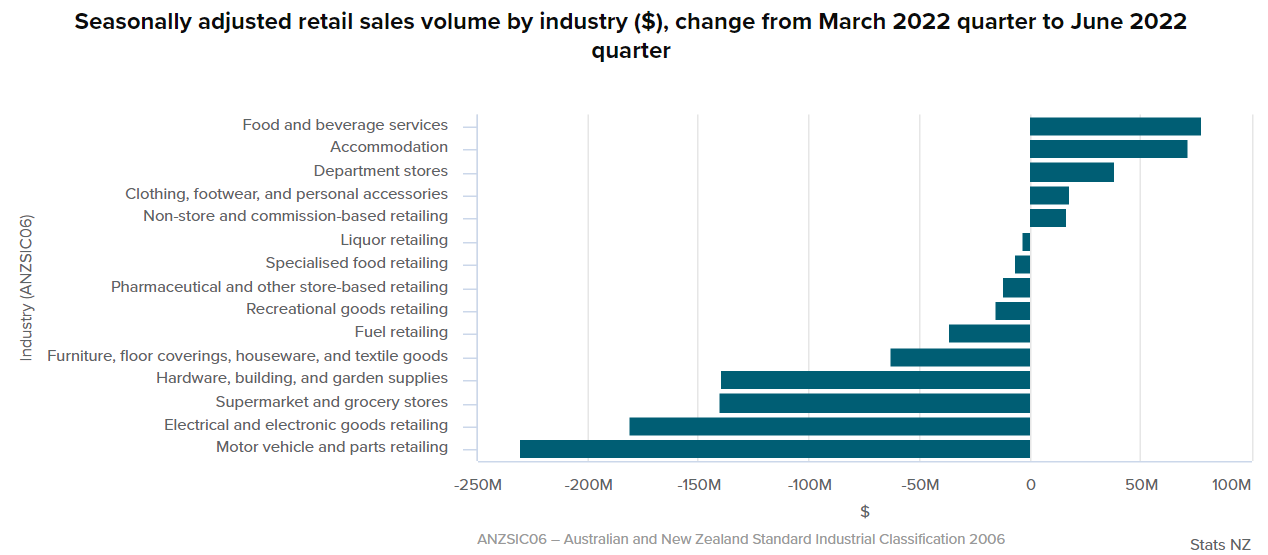
Statistics New Zealand said the volume of total retail sales fell 2.3% in the June 2022 quarter, after a 0.9% decrease in the March 2022 quarter when adjusting for price and seasonal effects.
This is the second time retail sales volumes have fallen over two consecutive quarters since the Covid-19 outbreak. The first was in the March and June 2020 quarters.
Of the 15 retail industries, 10 had lower sales volumes in the June 2022 quarter compared with the March 2022 quarter. In percentage terms the biggest fall was the 8% drop in furniture, floor coverings, houseware and textiles. Electrical and electronic goods retailing was down 6.1%. Motor vehicle and parts retailing dropped 5.8% in seasonally adjusted volumes, after a 5.3% fall in the March 2022 quarter. Hardware, building, and garden supplies were down 5.3% compared with the March 2022 quarter. Supermarket and grocery stores fell 2.9%.
ANZ senior economist Miles Workman said while the retail sales data are only a small share of total production GDP (around 7%), they do tend to provide a relatively good signal on overall GDP growth.
"On its own, today’s data present downside risk to our forecast for a 1.0% [quarter on quarter GDP] rebound. In fact, on face value, today’s data suggest the economy may have been in a technical recession in the first half of the year," Workman said.
Westpac senior economist Satish Ranchhod noted that households have been winding back their spending on durable items like electronics and furnishings, while there has also been a fall in vehicle sales.
"Those are the same categories where spending rose strongly when Covid-19 first arrived on our shores and measures to protect public health prompted a shift away from spending on services," he said.
"We’ve been forecasting a slowdown in household spending for some time, with increases in mortgage interest costs signalling a significant squeeze on households’ budgets. However, that slowdown in spending has come through sooner than expected.
"Importantly, many households have been shielded from the impact of interest rate increases to date due to the high level of mortgage fixing in the New Zealand market. Over the coming months, debt servicing costs will rise sharply for many households as they refix at higher interest rates. And coming on top of today’s soft result, that points to weak spending through the back part of the year.
"The softer than anticipated retail spending result signals downside risk to our forecasts for a 1.0% rise in June quarter GDP. More importantly, it also signals significant downside risk to the RBNZ’s forecast for 1.8% growth. In its recent policy statement, the RBNZ highlighted the strength in inflation and need for further OCR increases. However, in our view the RBNZ gave little credence to the signs of softening demand that have been emerging.
"Today’s result further reinforces our expectation that the OCR will peak at 4% by the end of this year, in contrast to the RBNZ’s projections which highlighted the risk of a higher peak," Ranchhod said.
We welcome your comments below. If you are not already registered, please register to comment
Remember we welcome robust, respectful and insightful debate. We don't welcome abusive or defamatory comments and will de-register those repeatedly making such comments. Our current comment policy is here.