

Unemployment has remained at an extremely low 3.3%, according to Statistics New Zealand - but the attention grabber in the latest labour market figures is the scorching rates of pay increase.
The Reserve Bank says the employment situation is "not sustainable".
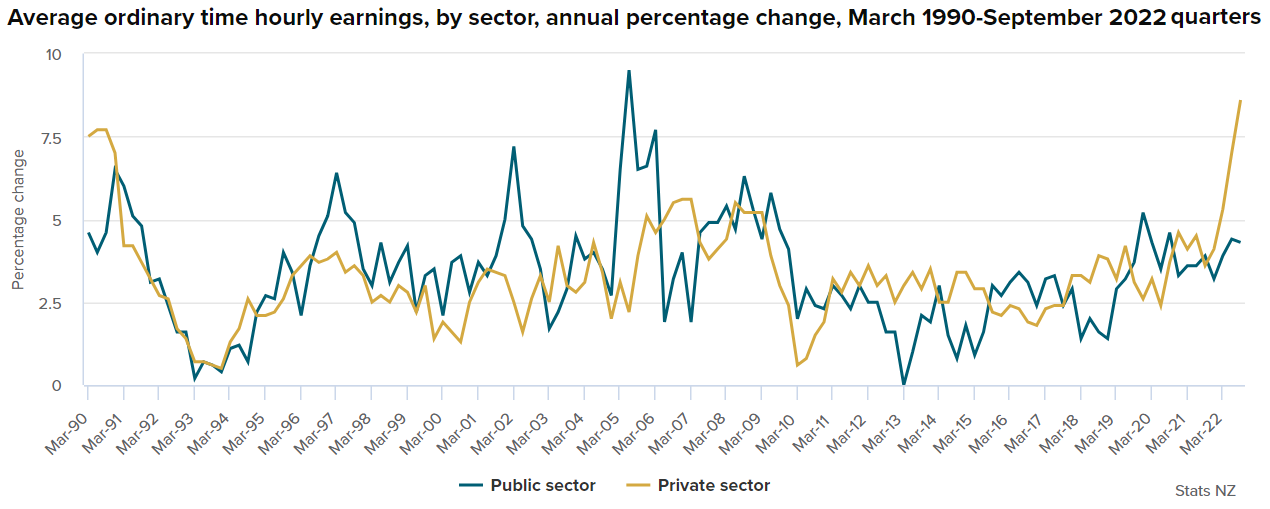
The big figure among the suite of labour market figures for the September quarter released on Wednesday is the astonishing annual 8.6% rise in private sector hourly wages.
Most economists had expected a figure with a '7' in front of it, while it was the RBNZ itself that had the highest forecast. It forecast an 8.3% rise. Other economists had commented ahead of time that it would, given the RBNZ's pick, take a lot to surprise it.
But 8.6% has completely blown everything out of the water and potentially has huge ramifications for interest rates as wage rises of this magnitude are almost certain to push prices higher. It's the classic wage-price spiral.
The RBNZ next reviews the Official Cash Rate (currently on 3.5%) on November 23. The general expectation was that it would raise the OCR by 75 basis points as it strives to bring inflation down from a too-high 7.2%.
However, the fact that wage rises have come in so stratospheric must (I think) open up at least some chance of a 100 point rise - though economists are not tipping or expecting this.
The RBNZ held a media conference on Wednesday for the release of its latest Financial Stability Report. This took place just quarter of an hour after the labour market figures had been released.
Bernard Hickey reports from the media conference that RBNZ Deputy Governor Christian Hawkesby was reluctant to comment too extensively on the jobs figures or monetary policy given that the data had only emerged 15 minutes earlier. The bank would update the market properly on its monetary policy outlook on November 23.
But Hawkesby did say the numbers appeared in line the bank’s view at first blush. He and Governor Adrian Orr reiterated though that employment was above maximum sustainable employment.
"We've been very clear with our monetary policy statements that not only is inflation, consumer price inflation, high at the moment, but employment is through its maximum sustainable level," Hawkesby said.
"So we have a very strong, very hot, labour market, and to achieve our monetary policy objectives, we need to ensure that demand cools such that it can keep pace with the supply that's available. And that's going to involve a period of a cooler demand, cooler consumption, all resulting in weaker employment growth going forward. Now, we have the risks around that which involve how quickly that occurs, what else occurs in the global environment, which may change interest rates further,” he said.
"We get into this and a lot more detail and a couple of weeks time with our monetary policy statement, but it is a combination of the demand side of the economy cooling, through higher interest rates, and the supply side of the economy relaxing, through immigration, increasing the size of the labour market."
Orr also said the labour market was above capacity.
"Employment is beyond maximum sustainable employment at the moment. So it's above. So we're not starting from maximum sustainable employment. And we know that it’s above by a vast array of indicators. An enormous amount of information is being sent to us about the global lack of labour. So this is not a sustainable position, where we are at the moment. Hence, employment growth may slow relative to the labour force. And over time, unemployment rises. And over time, the ability to attract, retain and get the labour you need, improves. And so that's one of the natural ways of going,” he said.
ANZ economists are still picking a 75 basis point rise in the OCR on November 23. Economist Finn Robinson and senior economist Miles Workman said despite the "dramatic monetary policy tightening" already delivered, "we are getting further into wage-price spiral territory".
"And with labour demand still miles ahead of supply, that’s unlikely to change without further action from the RBNZ."
They see the September quarter's underutilisation, employment, wage, and CPI inflation data as "tilting the odds further towards the second 75bp OCR hike that we’ve pencilled in for February (taking the OCR to a peak of 5.0%)".
They say there’s a lot of water to flow under the bridge before we get to the February review, including September quarter GDP figures and December quarter CPI and labour market releases, "but so far there’s been scant evidence that the RBNZ is having a significant impact on domestic inflation pressures".
"And apart from the sharp increases in interest rates that the RBNZ is delivering, there’s not much else to suggest why domestic inflation will actually fall markedly over 2023 (unless we saw a sudden improvement in the supply-side of the economy, or something nasty (and deflationary) hitting us from offshore – unforecastable things).
"We see the RBNZ needing to lift the OCR to a peak of 5.0% to bring the current inflation surge under control, but despite clear downside risks to growth, the upside risks around that forecast dominate, just as has been the case with every one of our OCR forecasts since COVID faded as an economic driver. The earlier the RBNZ gets the OCR to 5%, the smaller the chance that it will need to keep on hiking past this level," Robinson and Workman said.
Stats NZ said the professional, scientific, technical, administrative, and support services industry was the largest contributor to wage growth.
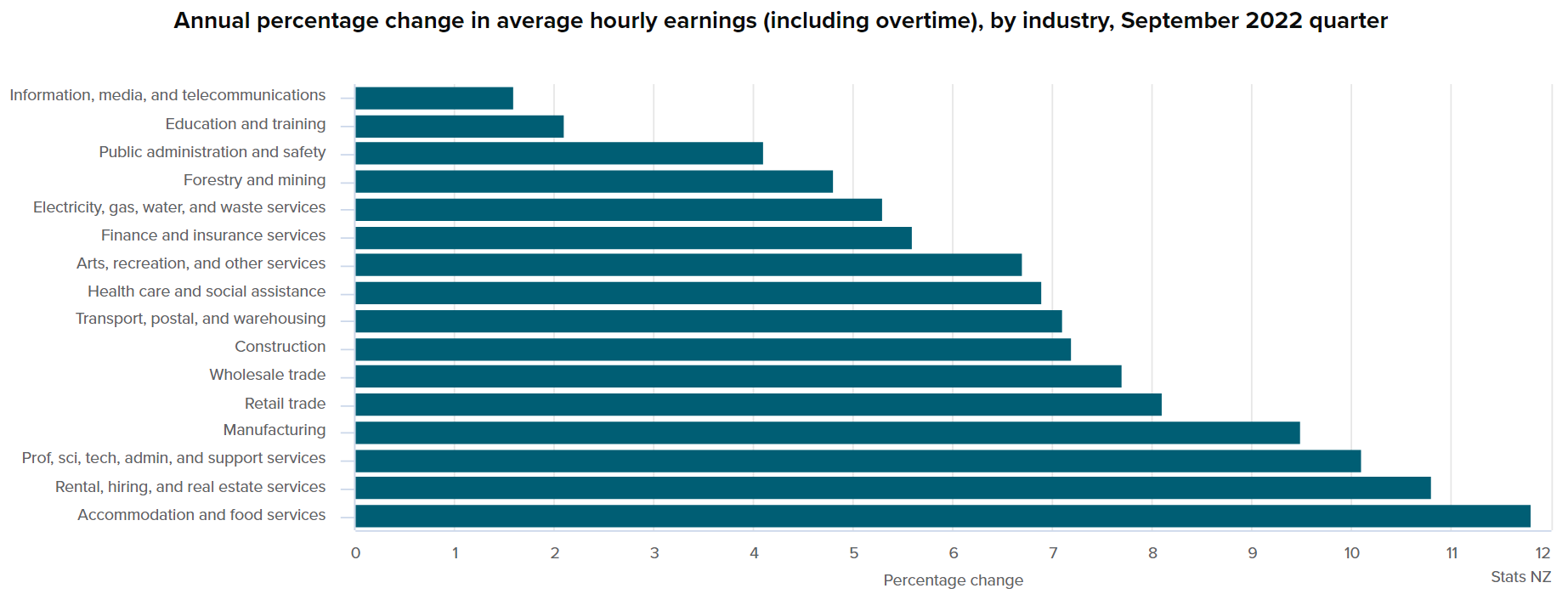
Manufacturing, and healthcare and social assistance were the next highest contributing industries, with manufacturing also experiencing all time high hourly earnings growth.
These industries are all relatively large, as well as having strong wage increases, causing them to contribute more to average wage growth than smaller industries.
In percentage terms, the largest annual increase in average total hourly earnings was in the accommodation and food services industry, which rose by 12%. The next largest movement was in the rental, hiring and real estate services industry, with earnings up 11% annually.
In terms of the unemployment figure, at 3.3% it was what the RBNZ forecast, while most economists had tipped it to fall slightly.
Stats NZ said, however, while the unemployment rate remained level, the underutilisation rate – a broader measure of spare labour capacity – dipped slightly to 9.0%, from 9.2% last quarter.
The seasonally adjusted labour force participation rate rose to 71.7%, up from 70.9% last quarter. This is a new all-time high.
This big rise in the participation rate was a key reason why the unemployment figure 'only' stayed at 3.3% rather than reducing.
But during the quarter there 35,000 more people were employed, bringing the total to 2,853,000.
The seasonally adjusted employment rate rose to 69.3%, up from 68.6% last quarter. This is also an all-time high in a data series that goes back to 1986.
The unemployment rate has remained remarkably steady at between 3.2% and 3.3% for a full year now.
ASB economist Nat Keall said the wage inflation readings were the chief area of focus for most analysts "as we look for evidence a worrying wage-price spiral might be unfolding".
"Today’s print didn’t offer a massive amount of comfort on that front."
Keall said ASB economists saw little prospect for any swift relief in either labour market tightness or wage inflation in the near future.
"Much of this tightness is set to be driven by muted growth in the labour force rather than rocketing jobs growth, but the net result is the same: demand and supply for labour are out of whack, with worker shortages remaining an issue stretching well into 2023."
We welcome your comments below. If you are not already registered, please register to comment
Remember we welcome robust, respectful and insightful debate. We don't welcome abusive or defamatory comments and will de-register those repeatedly making such comments. Our current comment policy is here.