
Well, you might have expected it would be bad. And it's REALLY bad.
The latest ANZ Business Outlook Survey, which takes in the full month of the Middle East Crisis, has shown a marked deterioration in the confidence of New Zealand businesses, coupled with a surge in inflation expectations.
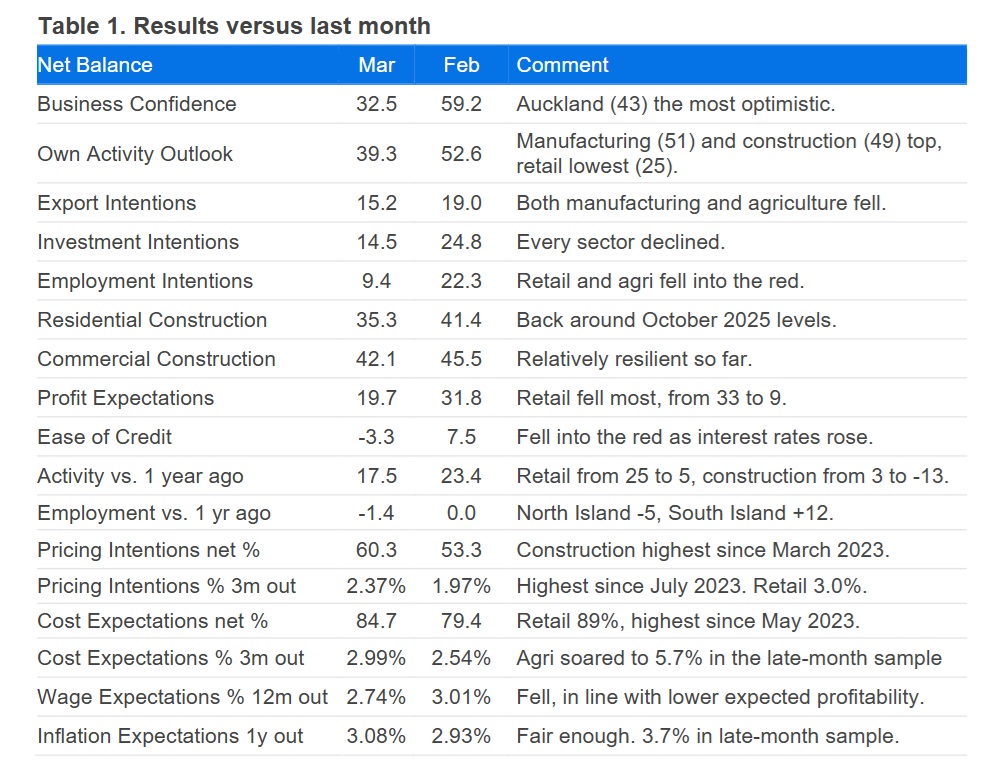
ANZ chief economist Sharon Zollner said the headline business confidence measure fell 26 points in March, down from 59 to 33.
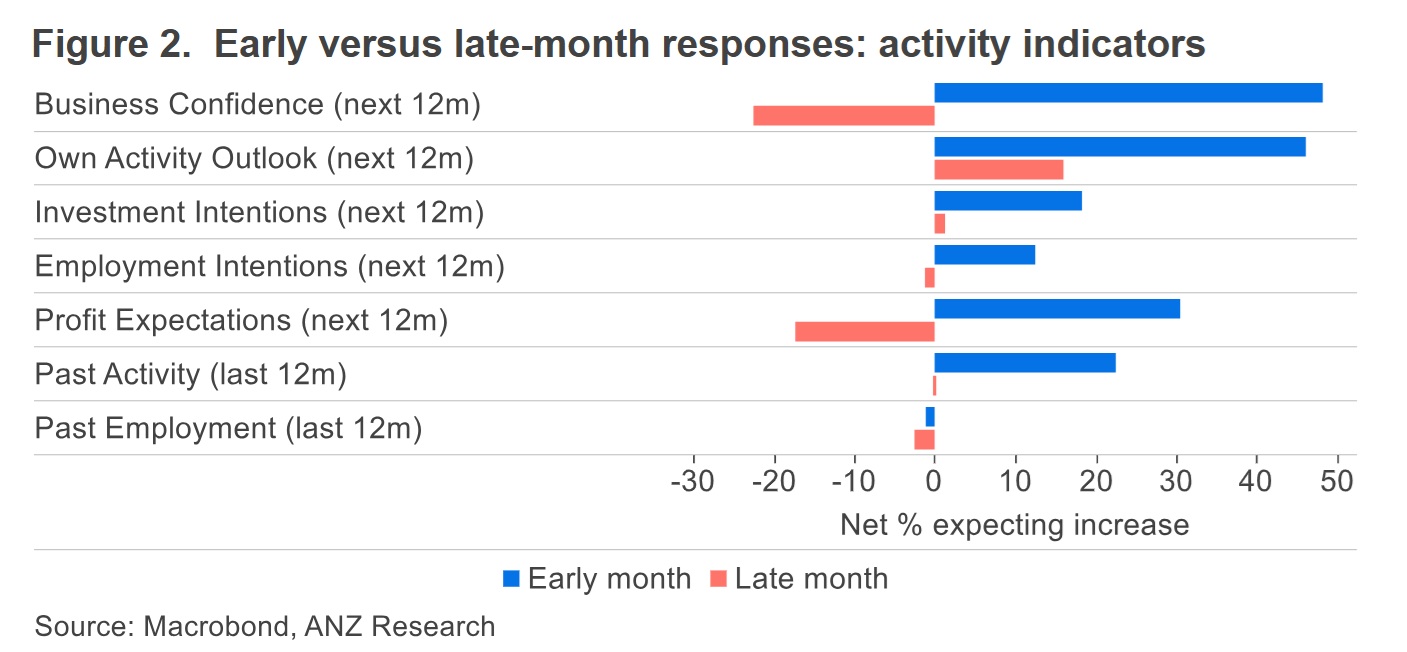
However, the late-month responses actually had an average score of minus-23 as businesses digested the potential implications of the Middle East shock - and realised that it was not likely to be short-run.
Zollner said the bulk of the latest survey responses were collected the day after the Middle East conflict began.
"However, around a third of responses came in following an email reminder on 23 March, enabling us to get an idea of how things evolved as the month went on (while noting that due to the smaller sample the late-month data is more volatile).
Forward-looking activity indicators dropped sharply as the month went on, while cost and price indicators rose.
"Nothing surprising there. Of the activity indicators, business confidence (which asks about “general business conditions”) took by far the largest hit over the three weeks in question, while profit expectations also went well negative.
"But arguably of most significance, the past own activity read was much weaker in the late-month sample, suggesting that some firms are already feeling the impacts. It was broad-based: every sector saw a sharp fall in this indicator. Retail and construction saw the biggest falls, but we would note the data is very volatile when split two ways, so we will stick to hand- wavy comments on that front," Zollner said.
She said in terms of impacts already being experienced, past activity fell from 23% to a net 18% of firms reporting stronger activity than a year ago, with a particularly sharp fall for retail (down 20 points to +5) and construction (down 16 points to -13).
"Late-month responses averaged 0, not boding well for next month," she said.
"Inflation indicators were higher, unsurprisingly. The net percent of firms expecting to raise prices in the next three months rose 7 points to 60% (67% in the late-month sample), while the average amount by which firms expect to raise their prices rose from 2.0% to 2.4% (3.3% in the late-month sample).
"The net percent of firms expecting cost increases (85%, up from 79%) is the highest since early 2023, while a monthly number equivalent to the late-month read (93%) hasn’t been since mid-2022."
Zollner said it was unsettling times for businesses.
"Just as the economic recovery was starting to feel real, dark clouds have gathered," she said.
"It’s not just anxiety about the future; many firms are already reporting that their activity has taken a hit as people defer their decision-making in the face of uncertainty."
The fall in the activity indicators as the month went on is understandable, as it has become increasingly clear that this is not a short-lived shock, but something more persistent, she said.
"Firms are understandably in a mood to reduce their risk-taking – but the unfortunate truth is that one firm’s risk (a purchase, an investment, a hire) is someone else’s opportunity."
We welcome your comments below. If you are not already registered, please register to comment
Remember we welcome robust, respectful and insightful debate. We don't welcome abusive or defamatory comments and will de-register those repeatedly making such comments. Our current comment policy is here.