
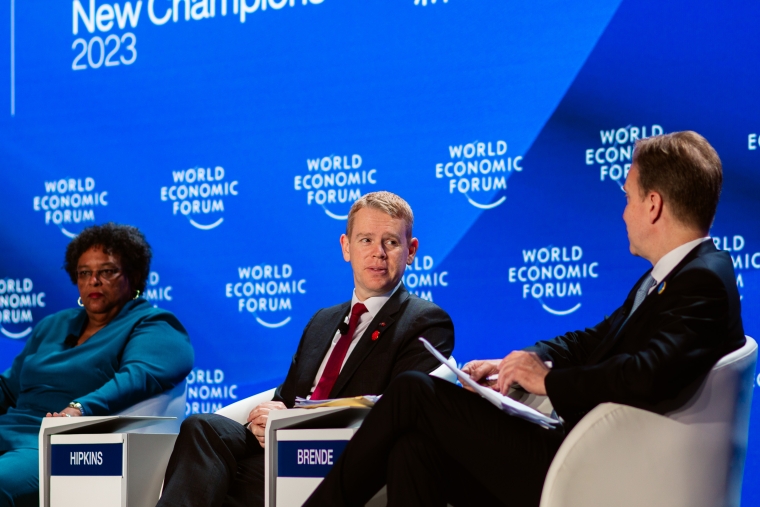
A third-term Labour government would focus on growing New Zealand’s exports, developing agriculture and renewable energy technology, and double-down on ‘high value’ tourism.
Party leader Chris Hipkins promised he’d lead a trade delegation to India within the first 100 days after forming a new Government.
His rival, Christopher Luxon, has previously said getting a free trade agreement with India would be a “strategic priority” for a National government.
India is the most populous country in the world and could be an enormous market for New Zealand exporters. However, it closely guards its domestic dairy industry and striking any trade deal that covered NZ’s key exports would be difficult.
Hipkins has often said his economic vision for New Zealand was for it to become “the best little trading nation in the world”.
A Labour economic plan, released on Wednesday morning, set out the three trade priorities the party would pursue if it wins the October election.
It would expand access to new and developing markets, help businesses to diversify their products and markets, and ensure NZ has strong supply chains and international links.
The second of Labour’s economic priorities would be to grow the agricultural technology sector to be worth $8 billion by 2030, from its current estimated value at less than $3 billion.
Labour would give the state-owned venture capital fund an extra $100 million to help kickstart more growth in the sector.
Further investments would be made in technology and research that could help farmers reduce emissions from agricultural activities.
Also included in this section was a commitment to reduce gross emissions, and not just rely on forestry offsets — it wasn’t clear how this related to the economic plan.
“We will drive down gross emissions and avoid over-reliance on offsetting through plantation forestry. We cannot offset our way out of the climate crisis,” the policy document said.
The third priority was developing renewable energy in New Zealand, with a view to exporting either products or expertise. Fourth, was a comprehensive plan to digitize the NZ economy.
This would include funding for small businesses to go digital and a grab-bag of other initiatives aimed at video, gaming, and science sectors.
Finally, Labour would adjust tourism policy settings to encourage more visitors who are willing to spend more money in the country, but less visitors overall.
The policy document said tourism was one of the fastest growing sectors prior to the pandemic, but the number of visitors was putting pressure on local resources.
Now, the government has been working with the industry to build “a more sustainable and higher value tourism industry that doesn’t overstep its social licence”.
This work would continue under a third-term Labour government with possible changes to the International Visitor Levy — a $35 tax charged to all incoming tourists.
More generally, Labour promised to continue its work on fair pay agreements, infrastructure investment, apprenticeship and skills training, and following its fiscal rules.
We welcome your comments below. If you are not already registered, please register to comment
Remember we welcome robust, respectful and insightful debate. We don't welcome abusive or defamatory comments and will de-register those repeatedly making such comments. Our current comment policy is here.