
Research by the Reserve Bank (RBNZ) suggests supply and labour shortages played a much greater role in New Zealand’s inflation pressures than it did in other economies.
Paul Conway, the central bank’s chief economist, said labour market tightness and supply shortages had been the two largest contributors to the Consumer Price Index (CPI) inflation spike. The CPI peaked at 7.3% in June 2022 having been at 1.5% in March 2021. CPI was 4% for the March 2024 year.
“Compared to other countries, tightness in the labour market, brought about by the border closure and strong domestic demand, had a big impact on inflation in New Zealand,” he said.
NZ was more reliant on immigration to grow the labour force and required more workers to create the same amount of economic output, relative to many other countries.
“This tightening in labour market capacity pressure was the most important factor driving up wages over the pandemic. By late 2022, as international borders reopened and migrants returned, labour market pressures began to ease, contributing much less to wage inflation.”
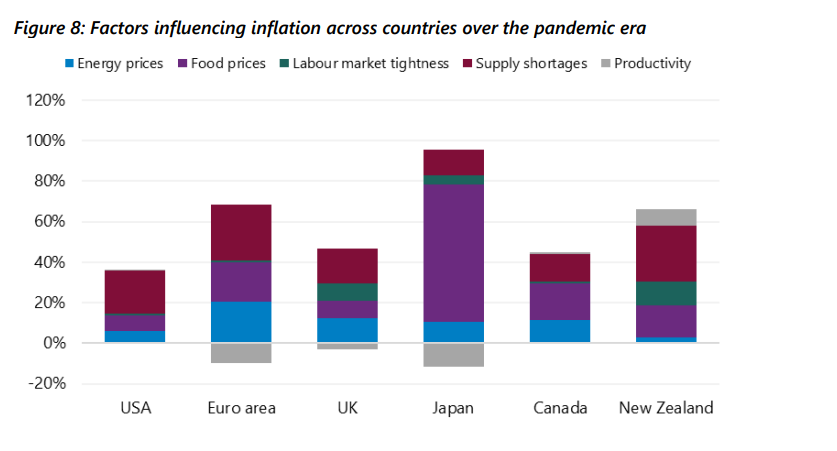
Increasing food prices also contributed to inflation in New Zealand but energy cost inflation, which hit Europe and the United Kingdom after Russia invaded Ukraine, was largely avoided.
Unlike most other countries, a decline in Kiwi productivity had also worsened overall inflation over the past three years.
This analysis looked at what drove price increases over a three year period, and didn’t attempt to deny that fiscal and monetary policy played a part in sparking inflation.
The RBNZ used the New Zealand Institute of Economic Research's Quarterly Survey of Business Opinion (QSBO) as a supply shortage indicator for the net number of NZ firms reporting materials as the factor most limiting production.
Policy implications
The RBNZ released four analytical notes, alongside Conway’s speech, on Wednesday which sought to help explain why domestic inflation hasn’t fallen as fast as originally hoped.
Conway said the research didn’t cause any radical change in how the central bank was assessing the economy and inflation, but did provide extra confidence in its approach.
He endorsed the bank’s May forecasts, which showed annual inflation should narrowly squeak into the RBNZ's 1% to 3% target range in the final quarter of 2024.
An analytical note called “The resurgence of the NZ Phillips curve” was called out as a particular confidence booster for the central bankers.
The paper looked at the Phillips curve, an economic model arguing inflation and unemployment have an inverse relationship, meaning higher inflation is associated with lower unemployment and vice versa.
“It gives us increasing confidence that what we are doing, with the economy definitely in a slow patch, is going to work — it is going to bring down inflation,” Conway said.
Unemployment was 4.3%, or 134,000 people, in the March quarter, up from 3.2% in December 2021, or 93,000 people.
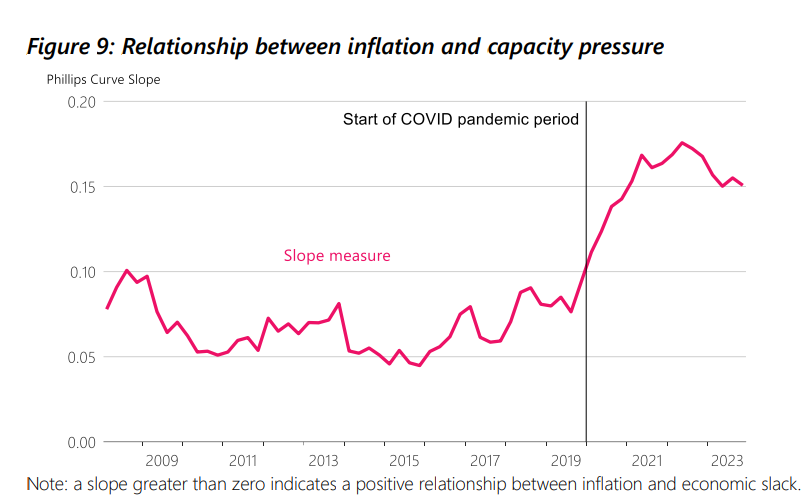
This idea is central to how monetary policy works but has been called into question after long periods of low inflation and strong employment.
The RBNZ’s paper argues inflation has become more sensitive to activity during the pandemic, particularly when measured by broader employment statistics.
Conway said the stronger relationship also suggested that remaining inflation could decrease quickly as spare capacity emerges in the economy over 2024.
Another note observed that New Zealand’s services inflation was higher and spread more broadly than in some other economies.
This may suggest that price and wage setting behaviour in New Zealand has resulted in a longer lag time for weaker demand to flow through into lower services inflation.
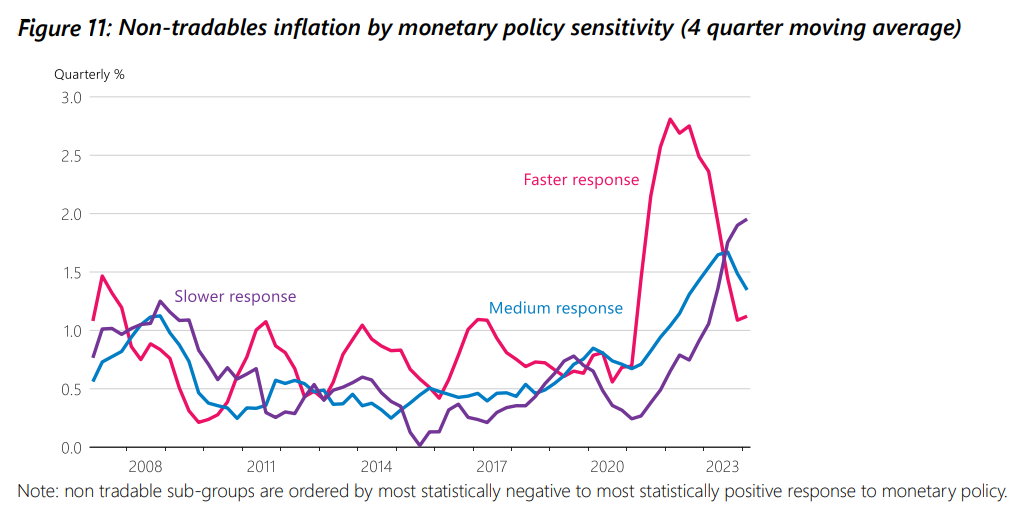
But it also said disinflation elsewhere should give the central bank confidence that dampening in overall demand conditions will bring inflation back to target.
Hamish Pepper, the director of fixed interest strategy at Harbour Asset Management, said Conway’s message didn’t deviate from the May Monetary Policy Statement.
Rather, it provided some more in-depth insight into the research and thinking that had backed up recent policy decisions and economic forecasts.
Miles Workman, an economist at ANZ, agreed the speech and papers were topical and interesting, but didn’t signal anything different about future policy settings
We welcome your comments below. If you are not already registered, please register to comment
Remember we welcome robust, respectful and insightful debate. We don't welcome abusive or defamatory comments and will de-register those repeatedly making such comments. Our current comment policy is here.