

Activity in New Zealand's services sector - which accounts for about two-thirds of the country's GDP - has fallen sharply again in June, according to a long running survey.
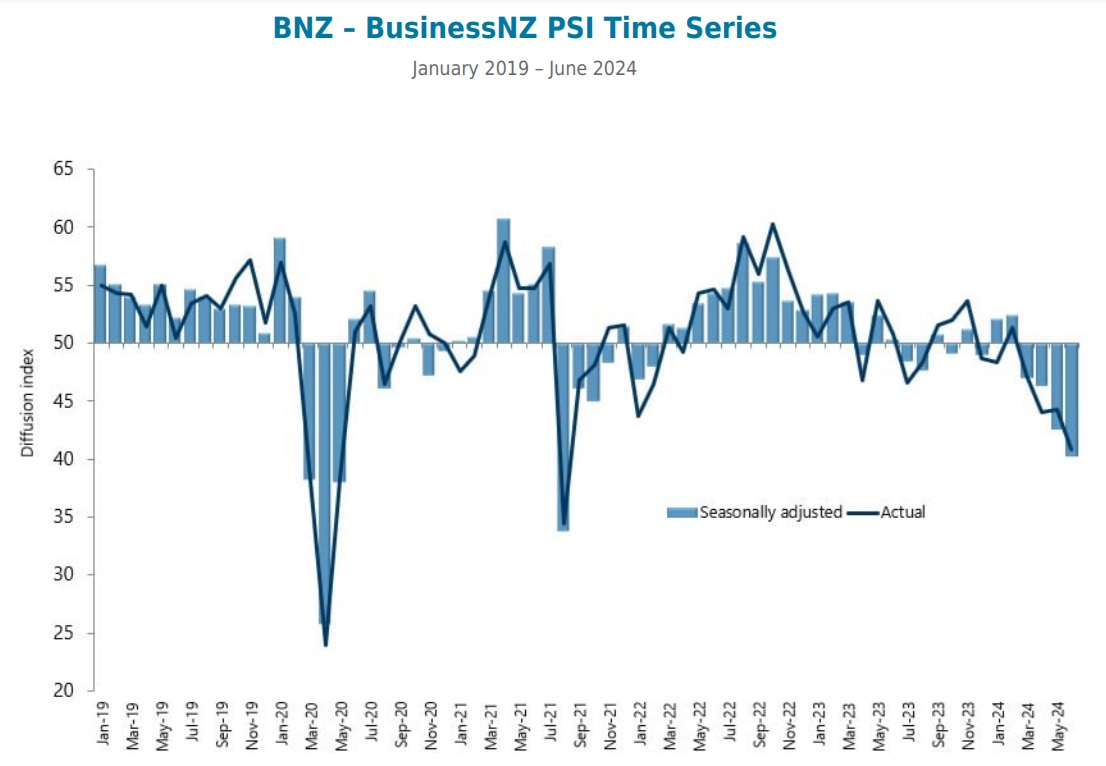
The BNZ – BusinessNZ Performance of Services Index (PSI), which has been going since 2007, has for the second month in a row recorded the lowest level of activity for a non-Covid lockdown month since the survey began.
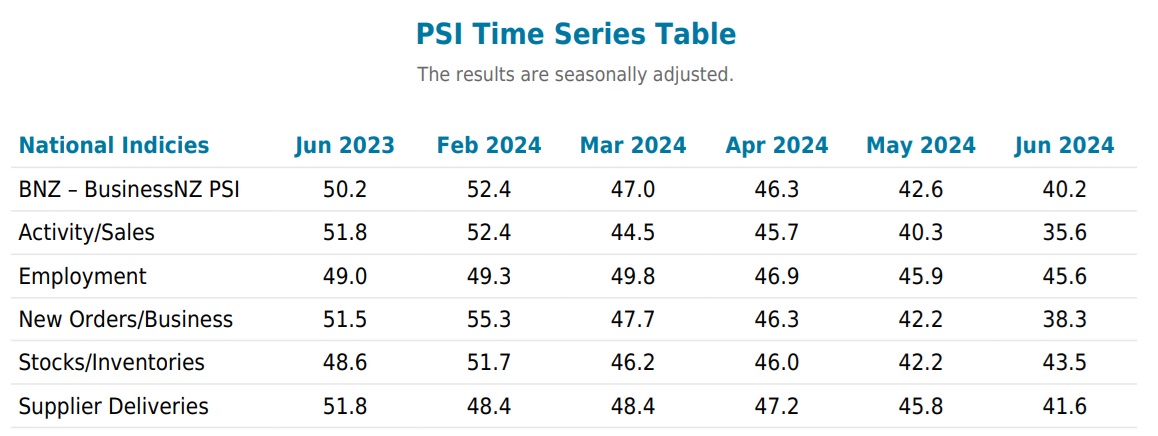
An index level below 50 shows a contracting services sector, above 50 shows it is expanding. The latest monthly result was 40.2 - down some 2.4 points from May. As recently as February 2024 the reading was 52.4.
This latest data comes amid a swathe of high frequency data that's pointing to the economy going backwards in a big hurry.
The Reserve Bank (RBNZ) belatedly acknowledged this last week when it said the range of declining data "may indicate that tight monetary policy is feeding through to domestic demand more strongly than expected". Financial markets have quickly moved to price in potential cuts to the Official Cash Rate, which is currently at 5.5%. The markets are now pricing in a 50-50 chance of a cut as soon as August, a full cut by October and TWO cuts by November.
Monday's continuing collapse of the PSI follows Friday's release of the June factory Performance of Manufacturing Index, which made for very grim reading, with this index now being below 50 for 16 consecutive quarters.
Commenting on Monday's PSI, BusinessNZ chief executive Kirk Hope said that "after a bad May result, the June figures simply got worse".
BNZ senior economist Doug Steel said the weakness in the PSI "appears to be accelerating".
In a separate Eco-Pulse note, BNZ chief economist Mike Jones said if there was a surprise in the RBNZ's "greenlighting of early rate cuts" last week it was only in the timing.
"We’ve long been of the view the economy is buckling, inflation is beaten, and rate cuts would ultimately be delivered much earlier than RBNZ projections. It was a matter of when not if. And it appears the deluge of extraordinarily weak economic data we’ve received over the past few weeks has prompted the change," Jones said.
Jones said from how the BNZ economists have been reading things, the RBNZ’s pivot "couldn’t come soon enough".
"There is a growing chorus of startlingly weak forward indicators that, at face value, warn of a crumbling in economic activity over the second and third quarters."
The BNZ economists had only just revised down their forecast of the second quarter GDP, picking a 0.2% contraction in the economy, but Jones said this was already looking "optimistic".
"Even in the few days since the RBNZ [Wednesday, July 10 OCR] decision we’ve seen further deterioration in the data flow," Jones said.
The June readings of the Performance of Manufacturing (PMI) and Performance of Services (PSI) indices fitted into the category of things pointing to crumbling economic activity.
"The prior month declines in these indices were of such a magnitude that we’d wondered if some sort of pause was in the offing this time around.
"It wasn’t to be. The additional, sizeable declines in the month of June put the PMI at the lowest level since the GFC (outside of lockdown months), and the PSI at the weakest level in the 17-year history of the series (again, outside of lockdown months)."
Jones said evidence of ailing labour demand is starting to mount.
"According to Stats NZ’s filled jobs measure, no jobs were added in May, on net. Labour turnover has slumped. And an 8% June fall in SEEK job ads in June confirmed the 18-month downtrend in job vacancies is accelerating rather than stabilising.
"Our projections for the unemployment rate to rise to 5½% by the start of next year have, to date, been largely built on expectations of stalled hiring against rising labour supply.
"The prospect of deeper employment cuts, as seem increasingly inevitable, means the rise in unemployment could occur faster than we’ve allowed for.
"The attendant impacts on job security, wage growth, spending intentions, and housing market activity have the potential to insert another layer of weakness into the economy over the second half of this year."
We welcome your comments below. If you are not already registered, please register to comment
Remember we welcome robust, respectful and insightful debate. We don't welcome abusive or defamatory comments and will de-register those repeatedly making such comments. Our current comment policy is here.