
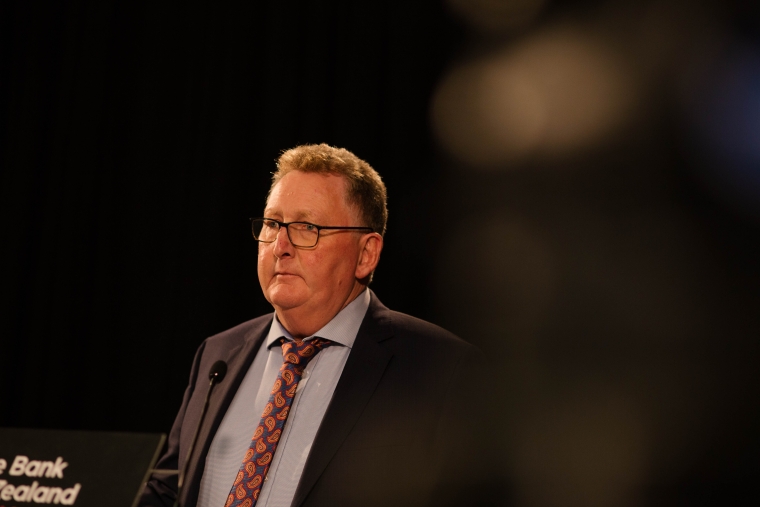
The Reserve Bank held the official cash rate at 5.5% on Wednesday but noted economic indicators may suggest monetary policy was hitting demand harder than expected.
RBNZ’s seven person Monetary Policy Committee agreed monetary policy needed to “remain restrictive” and also that it could be loosened as inflation falls.
“The extent of this restraint will be tempered over time consistent with the expected decline in inflation pressures,” they said in the April meeting notes.
“Some domestically generated price pressures remain strong. But there are signs inflation persistence will ease in line with the fall in capacity pressures and business pricing intentions”.
The Kiwi dollar fell sharply immediately after the announcement from US61.3c to US60.9c in a clear sign that the financial markets saw the comments from the RBNZ as more 'dovish' than had been expected. Wholesale interest rates also dropped quite sharply with, for example, the two-year swap rate falling by 8 basis points.
Economists expected the central bank to hold the OCR steady in this meeting, but have been calling for policymakers to rethink their plan to leave rates unchanged until late next year.
At its meeting in May, the RBNZ was surprisingly hawkish. It lifted its OCR projection to peak at 5.65% and pushed possible rate cuts out until August 2025.
But last week, a survey of businesses found 28% had experienced a drop in activity during the past three months and 25% had laid off staff — similar to in the Global Financial Crisis in 2007.
Treasury said it showed the economy may have contracted during the June quarter and that fewer firms were raising prices “despite elevated but stable costs”.
Stephen Toplis, head of research at BNZ, said the survey showed inflation had been beaten and virtually “screamed” for monetary policy to be relaxed sooner rather than later.
The same data caused economists at ASB Bank to shift their forecast for interest rate cuts to begin this November, instead of in February next year.
Nick Tuffley, the bank’s chief economist, said unnecessarily damaging the economy and employment levels had overtaken inflation as the biggest risk facing the RBNZ.
Falling faster
The record of the RBNZ's Monetary Policy Committee meeting on Wednesday showed the committee agreed there was “more evidence of excess productive capacity emerging” and signs the economy may be falling below forecasts.
It noted recent higher frequency indicators were suggesting that near-term growth in business activity had weakened, likely a reference to the NZIER’s quarterly survey.
“A range of business and consumer surveys, and higher frequency spending and credit data, all point to declining activity,” the committee said.
“Members discussed the risk that this may indicate that tight monetary policy is feeding through to domestic demand more strongly than expected”.
The RBNZ has previously forecast inflation in the June quarter to be 0.6% and bring the annual number down to 3.6%. It expects economic activity to grow extremely slowly for the rest of 2024, while unemployment climbs to 5%.
Many other economists now think activity will actually go backwards, unemployment will climb well above 5%, and inflation will fall faster than expected.
Some commentators said they would be reading the record of the meeting for possible signals the Reserve Bank was setting the scene for rate cuts sooner than previously indicated.
In the notes, committee members said the Selected Price Indexes showed weakening price pressure on more volatile inflation components, and a fall in businesses’ pricing intentions.
This helped to confirm their belief that headline inflation should return to within the 1% to 3% target range before the end of the year.
“Domestic inflation measures remain more persistent, but growing excess capacity in the domestic economy provides greater certainty that they will sustainably decline,” they said.
We welcome your comments below. If you are not already registered, please register to comment
Remember we welcome robust, respectful and insightful debate. We don't welcome abusive or defamatory comments and will de-register those repeatedly making such comments. Our current comment policy is here.