
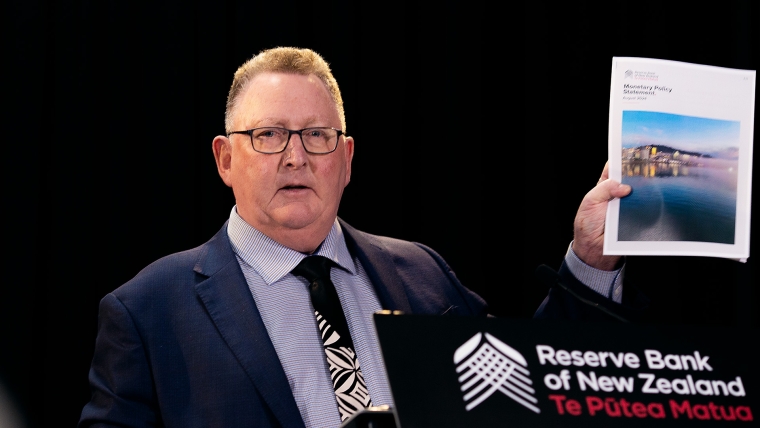
Reserve Bank (RBNZ) Governor Adrian Orr defended the central bank’s monetary policy shift during a combative session with Parliament’s finance and expenditure committee on Thursday morning.
Committee Chairman Stuart Smith said the new policy statement had been described as a “complete 180 degree turn” on the May statement, and asked what had driven the “unexpected and sudden weakness” in the economy.
Orr initially refused to answer the question, saying, “I cannot give time to that. That comment is wrong, that's why. So, I won't bother”.
When pressed to answer, Orr said there had not been a U-turn and quoted from the July monetary policy review, which first opened the door to the possibility of rate cuts.
“I will quote: ‘the extent of restraint will be tempered over time consistent with the decline in inflation pressures.’ If people can't understand what that means, I'm not sure they should be commentating,” he said.
Brad Olsen from Infometrics introduced the specific phrase 'U-turn,' but various others described the August decision as a significant change in stance.
Nick Tuffley, chief economist at ASB, described the possibility of a rate cut so soon after the May statement as being a “Simone Biles-esque gymnastic move” in a note previewing the decision.
These commentators recognized the signal in July but still believed there was an abrupt change in policy between the May and August meetings.
Interest rates were tipped to rise in May, then the RBNZ signaled a change in direction in July, and by August, they had cut rates, dropping the Official Cash Rate 25 basis points to 5.25% on Wednesday. If it’s not quite a U-turn, then maybe it’s a three-point turn.
Whatever you call it, Orr said the July announcement showed the committee had growing confidence it would be able to ease monetary policy conditions if trends continued.
“And it's very pleasing to say that confidence has now reached a point where the committee was able to act yesterday,” he told the committee.
Faster transmission
The central bank leadership told the committee looser monetary policy may flow through to households and the real economy faster than tighter policy has over the past few years.
Assistant Governor Karen Silk, who has responsibility for markets and banking, said just over a third of households had a mortgage but those households tended to be higher income ones.
This means about 65% of all household income was impacted by mortgage rates, and will find themselves with more money to spend as they shift onto lower rates.
Since interest rates have been high, many mortgage holders have opted for shorter terms in the hopes that rates will fall. Silk said 70% of these mortgages will be repriced within the next nine to 12 months, significantly more than in previous years.
“So, our expectation is any reduction in mortgage rates from here, or lending rates for businesses, would pass through more quickly than we have seen previously,” she told the committee.
Bond traders have priced swap rates to suggest they expect the OCR to be cut by up to 200 basis points during that period, according to an ANZ analysis published Thursday.
Orr said mortgage rates were just one channel of transmission for monetary policy, and other channels would hit the real economy even faster than that.
Business confidence and expectations would rise, assets in the housing and equity markets would be repriced, cash flow in the economy would increase, and loans would become easier to access. All these factors could significantly impact economic activity, he said.
We welcome your comments below. If you are not already registered, please register to comment
Remember we welcome robust, respectful and insightful debate. We don't welcome abusive or defamatory comments and will de-register those repeatedly making such comments. Our current comment policy is here.