
You could almost hear it happen. The Reserve Bank cut the Official Cash Rate by 25 basis points on Wednesday to 5.25%, bringing three years of tightening monetary policy to an abrupt close.
Markets snapped into the new reality. New Zealand’s benchmark stock index shot up almost 2%, and the kiwi dollar fell more than 1% against the United States and Australian dollars.
The smallest reaction was in the bond market, which had positioned itself for a rate cut. One year swap rates fell 10 basis points and the rest of the curve held fairly steady.
This highlights the paradox in the August decision. It was a shock rate cut occurring a year ahead of projections, and yet largely priced into bond markets.
Brad Olsen, the principal economist at Infometrics, said it was one of the sharpest monetary policy U-turns on record, given the central bank considered a hike just three months ago.
“RBNZ has probably made the right call in starting to cut the OCR, but in doing so, it implies that its view of the economy and its forecasts in May were hopelessly wrong,” Olsen said.
Please explain
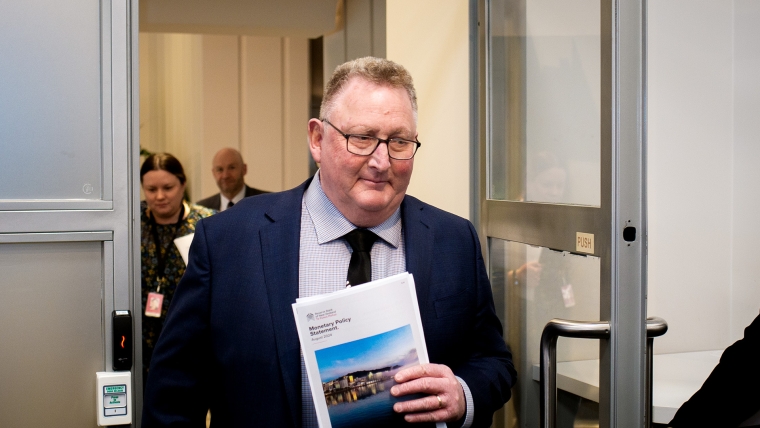
RBNZ Governor Adrian Orr played down the significance of the early rate cut during the press conference, after delivering the August Monetary Policy Statement.
The OCR projection published in May, which showed no rate cut until August 2025, reflected the fact that there were both upside and downside risks to the forecast, he said.
While there was a risk that inflation expectations could remain elevated, there was also a risk that economic growth could slide sharply into reverse.
“That near-term growth weakness is here, and at the same time those concerns around pricing intentions and expectations have dissipated, and actual inflation has declined,” Orr said.
The August MPS predicted the country is in the midst of a two-quarter contraction which will see the economy shrink 0.4% this calendar year, down from 1% growth in May forecasts.
Unemployment is now expected to climb to 5.4% in the upcoming summer, compared to a peak of 5.1% forecast in the previous statement.
Headline inflation is expected to drop to 2.3% in the September quarter and remain at that level. This eliminates doubts about returning to the target range, although the midpoint is still years away.
Orr said it would have been irresponsible to consider a cut in May, when economic conditions were stronger and near-term inflation was barely within the target band.
“In May, we didn't have CPI at 3.3%, we didn't have core inflation declining and all indicators of core inflation declining. We didn't have inflation expectations anchored at the target rate, and we didn't have price setting behaviour consistent with low and stable inflation,” he said.
“We now have all of those. So, that is a material shift in the confidence the committee has that monetary policy is working.”
Keep on cutting
Stephen Toplis, head of market research at BNZ, said the criticism of the Reserve Bank for switching its policy stance was not warranted.
“If the data moves against your expectations, then you move your stance. This is what the Bank has done,” he said.
“However, back in May we questioned the decision to adopt that tightening bias and we think that in hindsight folk will come to accept that May was a mistake, not today’s decision”.
John Carran, an economist and investment strategist at Jarden Wealth, said he thought it would have been “too much of a leap” for the central bank to cut at this meeting.
“It is heartening the RBNZ has recognised the parlous state of the New Zealand economy and that an ultra-cautious stance on inflation is no longer warranted,” he wrote in a note.
However, monetary policy was only marginally less restrictive than it was previously and the RBNZ needed to follow up with more cuts to stabilise the economy and stem job losses.
Sharon Zollner, chief economist at ANZ, said the new OCR projections implied there would be rate cuts at the next three meetings. The pace of cuts are expected to slow down after that.
Policymakers may be gauging the economy’s response to looser settings before easing toward the 3% neutral rate.
“Even though it’s hard to envisage here and now, given the clear weakness in the economy, there is a risk that activity (and the housing market in particular) could surprise everyone with the speed with which it bounces back,” she said.
Tax cuts, ahoy
Kelly Eckhold, chief economist at Westpac NZ, said the RBNZ appeared to have taken a relaxed view of how the Coalition's first budget was affecting the economy.
The May meeting had already accounted for reduced government spending, with the August reaction focused on the finer details.
It said spending reductions in the public sector would reduce inflationary pressure, while income tax threshold changes would increase inflationary pressure.
“The net impact for monetary policy is expected to be small and is highly uncertain,” it said.
Eckhold said the updated details added slightly to medium-term inflationary pressure but any effect was “clearly swamped by other economic developments”.
This didn’t stop the politicians from taking credit for the interest rate cut. Prime Minister Christopher Luxon tweeted that his Government had “delivered lower inflation”.
In a statement, Finance Minister Nicola Willis said its “careful and deliberate plan to get on top of inflation” was working.
Orr said he was unaware of the comments and declined to address them but playfully quoted a famous line popularised by US President John F. Kennedy in 1961.
“Victory will always have a thousand fathers, so I don’t mind who wants to put their name to achieving low stable inflation, as long as we get it”.
We welcome your comments below. If you are not already registered, please register to comment
Remember we welcome robust, respectful and insightful debate. We don't welcome abusive or defamatory comments and will de-register those repeatedly making such comments. Our current comment policy is here.