
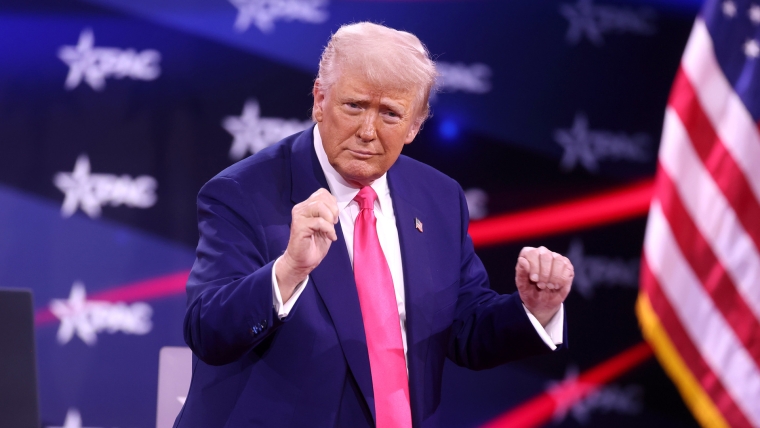
Finance Minister Nicola Willis says US President Donald Trump derailed the economic recovery she had been incubating as Minister for Economic Growth with his tariffs.
In a press conference, the minister fended off accusations that she was responsible for a 0.9% slump in activity during April, May, and June this year and instead pointed the finger at President Trump.
A reporter asked Willis whether the Prime Minister still had confidence in her considering there had not been any economic growth since she was given the job at the start of 2025.
“There was in the first three months of my tenure. At 0.8%, it was much faster growth than there was in Australia. It is true, Trump disrupted my momentum,” she said.
Trump announced massive tariffs on virtually every country in the world on the second day of the June quarter. This spooked global markets and triggered a trade war with China.
Willis said this had “knocked the stuffing” out of the New Zealand economy with firms and households having an “outsized” reaction relative to other countries.
Most other economies continued to grow in the June quarter but some with large exposure to the United States, such as Germany and Canada, experienced small contractions.
Labour Party finance spokesperson Barbara Edmonds said Prime Minister Luxon—not Donald Trump—was to blame for the lacklustre economic recovery.
“Christopher Luxon stood in front of New Zealanders in 2023 and said his business experience would fix cost of living and the economy. Instead, he has failed dramatically,” she said.
She said this was highlighted by the fact Australia’s economy grew 0.6% in the same quarter while facing similar challenges from the Trump tariffs.
“They will blame everyone else for their failure and say they just need more time. But the truth is clear: under Christopher Luxon, New Zealand is heading in the wrong direction.”
Stick to the plan
Broadly speaking, the Coalition’s economic strategy is to reduce government spending as a percentage of GDP to encourage interest rate cuts, while also relaxing regulations and planning restrictions to boost private sector investment.
Critics argued tightening fiscal policy while the economy was still in recession could be damaging and that stimulus should continue until the recovery had been cemented.
Willis said she didn’t think there was a need to change strategy, as the June downturn was a temporary reaction to uncertainty which wouldn’t be repeated in the third or fourth quarters.
“I still think that our fiscal path is the right one. This is not a time for drastic action, but we do need to consolidate our finances. We have forecast a track that gets us back to surplus in the 2028/29 year.”
The Government was already "consciously choosing” to spend more on infrastructure and services than it was earning in tax revenue as a form of fiscal stimulus, she said.
“We are already stimulating the economy, by definition, because we are borrowing billions in order to keep investing in the infrastructure we think is essential for growth [and] to continue investing in a range of government services.”
The Finance Minister hinted the Reserve Bank should continue to cut interest rates, saying the June slowdown affirmed their lower August interest rate track.
“It is the case that the Reserve Bank has the largest levers here for ensuring economic recovery, in terms of providing confidence that interest rates will remain low and borrowing will be more affordable,” she said.
We welcome your comments below. If you are not already registered, please register to comment
Remember we welcome robust, respectful and insightful debate. We don't welcome abusive or defamatory comments and will de-register those repeatedly making such comments. Our current comment policy is here.