

Here are the key things you need to know before you leave work today (or if you work from home, before you shutdown your laptop).
MORTGAGE RATE CHANGES
ASB hiked its 4 and 5 year fixed rates today. UnityMoney also raised fixed rates. All current mortgage rates are here. And note, you can compare mortgage offers with our new calculator that takes into account other costs and cashback incentives, here.
TERM DEPOSIT/SAVINGS RATE CHANGES
Mutual Credit Finance raised some TD rates today. NBS did too. All updated term deposit rates less than 1 year are here, for 1-5 years, they are here.
PERSONAL LOAN STRESS BUILDING
Equifax says home Loan enquiries finished the year on a strong note, driven by sustained switching activity and a fresh boost from the late November -25 bps OCR cut. They noted hardship volumes continue to ease for home loans and credit cards, but pressure is building within the personal loan segment.
TRACTOR RECOVERY
There were 169 new tractors registered in December, the most for a December month since 2022. That is now eight straight months of year-on-year increases. And apart from the pandemic recovery, that is the most positive its been sine 2019.
20% BRANCH CUTBACK
NZ Post said today it is closing "142 urban retail partner stores" nationwide in 2026. But the remaining network of 567 stores will still be significantly larger than any New Zealand supermarket or bank branch network. In fact, 90% of Kiwis living in urban areas will still be within 4 km of an NZ Post store.
OUR LATEST QUIZ IS OPEN TO PLAY
Our quiz has been updated for this week's edition. You can do it here. And a new one will be added every Monday.
NZX50 HOLDS TO START THE WEEK
As at 3pm, the overall NZX50 index is up just +0.1% so far today. That puts it down -0.8% over the past five working days. But is up +4.3% from six months ago. From a year ago it is now up +3.6%. Market heavyweight F&P Healthcare is down -1.1%. a2 Milk, Chorus, Vector, and Skellerup lead today's gainers, while SkyCity casino, Summerset, Mainfreight, and Scales are the main decliners.
RE-SIGNED, THEN SOLD
Following the extension of the lease to ASB for its headquarters North Wharf building, Kiwi Property said it will now sell it for $205 mln to a Precinct investment partnership.
UP-TICK NOT WHAT IT SEEMS
Actual credit card billings on NZ-issued cards came in +3.5% higher in December than the same month in 2024. But when the RBNZ seasonally adjusted this (taking into account how the season fell with holidays and weekends), it was only a sub-optimal +0.8% rise, far less than inflation. No great sign of a retail recovery here. And for all of 2025, billing on credit cards came in at $46.4 bln, a mere +1.4% gain over the 2024 total of $45.8 bln, and also confirming dour retail conditions.
CONDITION IMPROVE, SENTIMENT LESS SO
In Australia, business sentiment as measured by the NAB survey, was stable and mildly positive in December. Business conditions however improved more strongly on better sales and margins.
A LATE TICK UP
In China, industrial profits rose +5.3% in December from the same month a year ago. They will be pleased with that because for the whole of calendar 2025 they were up merely +0.6% (and would have declined but for the late December rise).
SWAP RATES HOLD
Wholesale swap rates are probably marginally softer today. Keep an eye on our chart below which will record the final positions closer to 5pm. The 90 day bank bill rate was unchanged at 2.50% yesterday. Today, the Australian 10 year bond yield is up +4 bps at 4.84%. The China 10 year bond rate is -1 bp softer at 1.82%. The Japanese 10 year bond is now at 2.28% and up +4 bps today as their bond market reels. The NZ Government 10 year bond rate is down -2 bps from this morning, now at 4.60%. The RBNZ data is now 'prior day' with Monday's rate up +1 bp at 4.59%. The UST 10yr yield is also little-changed from this morning's open at 4.22%.
EQUITIES MIXED
The local equity market is now up +0.1% in Monday trade so far. However, the ASX200 is up +1.0% in afternoon trade. Tokyo is unchanged in its opening trade. Hong Kong is up +0.4% today so far and Shanghai is down -0.6%. Singapore is up +1.0% at its open. Wall Street ended its Monday trade with the S&P500 up +0.5%.
OIL DIPS
The oil price in the US is down -50 USc at just under US$60.50/bbl while the international Brent price now at US$65/bbl.
CARBON PRICE HOLDS LOW
Secondary market has seen few transactions and the price is still at $34/NZU today. See our daily chart tracker of the NZU price for carbon, courtesy of emsTradepoint.
GOLD SETTLES IN, HIGH
In early Asian trade, gold is down -US$25/oz from this morning, now at US$5062/oz. Silver down -US$5 at US$110/oz, and platinum is now at US$2686/oz, down -US$170 from this morning's spurt.
NZD HOLDS
The Kiwi dollar is holding up from this morning's open at just on 59.2 USc. Against the Aussie we are down -10 bps at 86.3 AUc. Against the euro we are down -20 bps at 50.2 euro cents. This all means the TWI-5 is now just on 63.3 and down -20 bps from this morning's open.
BITCOIN LITTLE-CHANGED
The bitcoin price is now at US$88,712 and up +1.2% from this morning. Volatility has remained low at +/- 0.9%.
Daily exchange rates
Select chart tabs
Daily swap rates
Select chart tabs
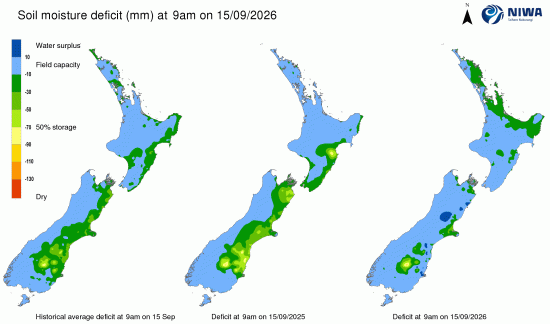
This soil moisture chart is animated here.
Keep abreast of upcoming events by following our Economic Calendar here ».
27 Comments
KiwiSaver withdrawals surge in 2025 | RNZ News
More than 10,000 more withdrawals were made from KiwiSaver for hardship reasons last year than in 2024, and providers say there's no sign of the rate slowing.
Inland Revenue data shows there were 58,460 withdrawals for hardship reasons in 2025, 10,000 more than were made for a first home.
In total, $514.8 million was withdrawn from KiwiSaver because of hardship, and $2.1 billion for a first home.
In 2024, there were 47,390 hardship withdrawals to a total of $403.8m
It'll be interesting to see if Kiwisaver becomes the de facto pension fund for retirement in years to come and how these early withdrawals end up affecting the retired relying on it.
Well if folk are withdrawing funds, prior to reaching pension age, chances are the final nest egg will not be enough to rely on. You therefore ask a very good question because in essence the whole concept of Kiwi Saver is thus weakened , if not defeated.
Typically, those withdrawing money only get a small amount rather than the entire sum. Nevertheless any withdrawal, especially early on, will have a big impact on the amount they will have at retirement. Retirement age comes around awfully quick.
A USD10,000 lump-sum investment in Apple at the start of 1990 would be worth USD10-11 million today.
Monster energy drink even better over same time period - up to USD27 million. Monster is one of the strongest long‑run performers in modern equity history.
And in Aotearoa, we pissed it up against the wall for the Ponzi.
NZ invented V and they turn over around a billion a year.
5 trillion dollars was pissed away by investors trying to find the next Apple in the late 90s.
Silly viewpoint is silly.
It is what it is P. Even Rocket Labs has a 20x return within past 2 years. Like data center and AI cloud infrastructure investments, it's all about timing. 2024 was a special year in that regard.
I think your fixation on outlier extreme performers interferes with critical reasoning.
Outliers? I'm sure in times past, personal computing, online bookstores, and social media platforms were discussed with little interest at the neighborhood BBQs.
That being said, CBA is also a good performer P. An AUD10K investment in 1990 would be worth AUD1-1.5 million today.
Outliers?
Yeah. You know what a statistical outlier is, right?
There's 10s of thousands of publicly listed companies, and your arguments only ever seem to trot out the small fraction that have done exceptionally well. And rarely the ones who've either plodded along, or gone to zero.
Well yes. There are different points in time when some companies have the opportunity to shine. Take SanDisk. IPO'd in late 80s. Not a company most people talk about as people have little interest in storage devices.
But up 80% in a month and 10x in past 6 months. Why? Because it has become a high‑beta, pure‑play beneficiary of the AI and data‑center storage boom, amplified by a recent spin‑off and a sharp turn in NAND pricing and earnings expectations.
There are different points in time when some companies have the opportunity to shine
It's not even that. Even when the sun is shining on a particular sector, there's a handful of winners and a bunch of losers.
So you're promoting trying to find the next gold rush (rare) and find the winners within that gold rush (even rarer).
Your views totally exclude this reality.
Times are changing. People are now using AI to surface “AI plays” in two broad ways: off‑the‑shelf stock‑picking tools that rank or recommend names, and custom workflows that use LLMs/NLP to map companies to AI themes from text (filings, earnings calls, news) - Danelfin, Kavout are examples. Users are not relying on others to do the work for them.
Similarly with crypto, AI is being used to surface “edge” from data that humans can’t practically monitor in real time, then turn that edge into tradeable signals, automation, and risk controls. Multi‑source predictive models ingest price, volume, order book depth, liquidations, funding, on‑chain flows, and social sentiment to forecast short‑term moves or regime shifts, often via gradient boosting, deep learning, or ensemble methods. These models underpin rating systems and “buy/sell” scores used for idea generation and portfolio tilts.
Oh well, I eagerly await AIs ability to reverse the very low probability of retail investors being able to reliably predict winners.
AI will not predict winners for you. It's not a magic box.
It would not have been able to tell you that if you had invested in silver (via the ETPMAG proxy) in 2019, that your returns would be approaching 500%.
Now we're getting closer to my point.
Likewise it wouldn't determine SanDisk would rise in value, because it's a commodity player in a mature market.
So at best, it'd help someone trying to make it day trading. Although if everyone's using an AI, it'll just become an echo chamber.
So pointing out highly unpredictable large price movements is nothing more than trivia. It is of no commercial use except an example of what to stay away from, unless you're wanting to have a flutter, or have some other motivation other than trying to have more wealth than you started with.
Likewise it wouldn't determine SanDisk would rise in value, because it's a commodity player in a mature market.
In hindsight, several mainstream AI-driven and rules-based frameworks could reasonably have flagged SanDisk as a high-probability outperformance candidate for 2025, but that would have depended on model design and inputs. For ex, captured AI value-chain signals; used factor and earnings-based features; incorporated structural industry data.
The driver set for SanDisk was classic “picks-and-shovels AI”: NAND flash and enterprise SSD demand from hyperscalers, with a tight supply-demand balance in memory and storage.
But Sandisks' actual financials and even those metrics you mentioned don't support such a rise in share value. It's down to investor perceptions regarding future AI demand, a surge in media stories regarding memory scarcity, fomo, etc.
You're really after an AI that can try and guess which attempt at making a stock go viral will strike. Which has a very high degree of erraticness.
Is this the first bubble you've invested through?
10,000 USD in 1990 is like 100,000 NZD now. A not insignificant sum to invest in an energy drink.
"And in Aotearoa, we pissed it up against the wall for the Ponzi"
Did no one tell me it was silly comment day today?
Not all all. If your incentives are wrong, then there is less opportunity for innovation and businesses to grow. I gave the example of Rocket Labs. There's a reason they're listed on the NASDAQ.
Congratulations JC, you can tell in hindsight which company one should have invested in 35 years earlier.
Hey, don't mock, some of us have magic perception powers at calling long shots.
For instance, I can win a bet with you over who will beat Mike Tyson in 1990. 42 to 1 odds. Most people at a BBQ wouldn't know that. I am secretly a genius.
The word from the providers is that hardship withdrawals are being abused for frivolous reasons. Not sure how prevalent this is, and if true it is even more depressing to think about the impact on future pension funding.
https://www.rnz.co.nz/news/business/577963/people-learning-to-manipulat…
In early Asian trade, gold is down -US$25/oz from this morning, now at US$5062/oz. Silver down -US$5 at US$110/oz, and platinum is now at US$2686/oz, down -US$170 from this morning's spurt.
There was a violent intraday swing where gold and silver spiked to fresh records and then sold off so hard that the implied combined value of above‑ground “market cap” dropped by about USD1.7 trillion in approx 90 mins - the largest nominal reversal in history and the entire mkt value of the ol' rat poison.
As soon as China mkts opened, silver proxies on ASX exploded.
What a time to be alive.
Who sold? One news catching up with a news piece about PMs this evening.
"Mr Trump promised Americans a new golden age. Nobody envisaged it would quite work out like this."
https://www.abc.net.au/news/2026-01-27/donald-trump-triggers-a-gold-rus…
Not really an article about gold but more about Trump Derangement Syndrome. Look at the reality of when central bank purchases started pumping:
2018: Net central‑bank purchases jump to a multi‑decade high of about 650 tonnes, signaling a clear step‑change in demand.
2022: Purchases hit the fastest pace since 1967, kicking off a new phase of very strong official demand.
2022–2024: Annual net purchases exceed 1,000 tonnes per year, dominated by Asian and other non‑Western central banks, greatly amplifying gold’s role in global reserves.
And Chinese pvte demand:
2020–2021: COVID‑era uncertainty boosts precautionary savings; gold is one of the main safe‑haven assets Chinese households lean into alongside bank deposits.
2022: As growth concerns and property stress deepen, investment‑driven gold demand rises; household risk appetite for equities weakens, increasing gold’s appeal.
2023: Consumer demand for gold (jewelry, bars, coins) jumps double‑digits; bar and coin demand alone grows roughly a quarter year‑on‑year.
2024: Pvte‑sector gold buying reaches its strongest level in several years, approaching around 1% of GDP by value and making China the dominant marginal buyer in the global market.
I think Trump mistook brass plated to be gold.

We welcome your comments below. If you are not already registered, please register to comment
Remember we welcome robust, respectful and insightful debate. We don't welcome abusive or defamatory comments and will de-register those repeatedly making such comments. Our current comment policy is here.