
Treasury is forecasting New Zealand’s inflation “worst case scenario” at 3.7%, as the war in Iran drags on and fuel prices continue climbing.
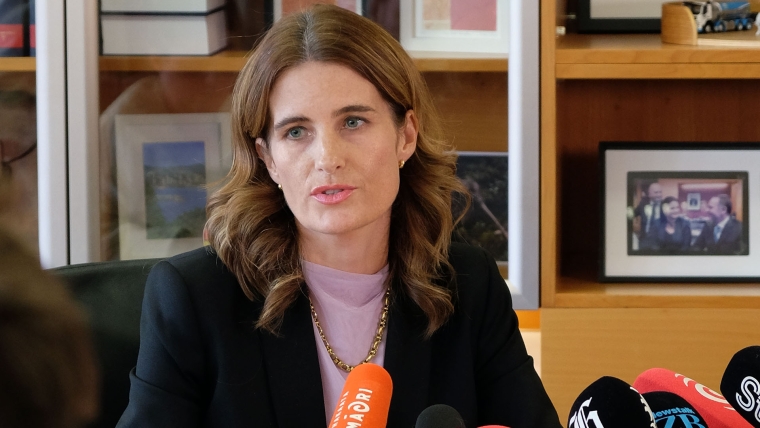
Finance Minister Nicola Willis briefed journalists from her office on Monday afternoon and said Treasury was forecasting inflation rising higher this year than anticipated.
Willis said the worst case scenario, “which is for a prolonged conflict with oil prices continuing to go higher than they are - that is a conflict potentially lasting through the rest of this year”, was 3.7%.
“That's too high for my liking, but it's lower than Australia has today. They are currently at 3.8%.”
Willis also revealed a “timely, temporary and targeted” response to high fuel prices would be considered, should the Government consider prices were raised to a point that was putting acute cost of living pressures on households.
Willis said the situation was difficult for forecasters. “They're not just trying to forecast what would the economic impact of particular events or price spikes be, they're also trying to anticipate what those very events might be”.
“And so even that number that I share with you is somewhat dated, and that it was a figure that the Treasury put together some days ago, and a lot has happened in the world since then.
“But what they did do as a scenario was… in a worst case scenario where you have a prolonged conflict, you see the oil price going as high as US$185 a barrel, you see a very significant impact on global growth and output, how might we see that flow through to the New Zealand economy?”
“I'd note that there was also a scenario that they gave me in which they thought inflation would only get to 3.2%, still out of band, but not nearly as high.”
The most recent Consumers Price Index rate from Statistics NZ, for the December quarter, showed annual inflation of 3.1%.
Willis said forecasters still expected the New Zealand economy to grow strongly this year.
"The lowest rate of growth that they forecast in the scenarios they shared with me was 2.5% - that is a healthier rate of growth than we experienced last year," Willis says.
20 Comments
Treasury: "what number do you want it to be?...
"Slightly less than the Aussies please"
Seems unlikely that that is the worst case. The worst case is that everyone starts raising prices because everyone else is. If the RBNZ does nothing again (e.g. its transitory) I can't see any reason we wouldn't see 7% inflation again.
Why bother modelling something when we just saw the worst case scenario a few years back (and who's to say it couldn't be even worse).
Remember that the OCR is currently at a fairly stimulatory setting below neutral. They are stimulating the economy at the same time fuel prices are going through the roof, yet treasury thinks there's nothing to see here.
Willis also revealed a “timely, temporary and targeted” response to high fuel prices would be considered, should the Government consider prices were raised to a point that was putting acute cost of living pressures on households.
As I said yesterday, if you're worried about inflation, then a government response would be the better thing to do at this point in time rather than relying on an OCR change which would take far too long to have any effect. Whether they do it remains to be seen. I agree though that 3.7% is lower than the worst-case scenario I would think.
"Oh crap we haven't got enough fuel"
"Let's make it cheaper, that should fix the problem"
Demand for fuel is price-inelastic in the short-term. The challenge here is stopping diesel prices driving up the price of everything else. A simple tax credits model for importers could have done the job. It's not like we didn't know that we would get another oil price shock.
That makes little sense. Supposedly most the country can’t afford the cost of living, yet they’ll still drive wherever they feel like it regardless of the price of fuel?
Many of the freight companies were quick to go from monthly fuel adjustment factor revisions to weekly once the fuel prices started moving. Those costs will flow through very quickly to retail prices.
I'm calling bullshit on this.
According to AI: "as of the December 2024 quarter, petrol makes up about 4 percent of the New Zealand Consumers Price Index (CPI) basket".
Petrol has gone up about 25% already, so 25% * 4% = 1%. A 1% increase in CPI from petrol alone to 4.1%, and that is assuming petrol stays around $3 a litre. This excludes any of the flow on effects and the other increases to transport costs (diesel).
Correct me if I'm wrong, a basic analysis I know.
Consumers consume directly about 59% of the petrol that is imported - according to AI.
That direct consumption is where the 4% of the CPI basket comes from.
Then there is the remaining 41% of petrol that also goes into the CPI via its effect on manufactured goods.
Then there are the effects on diesel and aviation fuel.
Exchange rates are also part of the overall equation.
And diesel doesn’t have a fixed tax component, so if petrols gone up 25% diesel probably more like 50%. So CPI at least 5% if petrol stays at $3 a litre. And surely that’s not the worst case scenario, we will probably see worse next week!
Yes but as we all know it becomes embedded in nearly everything else we consume as each part of the manufacturing and supply chain gets impacted with rising input costs.
Exactly, so CPI at 4.1% just from the price at the pump that the average household consumes, surely at least 5% with it embedded in other costs.
Then it can also cause spiralling inflation. People will demand pay increases, especially the likes of teachers, firefighters, etc. Businesses will take this opportunity to raise their prices even if they aren’t affected by fuel costs.
I’d like to see treasury’s maths. I feel like they forgot to carry the 1.
It gets into everything - because as the prices of fuel and everything else rises, people demand more wages from their bosses to pay their bills, which forces the accountants doing the pricing to increase costs of goods and services they also sell so they can maintain their profit margin (or at least breakeven). And the spiral starts.
Why we were so stupid during COVID not to act faster to prevent that spiral from starting - because once it does, it takes years to get back under control.
COVID was always going to have a years long tail. It's still a problem for us now.
No, you're right. Petrol is 3.5% of the basket but add in diesel and engine oils etc and you get to just over 7%.
So, if all of the above goes up 25% and stays up for the quarter, then that's 1.75 percentage points added to annual CPI.
The propogation through other prices will add to this - noting that a similar sustained rise in 2011 drove CPI above 5%.
So are treasury blatantly lying? Or do they think the worst case is $2.70 a litre or something?
Why does this sound so familiar? "forecasters still expected the New Zealand economy to grow strongly this year". Expectations based on misunderstand the real-world operations of a fiat based economy. There is also no consideration given to private sector debt cycles.
I found it interesting that people think that importing inflation isn't the RBNZ's job to handle - that it should be subsidised by the tax payer so that companies don't fail with higher input costs.
But when we spent 30 years importing deflation from cheap foreign labour that decimated our manufacturing and production bases (killing off many many companies, trades, jobs...), then it was absolutely the RBNZ's job to raise aggregate demand via cheaper mortgage lending to stop a deflationary spiral occurring.
Why didn't we protect our businesses from the deflationary forces of globalisation so that we could have kept jobs and companies here (instead of giving the work to people in China or Vietnam) - while preventing our private debt from skyrocketing by limiting interest rate falls?
All we have done for 3 decades is traded jobs (productivity) for higher private debt. "Here Vietnam, you make this thing for us cheaper so that the CPI falls, so that we drop interest rates, so that we can get a bigger mortgage and pump house prices, while we simulatenously lay off workers and kill businesses in NZ who would have originally made the same product". Economic suicide and stupidity in my opinion.
(likely a controversial take, but I'm trying to fathom the extent of our self destruction/economic stupidity from the 1990's to now).
The simplest way to understand it is governments would rather use debt to gloss over the fact that our labour is priced out of the market, than to allow the sort of destruction that'd rationalize that.
And then we can all think there's some sort of miracle proprietary productivity booster to make up for the labour cost disparity.
We welcome your comments below. If you are not already registered, please register to comment
Remember we welcome robust, respectful and insightful debate. We don't welcome abusive or defamatory comments and will de-register those repeatedly making such comments. Our current comment policy is here.