

Well, the employment market was looking as though it might have been turning the corner in February.
But thanks to the ructions in the Middle East and attendant uncertainty that's introduced, I guess we'll find out in March whether there was a brick wall around that corner.
Statistics NZ reported in its monthly employment indicators (MEI) that February filled jobs were, on a seasonally adjusted basis, up by just over 0.3% in February (7146 jobs) to 2.35 million.
As usual though, these stats do come with something of a health warning - that they do tend to be revised down in subsequent months. The figures for January, for example were originally shown to be a gain of just under 0.2%, but this has now been revised down to a loss of just under half a percent.
However, generally the more recent trend, including an over 0.5% gain in November, has been suggesting the job market is looking up.
ASB economist Wesley Tanuvasa said February filled jobs data maintained signs of a stabilising labour market.
"Downward revisions continue to slow the underlying firming trend, but employment prospects looked to be on the expansion path to start 2026.
"However, risks posed by the US-Israel war on Iran to New Zealand inflation and growth are material. We expect a confidence hit that is likely to dampen hiring intentions and therefore employment growth over 2026. There remains pronounced uncertainty given the fluidity of global developments but for now, we expect the labour market recovery to be delayed yet again," he said.
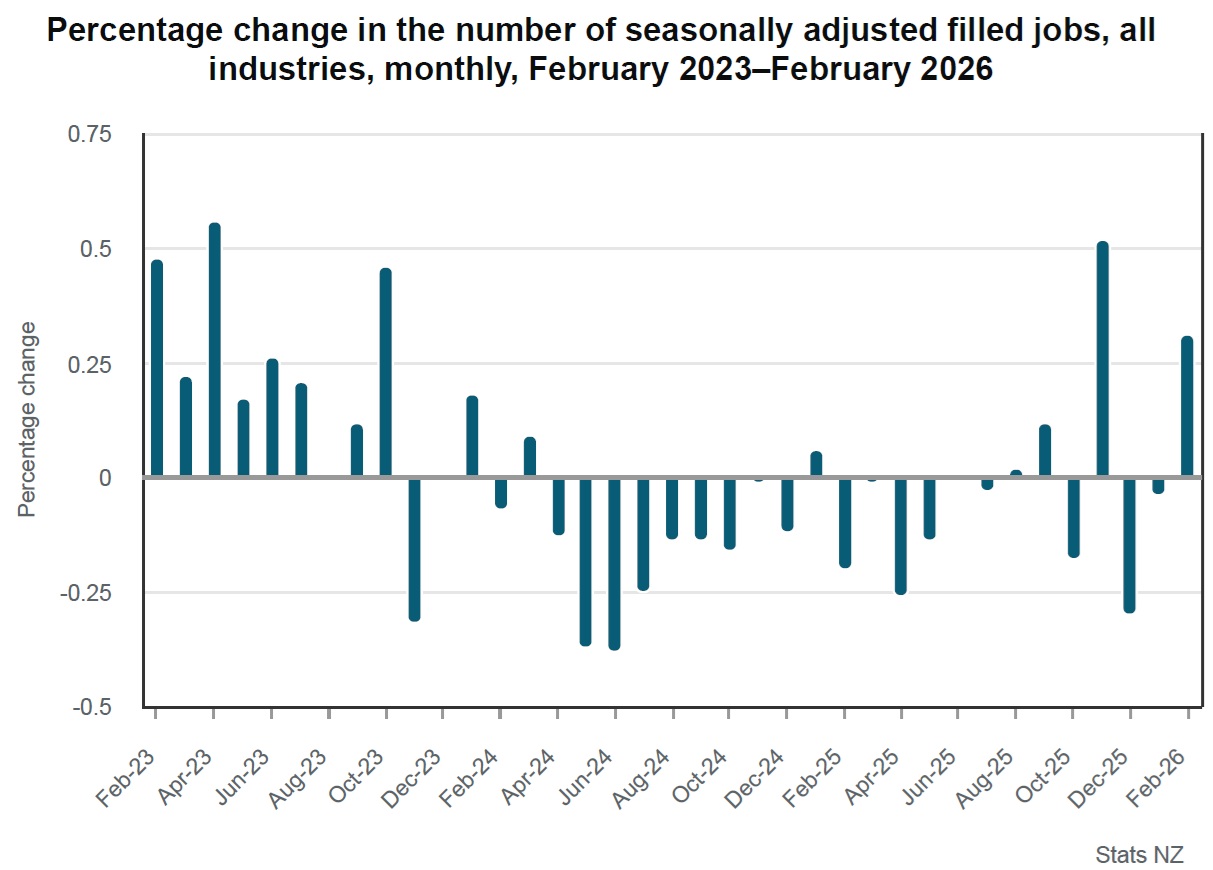
The MEI figures are not directly comparable with the official unemployment figures as they are sourced quite differently - coming from Inland Revenue data - but they nevertheless have tended to be quite a good indicator of future trends.
However, we'll have to wait till next month now to see if the Middle East crisis has turned sentiment in the labour market.
The official unemployment figures for the December quarter showed an unemployment rate of 5.4%, which was up from 5.3% from the September quarter - however, a meaningful rise in the 'participation rate' in the December quarter - more people making themselves available for work - made those December figures look somewhat worse than they were.
The Reserve Bank (RBNZ) as of its February Monetary Policy Statement (MPS) was forecasting that the unemployment rate will ease to 5.3% in the March quarter we are currently in and then slowly ease to 5.0% by the end of the year. However, the RBNZ will now undoubtedly be looking again at those figures ahead of its next MPS in May and it will likely give some indication of its current thinking at the next Official Cash Rate (OCR) review on Wednesday, April 8.
Economists are already eyeing a higher unemployment figure in the near term of around 5.6%.
But back on the monthly figures for February, these were the key, seasonally adjusted facts as reported by Stats NZ:
- all industries – up 0.3% (7,146 jobs) to 2.35 million filled jobs
- primary industries – up 1.6% (1,735 jobs)
- goods-producing industries – up 0.1% (326 jobs)
- service industries – up 0.3% (5,024 jobs).
In terms of actual figures (IE not seasonally-adjusted), in February 2026, there were 2.35 million actual filled jobs, up 1,505 jobs (0.1 percent), compared with February 2025.
By industry, the largest changes in the number of filled jobs compared with February 2025 were in:
- public administration and safety – up 3.2% (5,181 jobs)
- health care and social assistance – up 1.7% (4,773 jobs)
- construction – down 2.1% (4,159 jobs)
- manufacturing – down 1.6% (3,672 jobs)
- education and training – up 1.2% (2,382 jobs).
By region, the largest changes in the number of filled jobs compared with February 2025 were in:
- Canterbury – up 1.5% (4,675 jobs)
- Auckland – down 0.4% (3,233 jobs)
- Wellington – down 0.9% (2,185 jobs)
- Waikato – up 0.9% (1,942 jobs)
- Otago – up 1.4% (1,638 jobs).
We welcome your comments below. If you are not already registered, please register to comment
Remember we welcome robust, respectful and insightful debate. We don't welcome abusive or defamatory comments and will de-register those repeatedly making such comments. Our current comment policy is here.