
Treasury warned of a "chilling" impact caused from uncertainty on investment and global growth during the early days of the war in Iran, as the purse strings tighten even more for the Government as it heads to its third Budget, set to be released three months' into the fuel crisis.
Documents proactively released by Treasury showed advice provided to Finance Minister Nicola Willis in March and April.
Updates emailed over the weekend of February 28 outlined potential economic impacts, talking points on the policy response and "a rough sketch of what Ministers and senior officials can expect to see over the coming days on economic impacts".
"It is possible that there will be supply chain impacts if maritime and air travel is disrupted for an extended period. Uncertainty could also have a chilling impact on investment and global growth," the update in the email by Kerryn Fowlie, Treasury's assistant secretary of economic strategy, said.
The update warned a sustained oil price shock; "would also weigh on global economic growth, weakening general demand for New Zealand’s exports".
Talking points provided, "if required", on March 1 included that there remained "significant uncertainty about the impact of this conflict on the New Zealand economy and therefore any policy responses", "the New Zealand economy is adaptable to shocks, with a floating exchange rate, independent monetary policy, and flexible goods, labour and insurance markets", and that the Reserve Bank had room to adjust monetary policy if required.
A Treasury situation report on March 2 stated that while there were many precedents for sharp rises in oil prices and households and businesses were adept at managing; "further price rises may begin to materially affect household purchasing power and lead to lower spending on other goods and services".
"Further escalation of the conflict may also have significant economic impacts for New Zealand through less direct channels.
"These include weaker trading partner growth that flows through to lower commodity export prices, and greater uncertainty for households and businesses that reduces spending and investment."
On March 16, Willis released Treasury's 'worst case scenario' of inflation forecast to reach 3.7%. Consumers Price Index (CPI) inflation was an annual 3.1% in both the March and December quarters.
Then, just over a week later, new scenarios developed by Treasury, but only released publicly at the end of April, painted a much bleaker picture. These had a worst case scenario with inflation at 7.4%, GDP at 0.8% and unemployment at 5.7% for the 2026 June quarter. Annual inflation hit a 32-year high of 7.3% in June 2022.
Willis described scenario one in the table below as "best case", with a ceasefire in early to mid-April and Persian Gulf oil flows gradually resuming, scenario two was a prolonged conflict, and three was a prolonged, more severe conflict.
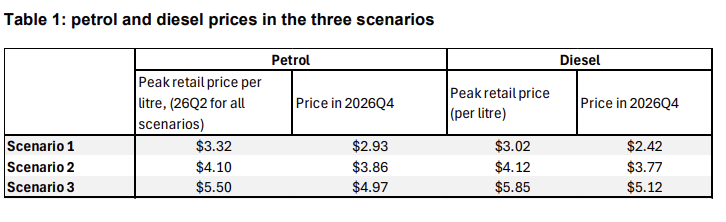
Included in the released documents was an aide memoire regarding the scenarios which predicted peak petrol and diesel prices under the different scenarios and the degrees to which they would have declined by the end of the year.
In an overview, Treasury said it was monitoring market developments ahead of the 2026 Budget on May 28.
"The continuing conflict has a significant impact on the outlook, particularly over 2026.
"The Budget Update will explain how higher fuel prices are expected to affect inflation, household costs, business expenses, the fiscal outlook and overall economic growth. Further, it will set out the key uncertainties surrounding the economic outlook."
Asked on Tuesday if the Government had signed off the Budget, Luxon said: "Our Budget's working through its normal budgetary process. I'm not going to talk about it before the Budget, but clearly ... there will be some impact on inflation and growth".
"Our job is to make sure we're keeping an eye on the long term and medium term for New Zealand, and you know that'll be revealed when we reveal the budget."
We welcome your comments below. If you are not already registered, please register to comment
Remember we welcome robust, respectful and insightful debate. We don't welcome abusive or defamatory comments and will de-register those repeatedly making such comments. Our current comment policy is here.