

Here are the key things you need to know before you leave work today (or if you work from home, before you shutdown your laptop).
MORTGAGE RATE CHANGES
The Police Credit Union adjusted some rates today, up and down. All current mortgage rates are here. And note, you can compare mortgage offers with our unique calculator that takes into account other costs and cashback incentives, here.
TERM DEPOSIT/SAVINGS RATE CHANGES
None here either. All updated term deposit rates less than 1 year are here, for 1-5 years, they are here.
THE PACE WILL HAVE TO LIFT
Updated analysis by interest.co.nz shows most new homes being consented in Auckland are getting built, for now at least. The same analysis shows Auckland's residential construction industry may have to increase capacity by 20% over the next two years to keep pace with the number of new homes being consented.
NOT ALL IT SEEMS
Updated. ANZ's June card spending tracking suggests much of the apparent uplift in their June data is a mirage caused by price hikes rather than volume gains. They see annual spending growth of +5.8%. They said hospitality fell 2.2% m/m after a 3.5% lift in May. Housing durables also fell, and apparel was flat. However, a lift in spending was seen for tourism & recreation, services, and non-retail trades and goods. (All data is seasonally adjusted). They also saw a sharp rise in spending on industrial supplies that seems more likely to reflect higher prices than higher volumes. These goods are largely imported, and some, like plastics, are directly impacted by oil prices.
AUTOMATIC STABILISER
The weak NZD has overcoming any softness in commodity prices. And that softness hinges on lower oil prices. While oil prices are not part of the ANZ Commodity indexes, they do influence many parts of it. In June, the World Commodity Index dipped -1.0% from May, but retailed a +2.7% gain from a year ago. That was boosted howeve to a 6.6% gain when expressed in NZD.
DRY WEATHER COMING, DELAYED PRICE IMPACTS
ANZ has been looking at El Niño and how that is likely to affect rural markets. Among their observations, they say agricultural prices rarely rise in El Niño years. If prices do rise, it typically occurs 12 to 18 months later as the impacts work through the global agricultural system. In fact, lamb and mutton prices are at risk of falling this season (from very high levels). Drought may compel farmers in here and in Australia to destock simultaneously, increasing supply and depressing prices.
DAIRY FARMERS IN SEASON LOAD-UP
Updated RBNZ new lending data shows that the seasonal May surge in bank lending to dairy farmers came in +11.7% higher than the equivalent year ago seasonal surge. Other rural new lending was unremarkable.
SHIFTING TO TWO YEARS FIXED
Other RBNZ new lending data indicates that residential occupier mortgage borrowers increasingly preferred 2 year fixed terms in May and pulled back somewhat from three year fixed borrowing.
NZX50 FIRMER
As at 3pm, the overall NZX50 index is up +0.5% so far today, with a weekly rise of +1.0%. It is now up +0.2% from six months ago. From a year ago it is up +7.3%. Market heavyweight F&P Healthcare is up +0.8% so far today. Strong gains from Vista Group, Vulcan Steel, Infratil and Ryman despite falls in Tourism Holdings, Air NZ, Napier Port and Oceania
SETTLING BACK BUT STILL VERY HIGH
In Australia, the Melbourne Institute survey of inflation expectations eased back slightly to 5.5% after the March spike that was rose again in April. But it has eased from there, and slipped again in June. Wage expectations, by comparison, have remained unchanged for the past seven months.
A ONCE-IN-A-GENERATION EVENT RECURS
And staying in Australia, it is probably worth noting that for a second consecutive year, South Australis's Lake Eyre is full again, an event that usually only happens three or four times a century. Floodwaters from Queensland have been strong enough to refill it in 2026, and that has been combined with rare local rains. As a strong El Niño is on its way, this is something that will mitigate it in the red center.
SWAP RATES HOLD-TO-SOFT
Wholesale swap rates will likely be marginally softer today. Keep an eye on our chart below which will record the final positions closer to 5pm. The 90 day bank bill rate was up +1 bp at 2.74% on Friday. Today, the Australian 10 year bond yield is down -3 bps at 4.78% from this morning's open. The China 10 year bond rate down -1 bp at 1.73%. The Japanese 10 year bond is up +1 bps at 2.78% today and its highest since 1996. The NZ Government 10 year bond rate is now at 4.47%, unchanged from this morning. (The RBNZ data is now 'prior day' with the Friday rate unchanged at 4.45%.) The UST 10yr yield is down -2 bps at 4.47%.
EQUITIES MIXED
The local equity market is firmer from Friday, now up +0.6%. But the ASX200 is down -0.2% so far. Tokyo has opened down -1.2%. Hong Kong has risen +1.2% but Shanghai is down -0.6% at its open today. Singapore is down a minor -0.1% at its open. Wall Street will return after its July 4th holiday tomorrow and the futures market suggests the S&P500 will open +0.9% higher. The Nasdaq futures signal a +1.5% gain.
OIL PRICES MARGINALLY SOFTER
American oil prices are down -50 USc from this morning with the WTI benchmark now just under US$68.50/bbl, while the international Brent price is just under US$72/bbl.
CARBON PRICE QUIET
There has again been very little trading and the price has remained at $54/NZU. See our daily chart tracker of the NZU price for carbon, courtesy of emsTradepoint.
GOLD HOLDS
In early Asian trade, gold is little-changed down -US$2/oz from this morning, now at US$4172/oz. Silver is unchanged at just on US$62/oz.
NZD SOFTER
The Kiwi dollar is down -20 bps against the USD from this morning's open, now just on 56.9 USc. Against the Aussie we are also down -20 bps at 82.1 AUc. Against the euro we are down -10 bps at 49.8 euro cents. This all means the TWI-5 is now just over 60.8 and down -10 bps from this morning.
BITCOIN FIRMS
The bitcoin price is now at US$63,368 and up +1.3% from this morning. Volatility has been modest at just on +/- 1.2%.
Daily exchange rates
Select chart tabs
Daily swap rates
Select chart tabs
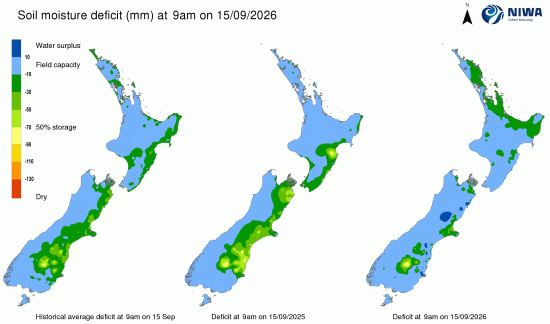
This soil moisture chart is animated here.
Keep abreast of upcoming events by following our Economic Calendar here ».
We welcome your comments below. If you are not already registered, please register to comment
Remember we welcome robust, respectful and insightful debate. We don't welcome abusive or defamatory comments and will de-register those repeatedly making such comments. Our current comment policy is here.