
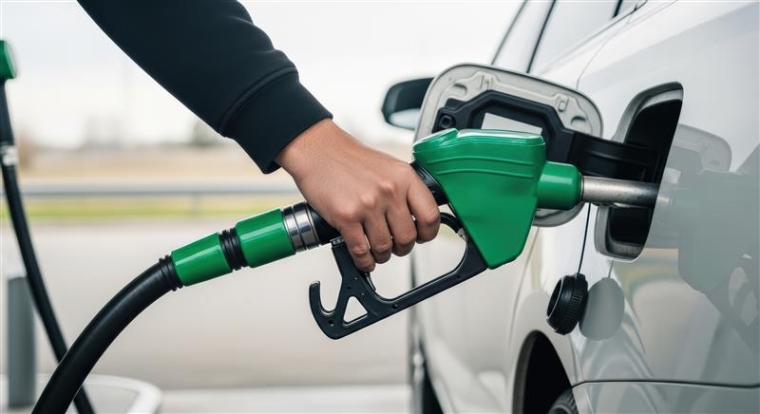
Finance Minister Nicola Willis says petrol prices driving New Zealand inflation above 4% are the result of a "Trump spike," but Labour says the Government can't dodge responsibility.
"I do not control Donald Trump. I do not control the ayatollahs," Willis said Tuesday, following Statistics NZ's release of the latest inflation figures.
Annual inflation, as measured by Statistics NZ's Consumers Price Index (CPI), increased to 4.1% in the June quarter – from 3.1% in the previous two quarters.
Petrol, up 27.5%, accounted for almost a quarter of the 4.1% annual increase. Despite diesel being up 71%, households were spending eight times more on petrol than diesel, meaning petrol prices had a larger impact on the CPI.
If petrol and diesel prices had not changed, the CPI would have increased 2.9% in the year to June, Stats NZ said.
Speaking to reporters, Willis described it as the "Trump spike in inflation, driven by higher petrol and diesel prices."
"New Zealanders have already experienced this at the pump, and we know that it's been a very difficult period for many. What New Zealanders have also experienced in recent weeks is those prices at the pump coming down, and with that, we expect that to reduce the pressure on inflation."
However, while there had been two weeks' worth of government data showing the national average of 91 octane under $3 a litre, Willis said with "things heating up in the Middle East again" she expected higher crude oil prices to be reflected at the pump.
"We're very conscious that it's been hovering just below $3 and that in recent days we've actually seen that price coming back up again. So we could see that reflected in the national data."
That meant the $50 per week tax credit for low-middle income families rolled out in early April, which will only cease after four consecutive weeks of 91 octane costing less than $3 a litre, or on April 7, 2027, would continue.
Asked if New Zealanders would believe it was all US President Donald Trump's fault, Willis said, "I think any New Zealander who's purchased petrol in the past few months knows what has happened".
"I do not control Donald Trump. I do not control the ayatollahs. If I could, I would do everything I could to bring peace to our land, so that you had cheaper prices at the pump. But unfortunately, some things are outside my control."
Willis said New Zealanders understood that high petrol price has contributed to the cost of living.
Pushed on areas such as increasing rates and electricity prices, Willis said that was why they were processing local government reform and consenting more renewable energy projects.
Electricity was up 12%, local authority rates and payments increased 8.8% and construction of new housing rose 2.7%.
Opposition hits out at government
Labour Party finance spokesperson Barbara Edmonds said Trump was not to blame for the inflation figures.
"For the last two years, we've seen rates increases, we've seen power increases, we've seen food price increases. She can't just blame the last quarter inflationary figures just on Donald Trump. What has been her solution?"
Asked about the fuel price contribution to the recent rise, Edmonds said that was for the last quarter, "but what about for the last two years?"
"I heard the minister talking about rates capping. Where is the legislation for it? They announced it last year. There's still no detail... I doubt that we'll be able to pass any sort of rates cap legislation between now and before the house rises."
Edmonds said Labour was open to looking at rates capping "but you also have to ensure that underlying funding tools are also there."
Meanwhile, Green Party Co-leader Chlöe Swarbrick blamed exposure to volatile fossil fuels for driving up inflation.
"The Greens saw this on the horizon when the fossil fuel crisis first hit, and offered the Prime Minister our Green support to minimise our country’s exposure to imported inflation through rapid decarbonisation. All [Christopher] Luxon had to offer as I probed this in Question Time was, 'I understand inflation, rest assured.'"
"This is the same Prime Minister who boldly declared, ‘Hope is not a plan,’ but clearly, he has worse than no plan. His government has worked to increase our vulnerability to fossil fuels and is trying to burn more than a billion dollars on an LNG import facility," Swarbrick said.
13 Comments
We have high inflation because of the pricing power of our necessities industries and because of the fact our central bank still follows monetary theory that is defunct in this environment. Set the cash rate as close to “neutral” as can be agreed upon and let market forces run the shape of the yield curve. Spend the vast amount of resources the RBNZ have to work on regulating monopolistic pricing behaviour and be brave against the lobbying
If this crowd loses the election over cost of living, it would be poetic.
Circumstances beyond the control of either bloc, are driving the narrative.
Maybe it needs a journalist, rather than a reporter?
If the worldwide Covid inflation was caused by Labour, then surely National have to accept responsibility this time?
In New Zealand, the COVID-19 economic response was one of the largest in the country's history, combining very large fiscal stimulus from the Government with extraordinary monetary stimulus from the Reserve Bank of New Zealand (RBNZ).
Fiscal stimulus (Government)
The Government's COVID-19 Response and Recovery Fund (CRRF), together with the initial March 2020 support package, totalled approximately $70.4 billion of allocated funding. This was equivalent to around 22% of New Zealand's 2019 GDP
.
Like a tidal wave in a puddle, it's still washing around.
Monetary stimulus (RBNZ)
The RBNZ implemented its largest-ever monetary easing programme:
1. OCR cuts
•The Official Cash Rate (OCR) was rapidly cut from 1.0% to 0.25% in March 2020.
•The OCR remained at 0.25% until October 2021.
2. Large Scale Asset Purchase (LSAP) programme ("quantitative easing")
•The RBNZ purchased Government and Local Government bonds in the secondary market.
•The LSAP programme had a maximum authorised size of up to $100 billion.
•Asset purchases stopped in July 2021.
3. Funding for Lending Programme (FLP)
•Cheap funding was made available to banks to encourage lower lending rates and support credit availability.
4. Financial market support
•Liquidity facilities and market operations were expanded to ensure banks and financial markets continued functioning smoothly during the crisis.
By international standards, New Zealand's response was unusually large relative to the size of the economy. The combination of:
•strict public-health restrictions,
•approximately $70 billion of fiscal support, and
•an LSAP programme with capacity of up to $100 billion
helped New Zealand avoid a prolonged recession and drove a very rapid recovery in employment. However, many economists and later reviews have argued that the combined fiscal and monetary stimulus became excessive once the economy reopened, contributing to the high inflation experienced.
Yet our inflation peaked at about the same as our peers, and has been lower than AU since.
Thanks to National it's not a whole lot worse.
Sounds like two Party hacks.
Neither Party are in the driver's seat.
As an investor across a range of assets I have a bias towards parties that show fiscal discipline. But not a national party member or voter.
We welcome your comments below. If you are not already registered, please register to comment
Remember we welcome robust, respectful and insightful debate. We don't welcome abusive or defamatory comments and will de-register those repeatedly making such comments. Our current comment policy is here.