

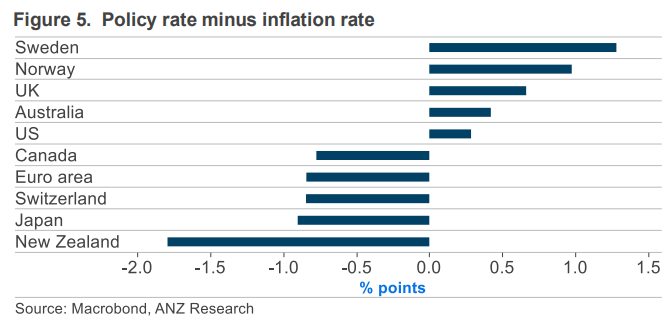
Economists at ANZ New Zealand, the country's biggest bank, say they now expect the Reserve Bank (RBNZ) to increase the Official Cash Rate (OCR) three more times, instead of just once, taking it to 3.50%.
ANZ NZ's economists, led by Chief Economist Sharon Zollner, say in addition to a 25 basis points OCR increase on October 28, they now also expect 25 basis points rises in both February and March next year, following a pause on December 9. The OCR is currently at 2.75% after 25 basis points increases in September and July.
They cite three main drivers for their changed OCR expectations. They are; a sharp increase in the crude oil price; the NZ dollar having fallen out of favour as global risk aversion has increased, and; the NZ economy currently having more momentum than expected.
"The spot Dubai [crude oil] price is now more than 40% above the RBNZ’s assumption for the fourth quarter of US$83.7/bbl. In addition, the refining spread has blown out, meaning global fuel prices (particularly diesel) could be considerably higher than the crude oil price would normally imply," ANZ NZ's economists say.
"The recent surge in fuel prices raises the odds of second- and third-round spillovers across the CPI [Consumers Price Index] basket."
In terms of the NZ dollar, they note the trade-weighted index is now 3.3% below the RBNZ’s fourth quarter assumption.
"This will raise the price of not only fuel but all imports. The RBNZ’s focus is on domestic inflation, but they are also worried about spillovers from high headline inflation into wage and price setting behaviour. A lower exchange rate will also provide a boost for exporter incomes and the import-competing/tradable sector. It represents a meaningful easing of monetary conditions."
Meanwhile with the "upside surprise" in second quarter Gross Domestic Product (GDP) of 0.2% quarter-on-quarter, and an upward revision for the first quarter, annual GDP growth in Q2 was 2.6% versus the RBNZ’s expectation of 2.2%.
"That implies the negative activity impacts of the oil shock have so far been less disinflationary, all else equal, than previously assumed. Certainly, some of the upward shift in GDP will be ascribed by the RBNZ’s model to potential output, rather than pure demand," ANZ NZ's economists say.
"In addition, how long the lift in momentum will last is highly questionable – the last big oil spike in late-February saw forward looking activity indicators in our Business Outlook survey tank. However, all else equal, the RBNZ’s Monetary Policy Committee will be revising their estimate of the output gap to be less negative, and the output gap assumption is crucial in their forecasts to offset the inflationary impacts of the oil shock."
Also on Monday, Kiwibank's economists noted the 0.2% June quarter economic expansion meant 1.7% annualised growth and a 2.6% increase compared with the June quarter of 2025.
"Those figures came in a touch above market consensus and our own forecast of 0.1%, 1.6% and 2.2% across the three measures respectively," the Kiwibank economists say.
"We have seen plenty of commentary that the economic growth observed over the June quarter should lead the Reserve Bank to hike in October rather than waiting for December. We think this kind of call is premature. Yes, the economy grew above the market’s and the Reserve Bank’s expectations despite a very challenging global backdrop."
"But when the economy is still in embers, now is not the time to be dousing it with water," Kiwibank's economists say.
The ANZ NZ economists' full report is here.
We welcome your comments below. If you are not already registered, please register to comment
Remember we welcome robust, respectful and insightful debate. We don't welcome abusive or defamatory comments and will de-register those repeatedly making such comments. Our current comment policy is here.