
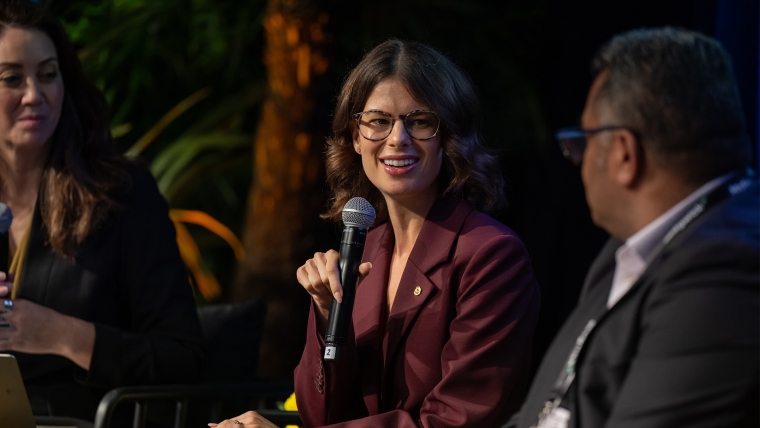
Insurance Council of Australia’s Alix Pearce says a critical decade of insurance risk poses challenges too big for either the Government or private sector insurers to manage alone.
Part of a panel at the Insurance Council of New Zealand (ICNZ) conference in Auckland on Thursday, Pearce alongside Gisborne Mayor Rehette Stoltz, ICNZ chief executive Kris Faafoi and Consumer NZ chief executive Jon Duffy spoke about the future of insurance.
Pearce, Insurance Council of Australia's general manager of climate, social policy and international engagement, recently travelled to six countries and had spoke with 120 decision makers on these issues. Asking them how they were solving this, she said from the responses, three things stuck out to her.
Pearce said we needed a step change in resilience investment. “Other markets are way ahead of the curve in comparison to New Zealand and Australia.”
“The second is that we absolutely can find new ways of spreading risk ... We're seeing globally, communities, industries, governments coming together to find new ways of spreading risk. Some of those ways are really effective and some of those ways offer cautionary tales. There’s some really clear lessons that will help us build clear strategies here.”
Her third point was: “We have to stop doing dumb things.” When Pearce asked people what was one policy lever that they could pull to make a difference, they all said land-use planning.
“‘Stop building in places that we know will flood, that we know will set alight, and we expect different things to happen.’ And that really resonated for me, and I think it’s really applicable to our regions as well.”
‘What we have is not currently fit for purpose’
Stoltz agreed with Pearce on land-use planning, saying there was about 10,000 hectares worth of forestry and farming in Tairāwhiti that were in high-risk areas.
If they addressed that, it would change how they recover, she said.
“It is so, so very important, but we need money. We do need investment into cases like that, so that we can make it happen. There are ETS [Emissions Trading Scheme] liabilities and bigger issues to address, so funding is needed in some or other way."
“What we have currently is not fit for purpose, Stoltz said.
Who pays?
The question that hovers over discussions on insurance, natural hazard risk, mitigation and adaptation is always: who pays?
Faafoi, whose organisation is proposing to replace the Fire and Emergency levy with a ‘Community Protection Levy’, said the main issue was that we needed to start answering that question.
“Everyone seems to be ignoring that question, so we want to start having that conversation … politicians might come and rubbish [the levy proposal], but okay, then what is the alternative? Because that’s the conversation that actually needs to happen for the long-term interests of communities like Rehette’s and [Auckland Mayor] Wayne’s and every other council in the country.
“I’ve seen the list of projects that would like to be included … it is long and it is immense, so someone actually has to start thinking about how we actually pay for that.”
Stoltz said local government was dealing with funding mechanisms that were not fit for purpose.
“We all know that and the discussions need to be had … there’s a clear distinction, who pays for what and who is responsible for what, especially in smaller communities where there’s a small rating base.”
Reducing a nation’s disaster recovery time
Pearce said if investment was made now, this would improve insurance penetration in those communities.
“What we’ve seen in global markets is that every percentage point you can increase [the] national penetration rate by, reduces a nation’s disaster recovery time by 12 months. So that’s 12 months you’re reducing recovery - that’s significant for community but it’s significant for the government bottom line as well.”
The longer it takes to recover from disaster, the longer you’re seeing mounting costs, she said.
While there was an upfront barrier, the benefits were considerable for the broader community as well, she said.
Lining up with other markets
Pearce said what was important to underscore is that investments were being made around the world in places that were facing similar fiscal challenges.
She pointed to the United Kingdom which had committed £4.2 billion over the next three years in flood defence and the Netherlands had committed an average of €1.25 billion a year (up to 2032) on flood defence.
“We need to line up with what’s happening in other markets, even if that number feels big to swallow.”
Budget 2026 did see investment in infrastructure - with a focus on things like rail, roads, hospital and school upgrades.
Nearly living in the river or ocean
Asked by a member of the audience if Gisborne District Council had control over where building occurred and if they had veto rights over developers, Stoltz said they didn’t.
Stoltz said they all followed the same rules and had a spatial plan where they were actively trying to incentivise people to build in areas where the council wanted them to build.
“But over the last 100 years, we have allowed people to nearly live in the river or in the ocean ... To pull back from that is like pulling your own teeth."
“So it is going to be really, really tough for us as we work with our spatial planning moving forward to be able to make sure we don't do planning where it is inappropriate, but often developers come with plans and support and funding, and it is tough for us to push them into the right direction," Stoltz said.
Pressed further by MC Miriama Kamo about why that was, Stoltz said developers had money.
Practical solutions
Pearce said there was no silver bullet solution but some interesting approaches were being taken in places like France and Norway.
“If a disaster rolls through, you can't automatically rebuild. There's this old idea that we must rebuild ... But actually, in these other markets, they say ‘no, a disaster has gone through. Is it appropriate to rebuild there at all? And if it is, should we do that to stronger building codes and standards, or if an individual chooses to live there, should they still be able to access insurance, knowing the risk?’”
“So there's some really kind of key questions that need to happen, and it's a bit of a wicked problem for local councils,” Pearce said.
Stoltz said: “We do need to make sure as a nation [we] do our adaptation planning. That what we see on the ground, the real stories happening in people's lives, are connected.”
“And those rules made by Government then flows down into practical solutions, which protect our communities and build our resilience more.”
We welcome your comments below. If you are not already registered, please register to comment
Remember we welcome robust, respectful and insightful debate. We don't welcome abusive or defamatory comments and will de-register those repeatedly making such comments. Our current comment policy is here.