

By David Chaston
In the past few days equity markets have tumbled worldwide. A major correction is underway in both the bond and stock markets.
Reading the headlines will make anyone nervous about what is ahead for investors. If you are a KiwiSaver you may well be wondering what to do, too.
As a direct response to the uncertainty, the answer is 'nothing'. Sit tight.
We may well be facing something akin to the Global Financial Crisis - or we may not be.
For a KiwiSaver, it actually shouldn't matter. You certainly should not rush out and change your investment strategy to try and avoid what you might think is an impending downturn.
Three things are important.
1. Firstly remember KiwiSaver is a long term savings program.
As Retirement Commissioner Diane Maxwell says, "KiwiSaver is a long game that will have bumpy patches, but will pay off in the end and make a huge difference to your retirement.” Try not to look at your balances too often - about once a year is enough (and ignore them on your banking app - that sort of visibility can set you into a short-term trader mindset and that is completely wrong for this type of investing).
2. Secondly, understand that it is a regular contribution system. While yesterday's investments may decline in value temporarily, you are also getting a powerful advantage because today's contributions are buying into your investment plan with an enhanced impact (your contributions buy more).
3. And thirdly, remember, we have been through this before. The next financial crisis won't be exactly like the last one. However it plays out we will emerge on the other side just fine and the transition will be relatively quick (a few years at most) and far shorter than your investment horizon.
The most important thing you can do is recommit to a long-term retirement savings strategy. You are hopefully invested in a type of KiwiSaver program for a good long-term reason. Impending volatility isn't a good reason to change that.
But this is not to say you should stay with an under-performing scheme. That is the power of our unique regular savings analysis approach. You can use it to compare how each fund performed (their track record) over the past ten years. And you can use this relative performance data to shift to a manager that has shown better achievements for their members within the equivalent investment strategy. That is, don't change strategy for your long term saving, even if you shift to a better performing fund.
We are now into the second decade of KiwiSaver and members now have more than $50 bln invested. Your regular monthly savings contributions will keep your balances growing. Now you need to realise that the value of what your fund manager can add will become increasingly important. Up to now, the bulk of your holdings are contributions - from you, and matching amounts from your employer, and for a while, the Government. But increasingly from now, the health and speed of growth in your nest-egg will rely on fund manager performance. Choose wisely.
There are two aspects to the choice: the risk profile you want to take, and the manager/fund you will use within that risk profile.
Unless you are close to retirement, you should not stay in a default fund. Adopt as much risk as you can tolerate because in the long run that will give you the best returns. Think of 'risk' as a tolerance for volatility; don't equate it with 'greed' because it isn't anything to do with that. Low risk is not wise because you will struggle to do much better than holding the funds in a bank - and to be frank, that is not really investing, nor will it help provide for a very long retirement. What you need to be seeking is the extra that comes from not being passive. This is the part that will be valuable in retirement.
Finally, try and ignore the 'fees' issue. We have the tools to look past that aspect. It is obvious that what you need is the after-all-taxes, after-all-fees returns. And this is exactly what we are measuring below.
Fund managers have had a good year to September and their overall performance has improved over the year to June. And that applies equally to default KiwiSaver schemes.
As we have noted before, the evidence is that many cash, conservative, or moderate funds actually don't deliver after-all-taxes, after-all-fees returns better than default funds. There are exceptions, but interestingly, very few. And that is why you need to do some 'work' to figure out where and why you would move your investment. Also remember that track record isn't everything. You would be best to move to a fund that has better future prospects rather than just a good historic track record.
How far out the risk curve is visually suggested in this updated chart.
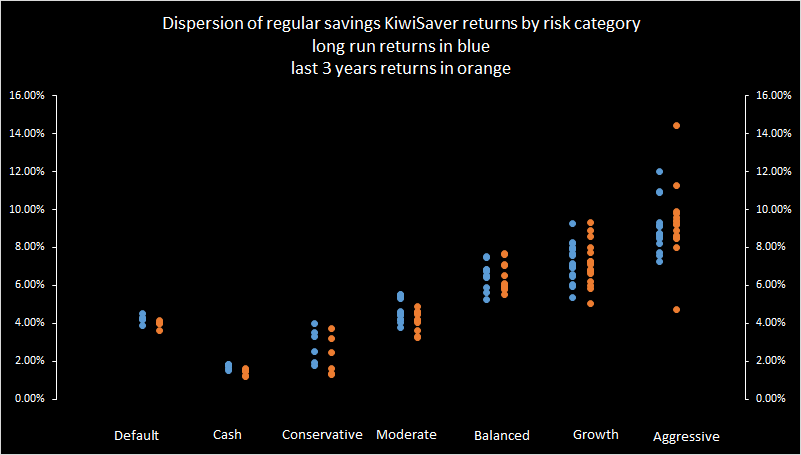
Return range of all funds, as at September 2018
Here are the updated results for default funds.
| Default Funds |
Cumulative $
contributions
(EE, ER, Govt)
|
+ Cum net gains
after all tax, fees
|
Effective
cum return
|
= Ending value
in your account
|
Effective
last 3 yr
return % p.a.
|
|||
| since April 2008 | X | Y | Z | |||||
| to September 2018 |
$
|
% p.a.
|
$
|
|||||
|
|
|
|
|
|
||||
| Mercer Conservative | C | C | C | 33,253 | 8,613 | 4.5 | 41,866 | 4.1 |
| ANZ Default Conservative | C | C | C | 33,253 | 8,163 | 4.3 | 41,416 | 3.6 |
| ASB Conservative | C | C | C | 33,253 | 7,953 | 4.2 | 41,205 | 4.0 |
| FisherFunds2CashEnhanced | C | D | C | 33,253 | 7,932 | 4.2 | 41,185 | 4.1 |
| AMP Default | C | C | C | 33,253 | 7,239 | 3.9 | 40,492 | 4.0 |
| Funds with a later start date ... | ||||||||
| BNZ Conservative | C | C | C | 20,695 | 2,598 | 4.1 | 23,292 | 4.2 |
| Kiwi Wealth Default | C | C | C | 15,951 | 1,414 | 3.9 | 17,365 | 4.1 |
| Booster Default Saver | C | C | C | 15,951 | 1,310 | 3.7 | 17,262 | 3.8 |
| Westpac Defensive | C | C | C | 15,951 | 1,290 | 3.6 | 17,241 | 3.7 |
| --------------- | ||||||||
| Column X is interest.co.nz definition, column Y is Sorted's definition, column Z is Morningstar's definition | ||||||||
| C = Conservative, D = Defensive | ||||||||
If you are not about to retire in the next few years, you should seriously review why you are in a default fund. We will review the track record performance of other classes of KiwiSaver funds over the next week or so, but being in KiwiSaver is a long term commitment and you should be applying long-term strategies to this investment.
That may well mean accepting some higher level of risk to gain a higher level of returns. Over a long-term, that is usually a sensible strategy. Sure, bumps in the road do come around (like the Global Financial Crisis) and they can knock growth fund returns. But as we have seen post-GFC, the bounce-back can turbo charge your results.
Here is where these managers have your default funds invested.
| Allocation, approx. | Mercer | ANZ | ASB | FF2 | AMP | BNZ | Kiwi Wealth |
Westpac | Booster |
| % | % | % | % | % | % | % | % | % | |
| Cash | 34.6 | 22.1 | 23.7 | 21.1 | 46.9 | 38.4 | 38.9 | 34.4 | 27.7 |
| NZ fixed income | 14.9 | 17.6 | 32.6 | 38.3 | 16.5 | 10.1 | 17.6 | 22.9 | 27.9 |
| Intl fixed income | 29.3 | 39.9 | 23.8 | 22.9 | 16.3 | 31.5 | 23.6 | 23.3 | 23.9 |
| NZ/Aust equities | 3.7 | 5.2 | 10.1 | 5.1 | 7.2 | 6.0 | 0.5 | 7.6 | 5.6 |
| Intl equities | 13.8 | 12.0 | 9.8 | 7.5 | 13.1 | 14.0 | 19.4 | 8.5 | 13.9 |
| Listed Property | 0.4 | 3.2 | 3.3 | 1.0 | |||||
| Unlisted Property | 1.3 | 5.1 | |||||||
| Other | 2.1 | ||||||||
| ---- | ---- | ---- | ---- | ---- | ---- | ----- | ----- | ---- | |
| 100 | 100 | 100 | 100 | 100 | 100 | 100 | 100 | 100 |
If you want your money allocated differently, you will need to change funds, either with the same manager, or with another. But before you do that, get some proper investment advice from someone who understands your investment goals and tolerance for risk. That involves work on your part. But it's not a good excuse to just leave it there because it seems too much effort.
KiwiSaver default funds are only part of a broader range of conservative funds available. Many of the 'traditional' conservative and cash funds are under performing the default funds. We will look at the rest of the conservative funds in another article.
For explanations about how we calculate our 'regular savings returns' and how we classify funds, see here and here.
There are wide variances in returns since April 2008, and even in the past three years, and these should cause investors to review their KiwiSaver accounts especially if their funds are in the bottom third of the table.
The right fund type for you will depend on your tolerance for risk and importantly on your life stage.
You should move only with the appropriate advice, and for a substantive reason.
We welcome your comments below. If you are not already registered, please register to comment
Remember we welcome robust, respectful and insightful debate. We don't welcome abusive or defamatory comments and will de-register those repeatedly making such comments. Our current comment policy is here.