
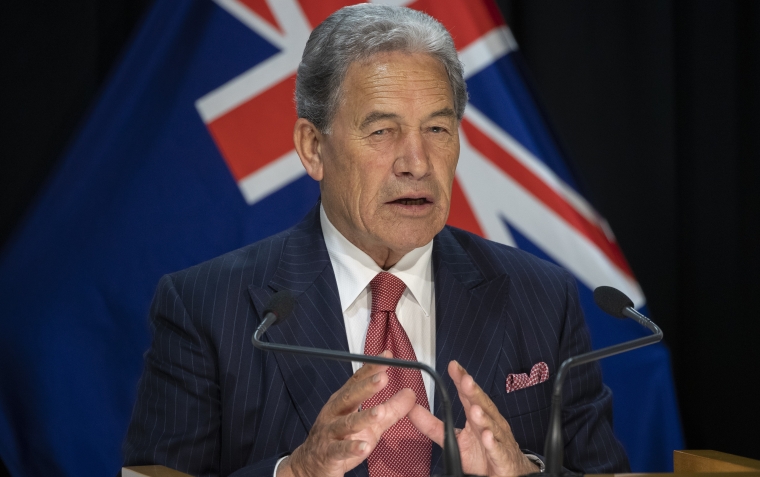
Foreign Affairs Minister Winston Peters has revealed Cabinet went against Ministry of Health advice by deciding to let travelling New Zealanders back into the country in March/April.
Peters said the Ministry recommended a “total shutdown of the border, including to returning New Zealanders”.
He said Cabinet rejected the advice because “it was and is inconceivable that we will ever turn our backs on our own. So, on March 17, New Zealanders were urged to come home while commercial options remained available.”
Defending Cabinet’s position was the main point of a speech Peters delivered on Wednesday, pitched to media as being on New Zealand’s “foreign policy response to COVID-19”.
With the Ministry’s advice only expected to be released in full next week, Peters appeared to be front-footing the contentious issue for political reasons.
He couldn’t say exactly when the Ministry wanted the border closed to New Zealanders, or whether it proposed a more staggered approach before a full shutdown.
Director General of Health, Ashley Bloomfield, in a press conference later said the Ministry wanted a full closure temporarily, until there was a secure process in place to isolate and quarantine arrivals.
25 travellers quarantined by government found to have COVID-19
Since March 14, around 80,000 New Zealanders have travelled home.
It wasn't until April 10 that all arrivals were made to go into government-managed quarantine for at least 14 days. On March 25 Prime Minister Jacinda Ardern said arrivals with COVID-19 symptoms and those who didn't have proper self-isolation plans would be put in government-managed quarantine.
There are currently 3,241 arrivals in government-managed quarantine. 25 people in these facilities have tested positive to COVID-19.
Ardern said Cabinet "never entertained" the idea of shutting kiwis out of New Zealand.
“It is an extraordinary thing to deem someone stateless," she said.
Peters made his speech against a backdrop of both himself and Australian politicians speaking of a trans-Tasman bubble at some stage being formed, enabling managed travel between the two countries.
He couldn’t say how much had been spent on repatriation flights to get New Zealanders home.
Direction of travel for New Zealand's foreign policy unclear
Peters didn’t provide any detail on how New Zealand’s foreign policy would evolve due to COVID-19, but did stand by a nationalist speech he delivered while wearing his New Zealand First leader hat on Tuesday.
“In 1882, our first export of frozen meat left New Zealand and confirmed that we were going to be then, and thereafter, an export nation. All our policy should be focused on that as well as import substitution,” Peters said on Tuesday.
“We're going to go back, dare I say it, to make New Zealand the great country it has been in the past, not because we have some nostalgic dream, but because in past times our country got it right. And of late, for far too long before this happened, as we tried to change our economy, we've been getting it wrong.
“New Zealand has enormous wealth and natural products above ground, below ground, and at sea, and it has, as the Prime Minister has referred to, a truly amazing people when put to the test.”
Notwithstanding this, Peters said he was on the same page as Trade Minister David Parker.
“We’ll soon be discussing with our Cabinet colleagues how New Zealand positions itself in the new normal that emerges post this COVID crisis,” Peters said.
Here's a full copy of Peters' Wednesday speech:
On behalf of the Coalition Government, and as responsible Minister, we extend our thanks to Secretary of Foreign Affairs and Trade Chris Seed and his team of dedicated diplomats, consular officials and other professionals working on behalf of their country.
We are very proud of your performance.
We acknowledge criticisms of the government’s efforts from individual citizens caught in difficult situations offshore, and by the media on their behalf. That is natural but sometimes the anecdotal can shade the larger response effort.
So, today offers an opportunity to explain the foreign policy dimension to choices the government has made in its COVID-19 response.
One criticism is that we should have closed our border sooner, that we did too little too late.
Another criticism was that the government’s response has been too myopic and captured by advice from the Ministry of Health. Both critiques could not be further from the truth.
We went hard and we went early.
International comparisons show that New Zealand was extremely unusual in closing its borders to foreigners and in implementing a lockdown before we lost a single person to COVID-19.
Very few other countries did that.
More generally, we were faster than countries we generally compare ourselves with, to:
• Require self-isolation by international arrivals, 17 days after the first Covid-19 case was confirmed;
• Close our borders to foreign nationals, 20 days after the first confirmed case, and;
• Impose a lockdown, 26 days after our first case.
These decisions were neither straightforward nor without debate.
Indeed, the Ministry of Health recommended a total shutdown of the border, including to returning New Zealanders. From its health perspective this was understandable and appropriate advice.
But the Coalition Cabinet rejected that advice because it was and is inconceivable that we will ever turn our backs on our own. So, on March 17, New Zealanders were urged to come home while commercial options remained available.
We built from scratch managed isolation and quarantine systems to mitigate against the heightened health risk posed by returning New Zealanders.
It was the right thing to do.
Around 80,000 New Zealanders have so far answered that call and travelled home since 14 March. Many thousands of those returning were assisted by MFAT.
This assistance has ranged from chartering planes to fly stranded New Zealanders home; getting Kiwis on to repatriation flights run by our partners, including Australia, Singapore and the United Kingdom; smoothing transit issues; and providing advice about travel options.
The managed exit of foreign citizens stranded here was another complex decision. The domestic movement of thousands of people risked our national health goals.
But one of the underpinnings of relations between nations is reciprocity. That is, we expect other countries to help return our people to New Zealand – so it would be wrong and dangerous to prevent foreign nationals from leaving here.
Cabinet rightly decided that, despite advice raising risks about the potential negative health consequences of such a decision, we needed to safely manage the exit of foreign nationals. So we did.
Around 45,000 foreign nationals departed our shores during the Level 4 lockdown.
Through these experiences we have built an effective delivery system for people safely entering and exiting the country, now and into the future.
Notwithstanding the ongoing massive consular effort, MFAT was also tasked three weeks ago with considering our post-COVID foreign policy priorities – and how we could use our foreign policy to support the domestic recovery and trade recovery that are starting to get underway.
Along with Minister of Trade David Parker, we’ll soon be discussing with our Cabinet colleagues how New Zealand positions itself in the new normal that emerges post this COVID crisis.
How we adapt internationally, how quickly, and how effectively, is crucial in promoting the peace and prosperity of New Zealand, and its regions, as it recovers from the massive disruption of COVID-19.
We welcome your comments below. If you are not already registered, please register to comment
Remember we welcome robust, respectful and insightful debate. We don't welcome abusive or defamatory comments and will de-register those repeatedly making such comments. Our current comment policy is here.