

ANZ's Business Outlook Survey for March has found that business confidence is falling, as is the outlook for future activity, while cost pressures are still building.
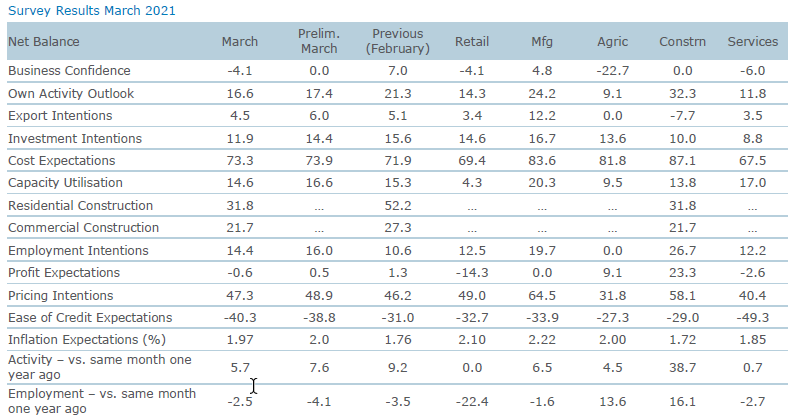
ANZ's chief economist Sharon Zollner said compared with February, headline business confidence fell 11 points to a net -4%, while firms’ own activity outlook fell 4 points to 17%.
“Business sentiment and activity indicators ticked down in March, consistent with our view that the economy would start to struggle a bit more as the lack of tourists reached its seasonal cash-flow peak impact and the unsustainable bounce in retail spending started to dissipate,” she said.
“The levels remain relatively robust but may have peaked for now."
“All forward-looking activity indicators were lower in the second half of the month. The preliminary results [released on March 9] would not have captured the full lockdown impact.”
Some of the detail from the survey:
- Business confidence fell 11 points to net -4.1% (prelim: 0.0%).
- Firms’ own activity outlook fell 4 points to 16.6% (prelim: 17.4%).
- Investment intentions fell 4 points to 11.9% (prelim: 14.4%).
- Employment intentions lifted 4 points to 14.4% (prelim: 16.0%).
- Capacity utilisation was little changed at 14.6% (prelim: 16.6%).
- Inflation pressure remains high. General inflation expectations rose to 1.97% (prelim: 1.95%).
- Cost expectations rose 1 point to a net 73.3% of respondents reporting higher costs (prelim: 73.9%). And more than 80% of firms in the construction, manufacturing and agriculture sectors expect higher costs.
- A net 47.3% of respondents intend to raise their prices, a historically very high level.
- Firms are more-or-less equally divided on whether profits will rise or fall from here at 0.6% (prelim: +1%).
- Export intentions were little changed at a net 4.5% (prelim: +6.0%).
- A net 40.3% of firms expect credit to be harder to get (prelim: -39%).
- Residential construction intentions fell 20 points, with a net 32% of firms expecting higher activity. Commercial construction intentions fell 5 points, with a net 22% of firms expecting higher activity.
- When it comes to firms’ current level of activity compared to a year earlier, construction remains the outlier, with other sectors back to par. However, there were signs of moderation in the construction sector, with decent falls across a range of activity indicators (particularly employment), while cost pressures continue to build.
Zollner said freight disruptions "remain problematic".
"Inward freight disruptions are most problematic for manufacturing and retail, though the latter improved slightly. Outward freight disruptions are generally less of a problem, but are worst for agriculture (and worsened considerably over the month) and manufacturing."
In March, firms reported that finding skilled labour remains their largest problem (and it’s getting worse) followed by regulation/paperwork and competition (though this improved). Low turnover is in fourth place, though a decent step back, Zollner said.
“We also ask firms every three months about what’s driving their investment decisions. Unsurprisingly the domestic economy remains a clear #1, but in terms of changes compared to three months ago, spare capacity and labour costs are becoming more important, while credit availability is slightly less of a driver.
“The March snap lockdowns make Business Outlook data a little harder to interpret. However, it is consistent with our view that as the demand overshoot wanes and the tourists are missed more and more, the economy will go largely sideways this year.
“The quicker cooling we now expect in the housing market plays into this theme as well. The vaccine rollout and the subsequent border re-opening will be game-changers, though it won’t be click-of-a-switch stuff.
“But there’s a path to the new normal, whatever precisely that looks like, and we’re on it. We’ll be keeping an eye on construction for possible bumps in the road," Zollner said.
We welcome your comments below. If you are not already registered, please register to comment
Remember we welcome robust, respectful and insightful debate. We don't welcome abusive or defamatory comments and will de-register those repeatedly making such comments. Our current comment policy is here.