
By Alex Tarrant
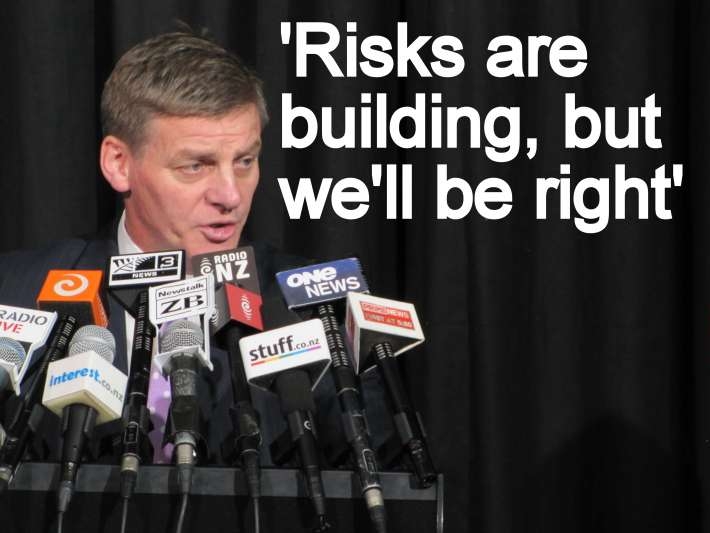
Risks are building for New Zealand’s economy as the sovereign debt crisis in Europe worsens, with stronger than expected domestic economic growth in the short-term at risk from what is shaping up to be a weaker outlook over the medium-term, Finance Minister Bill English says.
Bigger than expected economic challenges in Australia could mean demand for New Zealand exports will come off, while jitters in global financial markets were a risk for the government and banks here due to their reliance on access to international funding lines, English said.
The government was working to keep its own net debt below 30% of GDP, while trying to enact policies that would not put upward pressure on interest rates, English said. This, along with the possible economic slowdown, could mean interest rates stayed at their current low levels for longer.
The latest news from Europe is that larger nations like Germany are preparing to let Greece default on its government debt, after hundreds of billions of dollars were spent on bailout packages to try and stop just that. See more here in Bernard Hickey's 90 seconds at 9am.
Concerns around the fiscal strength of Italy, Spain, Portugal and Ireland continue to linger and grow, while anger grows in Germany and France where voters are growing more and more disenchanted with political leaders and their response to the Eurozone’s economic woes.
'Concerned, but it's not too serious'
Speaking to media in Parliament buildings after Question Time on Tuesday, English said what was happening in Europe had been building up for some time because they had not been able to find a solution to problems created by enormous debt and a single currency.
“For New Zealand, our vulnerability is that the financial markets where we’re borrowing could be disrupted,” English said.
“We’re in better shape now to handle that than we were three years ago, so while we’re concerned about it, we don’t see disruption there as a really serious threat,” he said.
Aussie worries
New Zealand’s largest trading partner Australia had economic challenges “more than we probably expected 12 months ago.” Europe wasn’t looking too flash, while the US was struggling to recover from the global financial crisis.
“That means that demand for our products is probably likely to be less than we expected just six months ago,” English said.
“So we face a couple of risks: One is the risk of disruption in financial markets where we borrow, and the other is the risk of less demand for our products,” he said.
In terms of Treasury’s budget forecasts released in May, the mix was different in terms of economic performance over the medium-term.
“I think the shorter-term economic performance has been a bit better than it was probably expected in the budget – there’s more new jobs and more growth in the domestic economy than we thought just six months ago,” English said.
“But looking two or three years out, maybe there’ll be a bit less growth. But we’ll get some indication of that from the Reserve Bank this week, when they’ll publish a set of forecasts, and then Treasury in the pre-election update,” he said.
'News just getting worse'
Earlier in Question Time in Parliament, English noted the news coming out of Europe continued to get worse.
“There are ongoing worries that a number of countries, starting with Greece, may be forced to default on their government debt. The resulting losses would affect the soundness of European banks and possibly send Europe back into recession,” English told the House.
“Europe still accounts for 13% of our merchandise exports, so any economic weakness in Europe is not good news for New Zealand. There’s also the possibility that the financial markets in which the New Zealand government and New Zealand banks borrow could be disrupted at times,” English said.
'Interest rates lower for longer'
Since 2008, the government had sought to reduce New Zealand’s vulnerability to the markets in which it borrowed, with the Reserve Bank ensuring banks were more sound than they were back then, English said.
“The government has also worked to sure up its own position at the same time as dealing with the recession, by aiming to keep net debt below 30% [of GDP], to do what it can to keep interest rates low, to continue to protect the most vulnerable, but also begin the task of making our export sector as competitive as possible so that regardless of what happens in Europe, New Zealand can continue to increase jobs and incomes,” English said.
Households had benefitted through job growth and low interest rates for mortgages, which had almost halved over the last three years from about 11% to 6%, he said.
“That is worth around NZ$200 per week, or NZ$10,000 per year to a borrower with a typical mortgage. On current trends, we should be able to keep lower interest rates for longer.”
(Updates with further comments from English, 'interest rates lower for longer').
10 Comments
English has maybe finally said to the pointy heads..."enuff of the crap, tell me how it really is"...or he has left out one other risk.....the risk that the public will no longer believe the BS and spin!
Forget the 170ooo jobs...it will be enuff just to hold the line...and did anyone ask him if he would stop allowing the currency to be debased?.....not a friggin peep.
As the banks start the haircut era that will expose them for what they are...and no doubt wipe many from the market...expect those which survive to drive higher the cost of their credit...leading to mortgage rates here going higher. It is what banks do when the stuff hits their bottom line..they move fast to grab more cash.
Maybe, just maybe, if BE really knew what he was doing, showed some common sense and intelligence, put aside his political ideologies and need to keep feeding from the trough, he wouldn't have to say anything to the pointy heads. He could've figured it out himself a long time ago and done something about it.
Oh I agree with you meh. I am sure he still thinks it's possible to borrow the country out of debt...feck me!
No I dont think he's said to the pointy heads "tell me how it is", I think he's known for a long while....he's finally admitting publicly that the EU/Greece is all but ready to implode and take the global economy with it....so he had thechoice of continue to deny the risks and look a baffoon when it blows, or try and keep some credibility....he finally did the latter....
"public no longer believe" actually I think joe and jane public have their heads in the sands....they desperately want to not have to believe its all falling apart because then its the "Great Austerity" where their over-valued house loses 50% (if not more) and we see double the un-employment we have now.....etc etc....
Banks haircuts, you really think they will and the losses wont be socialised onto us? get ready to be shafted.....
regards
The timing of this suggests a fear that the wheels may fall off the economic stats BEFORE the election. That wasn't in the plan - not at least until 2012.
So, as I have said before, the name of the game now becomes passing the blame - regardless that it was clear that what is about to happen was obvious from late 2008.
Spending to keep up entitlements (and confidence) was always a dumb idea - Bill and John have stuffed up big time and that appears to be coming home to roost earlier than expected.
"before the election" good point, I suspect you are right....
"Spending to keep up entitlements (and confidence) was always a dumb idea" now this is where we dont agree....taxes should rise to cover spending...and yes, hence "coming home to roost".
regards
I am surprised you support "spending to keep up entitlements". Maybe we differ on what we understand as an entitlement.
The following illustrate some of the sorts of entitlements that Bill understands he is borrowing to support:
- http://www.nzlotteries.co.nz/wps/wcm/myconnect/lotteries2/nzlotteries/G…
- http://www.interest.co.nz/opinion/55372/bernard-hickey-talks-marcus-lus…
- The major investors in South Canterbury Finance
Ha ha - what a surprise !! No-one with any intelligence believed their ridiculous budget forecasts anyway - growth of 4% - what a joke.
National are just a bunch of complete incompetents. Yes, big probs ahead - will be interesting to see when the general populous cotton onto the fact that National have been telling porkies and their policies have achieved nothing since they got to power.
OMG - it is increasingly embarrasing living in this country. Incompetent Governments for years. The debacle with Friday's transport to the World Cup. 25% of children in poverty. One of the world's highest youth sucide rates.
NZ used to be a great place to live - it has gone markedly down the tubes (and is continuing to do so on a daily basis). The "she''ll be right" attitude drives me nuts. NO - I don't think it will actually.
That's why we're headed back across the ditch - permanently - early next year. Sell the house and pull our equity out before the shit really hits the fan. I reckon its only a matter of time before NZ is downgraded by the credit agencies as we struggle to pay off that huge debt round our neck (created - in part - because National thought they should give the rich a 6% tax cut).
As an immigrant I used to really love this country - unfortunately it is being destroyed by hopeless politicians with no foresight beyond their 3 year term in office, banks and the rich.
Ha ha - what a surprise !! No-one with any intelligence believed their ridiculous budget forecasts anyway - growth of 4% - what a joke.
National are just a bunch of complete incompetents. Yes, big probs ahead - will be interesting to see when the general populous cotton onto the fact that National have been telling porkies and their policies have achieved nothing since they got to power.
OMG - it is increasingly embarrasing living in this country. Incompetent Governments for years. The debacle with Friday's transport to the World Cup. 25% of children in poverty. One of the world's highest youth sucide rates.
NZ used to be a great place to live - it has gone markedly down the tubes (and is continuing to do so on a daily basis). The "she''ll be right" attitude drives me nuts. NO - I don't think it will actually.
That's why we're headed back across the ditch - permanently - early next year. Sell the house and pull our equity out before the shit really hits the fan. I reckon its only a matter of time before NZ is downgraded by the credit agencies as we struggle to pay off that huge debt round our neck (created - in part - because National thought they should give the rich a 6% tax cut).
As an immigrant I used to really love this country - unfortunately it is being destroyed by hopeless politicians with no foresight beyond their 3 year term in office, banks and the rich.
what a joke NZ has become, just read this news about the RWC farce in Auckland:
http://www.nzherald.co.nz/rugby-world-cup-2011/news/article.cfm?c_id=522&objectid=10751502
that guy Mike Lee is a moron!
We welcome your comments below. If you are not already registered, please register to comment
Remember we welcome robust, respectful and insightful debate. We don't welcome abusive or defamatory comments and will de-register those repeatedly making such comments. Our current comment policy is here.