
Here's my summary of the key events over the weekend that affect New Zealand.
The international Demographia annual survey is out today for September 2016 and 7 of 8 New Zealand cities feature in its "most unaffordable" rankings. Demographia's data is a little suspect and a little dated but the overall general relationship is probably about right and it is the only international study in this detail. According to this metric, the most unaffordable city in their rankings is Hong Kong, followed by Sydney, Vancouver, Santa Cruz, CA, Santa Barbara, CA, then Auckland as #6. Last year Auckland was ranked #5. (You can find a more up-to-date review of "median multiples" for most New Zealand urban areas here and since the Demographia survey, we find the trend is turning.)
China's currency outflows have changed from a flood to a trickle with less than -US$1 bln in December and far less than the fast outflows reported in the previous seven months. New regulations and limits are having a dramatically quick impact on the ability of Chinese citizens to move money out of the country. That’s less than 2% of the record amount in September, and compares with an average outflow of -US$25.8 billion a month in 2016.
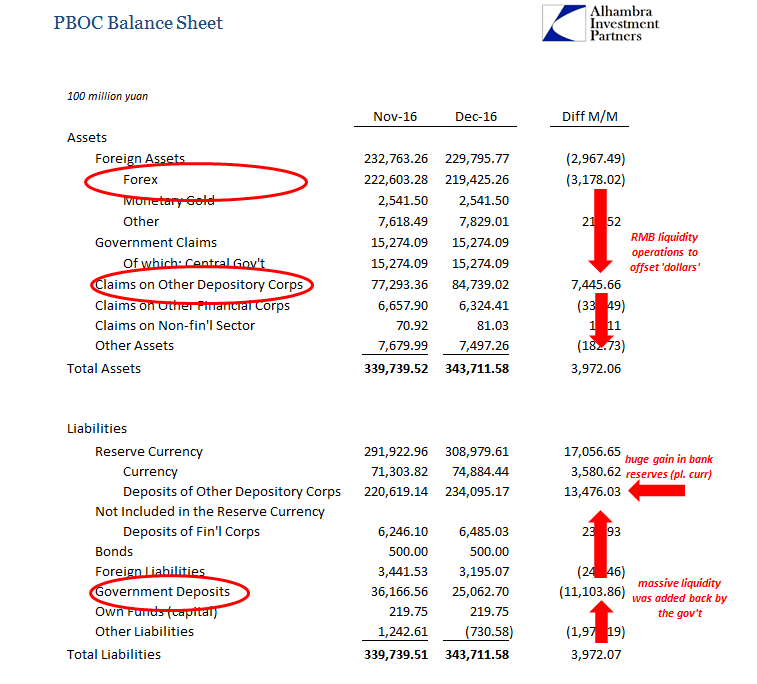
And staying in China, we are approaching the week-long Chinese New Year holidays, a time when banking system liquidity undergoes major stresses. This year their central bank has decided to offer major banks a 28 day liquidity facility to help them cope. It is hard to know why the regulator needs to provide such support when the banks know the stress period is coming. They should be making their own arrangements without using the public treasury.
In Europe, there is growing nervousness about real estate valuations. These are highly correlated to bond yields and as those yields rise, property valuation are very likely to fall. In fact, that is what the Europeans are now finding. A key indicator is now on the verge of falling below a technical threshold that has acted as a support since 2009, which would be a strong bearish signal. These market basics probably apply here too. The NZX Property index is now +13.6% higher than when it was formed in June 2015, and may come under similar pressures as yields rise.
Over in Melbourne ANZ is busy preparing its wealth business for sale. And all sorts of European, Japanese, and American businesses are lining up to bid to buy this division. The AFR is reporting that Goldman Sachs is doing the selling for ANZ, and that there is "pressure" to sell the life insurance part separately from the 'wealth' part. Last November ANZ group CEO Shayne Elliott said ANZ's NZ wealth business "will be considered separately" from ANZ's Australian wealth operations "during 2017."
In New York, the UST 10yr yield actually rose to over 2.51 on Friday, but then slid and will open this week at 2.47%.
Oil prices are a little higher today, now up to just over US$53 for the US benchmark, while the Brent benchmark is now just on US$55.50 a barrel. There was a big jump in the number of new wells brought back into production in North America last week. In fact it was the largest gain in 285 weeks, and the second largest in over ten years. Meanwhile, OPEC is claiming their output restraint is ahead of target. OPEC seems to be just making space for American frackers to profit.
The gold price rose just ahead of the swearing in of the new US Administration and is now just on US$1,210/oz. History shows that gold prices rise +15% in the first year of a new President in the US. But there are exceptions; that didn't happen for Reagan, nor for either of the two Bush's.
The New Zealand dollar has moved very little over the weekend and will open at 71.7 US¢. On the cross rates it is at 94.8 AU¢, and against the euro at 67 euro cents. The NZ TWI-5 index is at 77.5.
If you want to catch up with all the changes on Friday, we have an update here.
The easiest place to stay up with event risk today is by following our Economic Calendar here ».
We welcome your comments below. If you are not already registered, please register to comment
Remember we welcome robust, respectful and insightful debate. We don't welcome abusive or defamatory comments and will de-register those repeatedly making such comments. Our current comment policy is here.