
By Gareth Vaughan
No sooner had the government appointed Tax Working Group (TWG) issued its interim report on Thursday morning than attacks from opposition National Party MPs started flowing.
On Twitter National leader Simon Bridges said; "Labour wants Kiwis to pay more tax, they are just working out how to do it." In a press release carrying the headline "Capital gains tax still hangs over New Zealand," National's finance spokeswoman Amy Adams concluded by saying; “In typical Labour style, this is a Government that clearly thinks it knows how to spend your money better than you do.”
And Paul Goldsmith, National's spokesman for economic and regional development, decried; "Govt won’t rule out tax grab on retirement savings."
TWG chairman Michael Cullen, Finance Minister in the Labour-led government from 1999 to 2008, would - of course - have expected this. So to what extent is Cullen conscious recommendations the TWG makes could give the Opposition ammunition with which to attack the Government?
"Yes, I know and it's a problem and [there's] the old saying 'no one has won an election proposing a capital gains tax'," Cullen told interest.co.nz.
"One of the reasons I've insisted that we've got to be as detailed as we can is that the less detail there is in any proposition, the more there is the possibility of creating mischief by misrepresenting what the likely outcome will be."
"So we can talk about what we're going to tax, but have you taken into account rollover relief, have you taken into account what would be deductible against that capital income gain...all those kinds of issues tend to get skipped over very, very lightly," says Cullen.
"I think to some extent opinion is shifting on some of these matters. People are beginning to realise there are genuine equity issues," Cullen adds. "You know somebody earning part of their income from capital income, somebody else fully from labour income, they've got the same income but the second person totally on labour income pays more tax than the first person. Is that fair? Well ...I think that's not actually fair."
"Because we don't tax very much capital income in New Zealand that reduces the extent to which our tax system is redistributive compared with most other developed economies we're right down the bottom end of redistribution through the tax system in New Zealand by developed economy standards," Cullen continues.
"So you've got the over investment in housing from the fact that it has been tax advantaged. There are lots of different issues that people are starting to come to grips with."
"I just wish the National Party people would take a bit longer to think about it and about the long-term sustainability issues of the tax system before pushing the short-term politics boat out," says Cullen.
He notes, however, the National Party in some cases - such as GST - has reversed its initial opposition, and in others - such as foreign dividends tax on investments outside Australasia - left changes made by Labour-led governments it opposed unchanged when National followed in government. As the political father of KiwiSaver, Cullen's also well aware of National's initial opposition to the savings scheme.
For its final report due in February Finance Minister Grant Robertson has asked the TWG to include measures that could result in a revenue neutral package.
The 'inequality-reducing power' of tax
According to the TWG interim report, the "inequality-reducing power" of the tax and transfer system has dropped over the past three decades, reflecting that the tax system and the transfer system have both become less effective at reducing inequality.
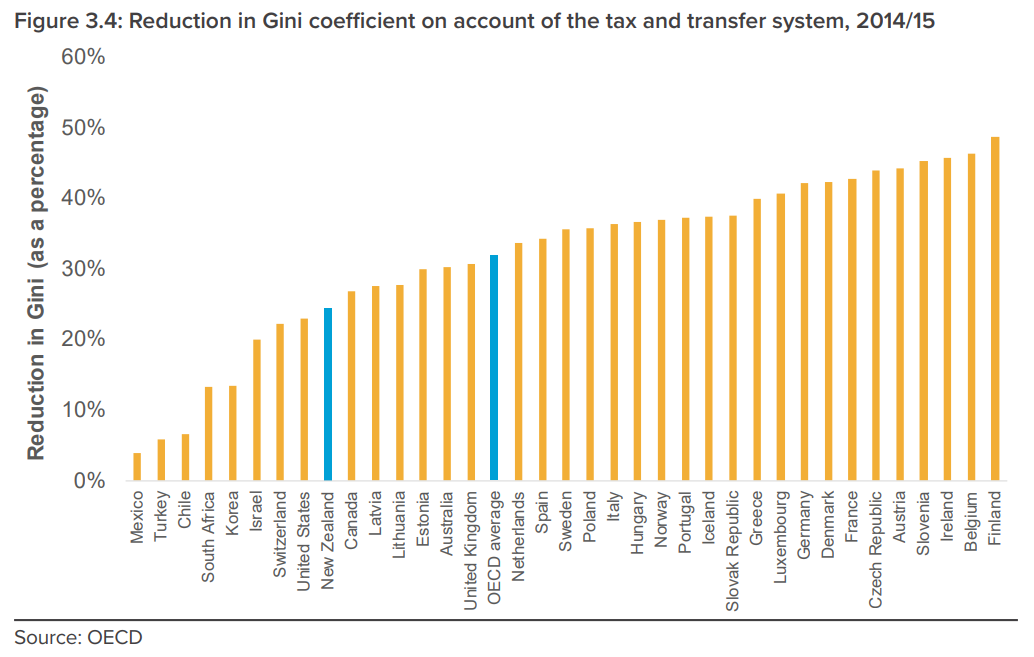
"It is difficult to make cross-country comparisons on this issue, because the outcome may be affected by choices about which taxes are included and which are excluded for the purposes of the analysis. Figure 3.4 [below] is based on the OECD Income Distribution database; it includes personal income taxes, employees’ social security contributions, and cash transfers, but excludes payroll taxes and value-added taxes (including GST)," the TWG report says.
"Figure 3.4 illustrates that New Zealand’s tax and transfer system reduces income inequality, but by less than is the case in Australia, or on average across the OECD. The progressivity of the tax system is also affected by the treatment of capital income. The incomplete taxation of capital income benefits the wealthy, whereas the absence of large concessions for retirement saving is a more progressive feature of the system."
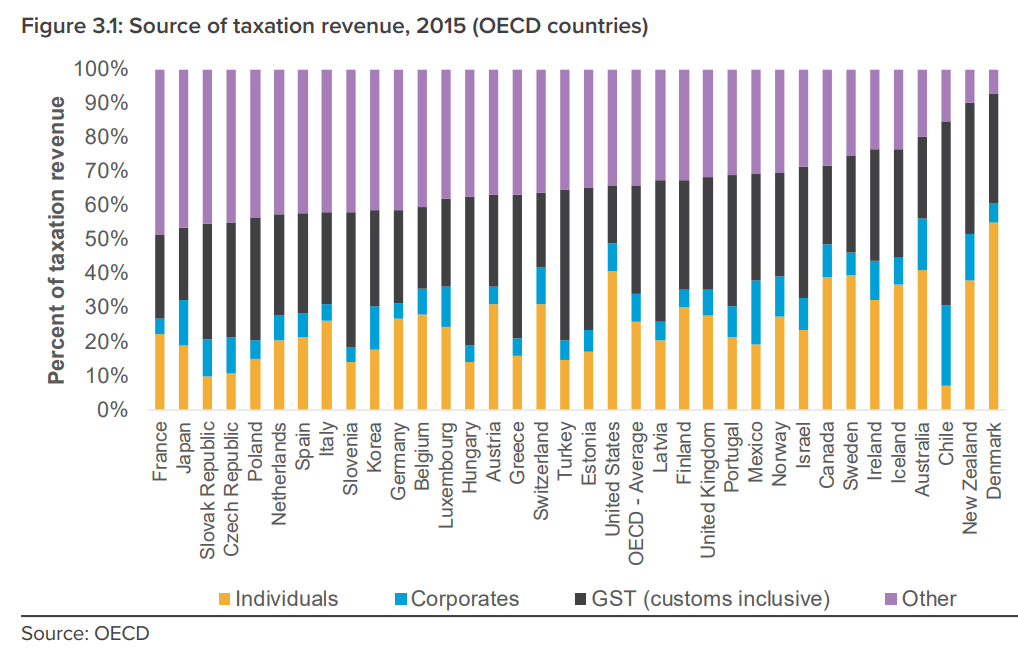
The chart below shows three forms of tax dominate NZ tax revenue.
Below are Bridges' tweets.
Re the Tax Working Group & a capital gains tax: Labour wants Kiwis to pay more tax, they are just working out how to do it
— Simon Bridges (@simonjbridges) September 19, 2018
New Zealanders are already being hammered through higher petrol prices & rents, & cost of living outstripping wage growth under Labour. Yet more taxes on top of the new ones they've piled on are the last thing we need!
— Simon Bridges (@simonjbridges) September 19, 2018
Here's Adams' press release.
Capital Gains Tax still hangs over NZ
Today’s report from the Tax Working Group will do little to reduce fears that more taxes are going to be imposed on New Zealand households and businesses, National’s Finance spokesperson Amy Adams says.
“Despite being given the opportunity to do so, the Government has refused to confirm its tax plans will be fiscally neutral. But this supposed review of the tax system shouldn’t be used as a stalking horse for higher taxes.
“Costs of living are already going up through higher petrol prices and rents, and outstripped wage growth in the last quarter. New Zealand families and small businesses deserve to know if this Government is softening us up for more taxes like a Capital Gains Tax.
“National welcomes the TWG ruling out a land tax or a wealth tax and not tampering with GST but is deeply concerned that the group clearly plans to bring in a Capital Gains Tax.
“The report is a missed opportunity to consider better ways to have the tax system incentivise savings and investment, lift productivity and help small businesses to grow.
“It isn’t good enough for the Government to say any recommendations it takes up won’t come into force until 2021. Taxes already take more of our income than in almost any country outside of Europe, amounting to $50,000 a year on average per household. And the tax take is already set to double by 2032 even before new taxes are added.
“Rather than working out ways to take more money from New Zealanders, the better approach would be to stop the low-quality and untargeted spending we are seeing all too often.
“National believes New Zealanders should be able to keep more of what they earn. The tax system should encourage productive investment and savings, not penalise those who try to get ahead.
“In typical Labour style, this is a Government that clearly thinks it knows how to spend your money better than you do.”
And here's Goldsmith's press release.
Govt won’t rule out tax grab on retirement savings
The Finance Minister is refusing to rule out a tax grab on the retirement savings of hard-working New Zealanders, National’s Economic and Regional Development spokesperson Paul Goldsmith says.
“When asked directly in the House today if he could rule out putting more tax on Kiwi savings, Grant Robertson was unable to give a straight answer and was only prepared to say it was a work in progress.
“Taxing KiwiSaver more is the last thing we need. It won’t help Kiwis get ahead.
“There are now 2.87 million New Zealanders invested in Kiwisaver funds and their combined nest egg has grown to more than $50 billion. The Government should be re-assuring Kiwis that it won’t raid their long-term savings to bankroll its excessive spending plans.
“Currently the capital gains element of retirement savings isn’t taxed, which is an obvious part of the incentive to save.
“The working group has recommended a package of modest incentives to encourage low and middle-income people to save more for their retirement. But it would be disingenuous for the Government to appear to be giving with one hand while intent on taking much more with the other, via a tax on capital gains.
“Rather than devising ways to take more money from New Zealanders, the Government should be reining in its low-quality and untargeted spending.
“National believes New Zealanders should be able to keep more of what they earn. The tax system should encourage productive investment and savings, not penalise those who try to get ahead.”
Cullen responded to the issues raised by Goldsmith in this Newshub interview, saying there was still a lot of detail to be worked through, and the TWG would look at ways to offset taxes on KiwiSaver savings.
"We don't want to end up with a reduction in the returns to low and middle income earners in KiwiSaver. One of the best ways of doing that of course... is to look at much heavier regulation of the fees they charge in KiwiSaver schemes," Cullen told Newshub, adding there's no reason providers should be "clipping the ticket" to the tune of more than 0.5%.
*This article was first published in our email for paying subscribers early on Monday morning. See here for more details and how to subscribe.
We welcome your comments below. If you are not already registered, please register to comment
Remember we welcome robust, respectful and insightful debate. We don't welcome abusive or defamatory comments and will de-register those repeatedly making such comments. Our current comment policy is here.