

By Bernard Hickey
Economists and the Reserve Bank broadly expect the Official Cash Rate (OCR) and floating mortgage rates to rise around 2-3% over the next two years, while house prices are expected to rise in line or slightly below inflation of around 2%.
Fixing or floating is seen as a close call and is dependent on a borrower's view on how quickly interest rates rise and their desire for certainty, although some economists have called this week to fix because they think interest rates will rise sooner and higher\
Most economists now expect the Reserve Bank to start increasing the OCR from its record low level of 2.5% from September 15 and to lift it to around 4.5% by the end of 2012. BNZ sees the OCR rising to 5% by the end of 2012. Westpac sees the OCR raised to 6% by the end of 2013. Both have said now is the time to fix. ANZ National expects the OCR to rise to 4% and says floating remains best, while ASB sees it rising to 4.5% and that floating is better for now.
Stronger than expected GDP growth and inflation figures in mid July have prompted some economists to pull forward or harden up their views on when the Reserve Bank will next hike rates. The Reserve Bank's decision on July 28 to leave the OCR on hold but to signal the removal of its March 10 rate cut has pulled forward the first rate hike to September 15. See our July 28 article on the OCR decision and the reaction of economists.
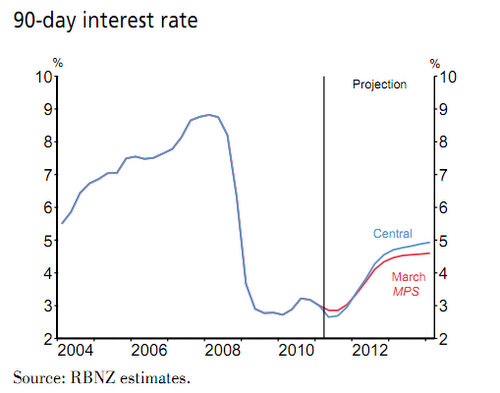
The Reserve Bank itself forecast in early June that the 90 day bill rate, which is typically around 0.2% above the OCR, will rise around 2% to 4.6% by end of 2012. That would imply floating mortgage rates rising to around 7.7% within the next two years from around 5.75% now.
The Reserve Bank forecast in June that house price inflation would be in line with or below the rate of inflation over the next couple of years. It is forecasting inflation of around 2% per year over the next three years. Economists are not unamimous on house prices, though most see house prices rising by around the inflation rate over the next couple of years.
Floating vs fixing?
Before the Global Financial Crisis this was an easy decision for most borrowers because fixed mortgage rates were almost always cheaper than floating rates. But that changed after the Lehman Bros crisis because banks were unable to find the cheap and easy short term wholesale funding that helped them keep fixed rates lower.
Since then the Reserve Bank has also tightened funding rules that encourage banks to fund more locally and for longer terms than before. This has made fixed more expensive than floating and is likely to keep it that way.
Any decision to fix or to float depends on how quickly and how high interest rates will rise. Floating makes more sense if interest rates stay lower for longer, while fixing makes more sense if the OCR rises soon, quickly and to a high level. Fixing may also make more sense for those who place a premium on having certainty about their repayments, regardless of whether they are higher than staying on floating. It's a close decision if you assume the Reserve Bank's own forecasts for the 90 day bill rate are correct. See our Brother in Law's guide for more discussion on the fixed vs floating debate.
Also see our calculator for working out whether fixing or floating is cheaper over the life of a fixed term mortgage.
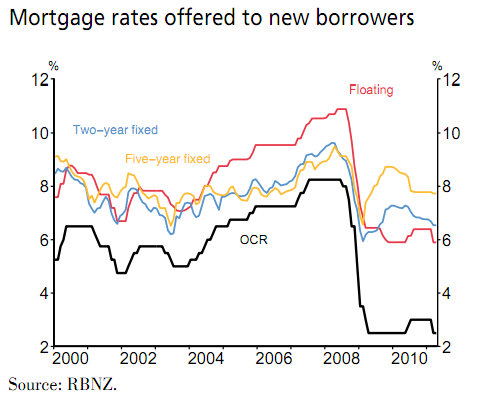
Here's the RBNZ's chart below showing how fixed and floating rates have tracked since 2000. And click here for our interactive chart showing average bank interest rates since 2002.
My view:
I think high household and government debt levels in many large developed economies will restrain global growth for some years to come and New Zealand households are being a lot more cautious about taking on new debt and spending than they were before the Global Financial Crisis.
Further financial market turmoil and a slow Christchurch rebuild may keep the OCR interest rates lower and for longer than economists think. That means I think floating is cheaper than fixing for now, but only because I have a more bearish view on global growth than the RBNZ and economists.
We have a calculator which works out whether fixed is cheaper than floating, given the assumption that the RBNZ's forecast track for the 90 day bill rate is correct and given the current average mortgage rates. See the current mortgage rates offered by banks here. The spreadsheet shows the average one year rate of 5.89% is the best, the average two year rate of 6.42% for 2 years is second best with a 'loss' of NZ$78 over the two period of a NZ$200,000 mortgage, while the floating rate is NZ$880 worse off over the two years or NZ$8.50 a week.
I also think house prices will grow less than inflation and may fall further in some areas. I stick to my longer term view that house prices are still over-valued and will eventually fall to around 15% below their 2007 peaks.
They are currently around 5% below that peak and are down more than 11% in inflation-adjusted terms since that peak, which is the biggest fall in real house prices since the stagflation of the 1970s.
See David Chaston's article here.
The RBNZ's view
The Reserve Bank of New Zealand said on July 28 the economy was recovering and it saw little need to leave its OCR at the 'emergency' level of 2.5% in place for much longer. However it said the high New Zealand dollar reduced the need after the removal of the emergency cut for further increases in the short term.
The RBNZ forecast on June 8 the 90 day bill rate would rise from 2.6% in June 2011 to 4.6% by the end of next year and 4.9% by March 2014. The Reserve Bank doesn't forecast the OCR, but the market watches its forecast 90 day bill track as a close proxy of where the Reserve thinks it will be.
Here's the chart of the forecast. The red line is where it the forecast was in the March quarter monetary policy statement. Click here for our interactive chart of bank bill rates going back to 2000.
The Reserve Bank said in its June monetary policy statement it expected house price inflation at or below the inflation rate over the next three years.
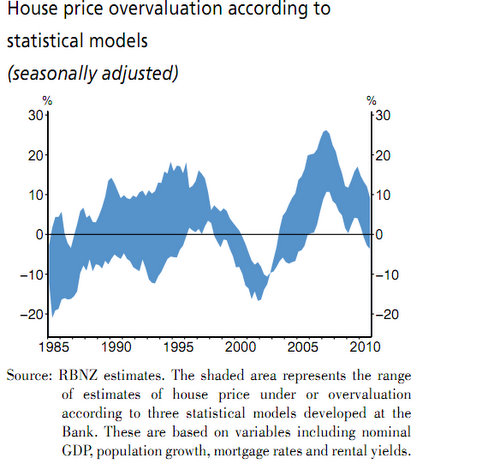
Here's its full comment with its chart below on how overvalued it thinks house prices are:
Consistent with subdued consumption, house prices are likely to increase only modestly over coming years. A number of in-house statistical models suggest that house prices continue to be overvalued when compared to metrics such as nominal GDP or rental yields (chart below).
As a result, house price increases are expected to be at or below the rate of inflation over the projection.
The Reserve Bank hasn't expressed a view on whether borrowers would be better off fixing or floating, but it notes that its ability to control the economy through the OCR is stronger when more people are floating rather than fixing. It said in June that the average duration of all mortgages was now below 6 months, compared with almost 2 years back in 2007.
The BNZ's view:
BNZ Head of Research Stephen Toplis said in a note titled "RBNZ too cuddly by half" that the bank appeared to be making the same mistakes it made during 2006 and 2007.
"In the last major tightening cycle the Reserve Bank got it horribly wrong because each and every time it raised interest rates to contain inflation it suggested that the hike, at the time, might be enough. In that fashion it failed to change the behaviours of the populace as there was no “fear” that interest rate increases might prove painful. Consequently, both interest rates and the exchange rate ended up higher than needed to be the case," Toplis said.
"Lightening appears to be striking twice. In today’s OCR review the Reserve Bank has given the green light for the removal of the emergency rate cut introduced immediately following the February 22 Christchurch earthquake but has then failed to push through with a stern warning that inflationary pressures are building. In fact the Bank goes so far as to downplay inflationary risks," he said.
The bank had sold its message poorly and signalled it would raise rates 50 basis points in September, although Toplis wondered why the bank was waiting until then.
"More worrying, though, is that the RBNZ goes on to say that the strength of the currency “is likely to reduce the need for further OCR increases in the short term”. We interpret this as meaning the Bank, currently, sees rates on hold at 3.0% until March next year. However, we also note the reference to “short term”. Accordingly, we still think the Bank believes rates will move up to its previously proposed 4.75% in due course."
The ASB's view
ASB Economist Nick Tuffley moved his rate hike forecast forward to September from December after the announcement. He now sees a 50 bps hike on September 15 to 3% before a pause until January.
"The RBNZ was very specific that further increases in the OCR (i.e. beyond the removal of the 50bp insurance cut) were dependent on the level of the exchange rate (the Trade Weighted Index is likely to be the most appropriate measure to consider)," Tuffley said.
"What is apparent is the RBNZ wants to take back the March 50bp ‘insurance’ cut very soon. That suggests a September hike is very likely, and in our view a 50bp is more probable than a 25bp. The RBNZ sees “little need for the March 2011 ‘insurance’ cut to remain in place much longer”, and our interpretation is that means an imminent move and also reversing the March cut in one hit," Tuffley said.
"Beyond that we see the RBNZ pausing until January, then resuming steady 25bp OCR increases. Further hikes, beyond removing the ‘insurance’ cut’ are conditional on the level of the NZD, ongoing NZ economic recovery, and the fluid global situation. We expect the NZ dollar will remain elevated, and “likely to reduce the need for further OCR increases in the short term”," he said.
"This means NZ interest rates are going to be trading as if the MCI was still in use. Furthermore, NZ commodity prices (and the Terms of Trade) are likely to moderate, reducing the income boost to NZ. These are reasons, we believe, for the RBNZ to pause (after removing the insurance cut) for the rest of the year."
Tuffley said markets had now fully priced in a 25 basis point hike in September.
"Meanwhile, longer-term domestic interest rates declined slightly, given the uncertainty around further OCR increases beyond the 50bp increase by the end of the year," he said.
ASB said in a July 1 note floating may be cheaper than fixing for the first year, but be more expensive after that, although it notes this all depends on how quickly the OCR rises.
Our calculations suggest floating could prove to be slightly cheaper than fixing for a year, due to the lower floating rate being paid over the coming eight months. However, for horizons beyond the one‐year mark, fixing may turn out to prove a cheaper strategy.
They forecast house price inflation firming to around 3.5% by the second half of 2012.
Westpac's view:
Westpac Chief Economist Dominick Stephens said he now expected two 25 bps hikes in September and October before a pause in December.
"The Reserve Bank today kept the OCR on hold at 2.5%, and issued a rather nuanced interest rate outlook. The upshot is that the RBNZ is planning 50 basis points worth of hikes in the near term, followed by a pause. But the early hike(s) are conditional on the domestic economy continuing to recover (which seems likely), and global financial risks receding (which is less certain)," Stephens said.
"We believe the most likely scenario is two 25bp OCR hikes, one in September and one in October, before a pause in December. A 50bp hike in September is distinctly possible, should global financial concerns about US and European sovereign debt abate. But that’s far from certain at this juncture. Indeed, a significant deterioration in financial market sentiment could yet delay the early hikes altogether," he said.
Stephens said now was the time to fix.
ANZ National's view
ANZ Chief Economist Cameron Bagrie said he now saw the RBNZ removing their March 10 'insurance' cut of 50 bps at the September 15 meeting.
"We see no point in unwinding the insurance cut in multiple steps. But we think the RBNZ will pause thereafter to assess the landscape," Bagrie said.
"The Governor made it clear that the high NZD is a concern, which will lessen the need for further increases thereafter. The bottom line is that the OCR is set to move off emergency settings but still remain stimulatory."
ANZ National's economists said in their June 24 Property focus they favoured floating over fixing for now...just. They said housing turnover was recovering but prices were "listless".
Mortgage rates were unchanged from last month. Given increased uncertainty, we favour floating for now. Broadly speaking, the rises implied by the mortgage curve are consistent with the RBNZ’s projections, and our own expectations. If it were purely a question of cost, it would thus be a line call between remaining floating, or choosing a fixed term like 2-3 years.
BNZ Chief Economist Tony Alexander said in his July Real Estate Overview on July 26 the housing market had entered a cyclical upturn.
New Zealand’s housing market is trading at low levels with prices on average still some 4% below late-2007 peaks, construction near the lowest levels in four decades, and turnover less than half that seen in 2003/04. However there is a shortage of property now manifesting itself in agents reporting a sharp increase in difficulties finding new listings. This is happening at a time when more and more first home buyers are entering the market in an environment of increased discussion of the shortage, awareness of upward creep in rents and prices, and with interest rates set to come off their four decade lows.
While high levels of debt and low affordability by world standards will tend to constrain the extent of the housing upturn, barring a new global economic catastrophe, it appears that New Zealand’s housing market has started a cyclical upturn.
Here is a summary of the various economists (and my) view on interest rates, house prices and fixing vs floating.
| Forecaster | First OCR move | Peak OCR | Fix or float? | House prices |
| RBNZ* | December quarter | 4.75% by Dec 2013 | Prefer you float | <2% pa |
| ANZ National | September 15 by 50 bps | 4% by end 2012 | Float for now | Listless |
| ASB | September 15 by 50 bps | 4.5% by Nov 2012 | Float for short term | 3.5% pa |
| BNZ | September 15 by 50 bps | 4.75% by Dec 2012 | Fix for 2-3 years | n/a |
| Westpac | September 15 by 25 bps | 6.0% by Dec 2013 | Fix | 0% in 2012 |
| HSBC | September 15 by 25 bps | 4.25% by Dec 2012 | n/a | n/a |
| Bernard Hickey | December 8 by 25 bps | 4.0% by Dec 2012 | Float | -5% |
* Forecasts implied from 90 day bill forecast track in June 9 Monetary Policy statement
We welcome your comments below. If you are not already registered, please register to comment
Remember we welcome robust, respectful and insightful debate. We don't welcome abusive or defamatory comments and will de-register those repeatedly making such comments. Our current comment policy is here.