


Auckland is a major winner from the government's skilled-based immigration policies, Wellington and Canterbury benefit to a moderate extent, while Canterbury benefits form the rebuilding-related skill-based policy.
All other regions are double losers as a result of the skilled-based immigration policies, as explained and quantified in this Raving.
Skill-based immigration policies would appear to be great at ensuring the largest group of immigrants, excluding Kiwis returning form OE, offer skills that fit with the evolving economy.
However, the evolving economy and the skilled-based immigration policies both favour large urban centres over other centres.
This is having a significant impact on regional economic growth, retail spending, residential building and house prices.
The Regional Barometer reports we launched this quarter that include analysis of migration behaviour provide the best available insights into regional and city/district prospects.
Restricting where immigrants can live would be self-defeating.
In time many skilled immigrants would end up filtering to the major urban centres even if they were originally restricted to living in provincial towns and cities.
However, if the criteria were changed to allow hard-working immigrants in as much as highly skilled immigrants it would even the playing field.
It would allow regions with cheaper housing costs to compete for immigrants on a much more equal footing with regions dominating new economy job creation.
Regional winners and losers from immigration
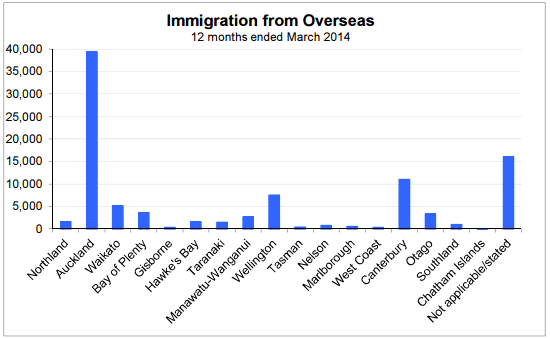
Auckland hogs a huge share of immigrants from overseas that includes Kiwis returning from OE (chart below).
Canterbury comes a distant second, aided currently by rebuild-related immigrants and Wellington third. The not applicable/not stated group actually comes second and I assume largely reflects people not filling on the immigration form completely. I assume the not applicable/stated group ends up spread around the country roughly in proportion to the stated/allocated group, but this may not be the case.
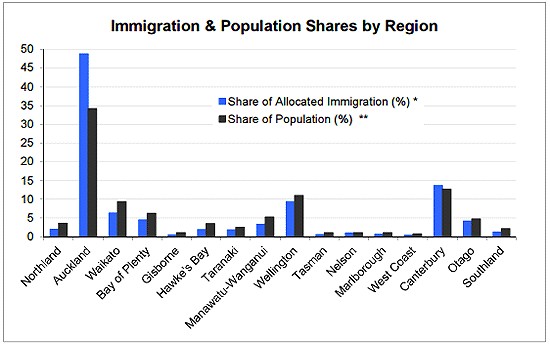
Comparing the regional shares of immigration, based on the stated or allocated group, to the region shares of population puts the immigration numbers in perspective (chart below).
Auckland's share of allocated immigration is almost 15% (15 percentage points) higher than its share of population.
Canterbury is the only other region with a larger share of immigration than population, but that is likely to be a temporary phenomenon related to rebuilding, while Nelson almost gets its share of immigrants.
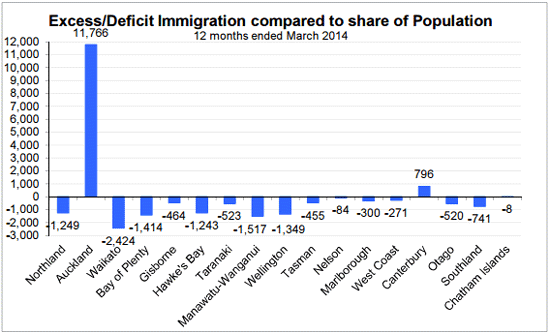
I have calculated the number of immigrants each region would get if its share of immigration matched its share of population. From those numbers I have calculated the excess or deficit for each region (chart below).
For example, in the 12 months ended March 2014 Auckland gained 11,766 more immigrants from overseas than it would have if its share of immigration matched its share of the population. Waikato had 2,424 fewer immigrants than it would have if its share of immigration was in line with its share of the population.
Canterbury is the only other winner, while Nelson is only a small loser.
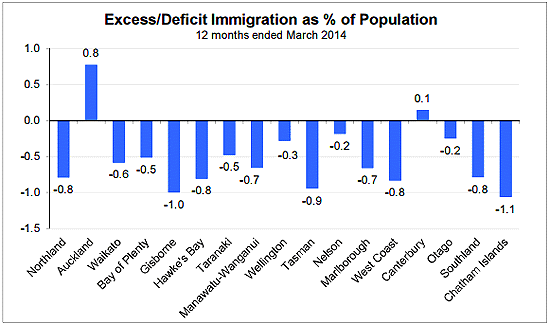
It is useful to see the excess/deficit numbers in the chart above as a % of population (chart below).
Setting aside Chatham Islands that is only included for family reasons, the majority of regions experienced a deficit share of immigration in the 2013/14 March year of between half a percent and one percent of the population (e.g. Tasman's population would have grown 0.9% more last year if its share of immigration had matched its share of population, while Auckland would have had 0.8% less population growth if it hadn't hogged an excessive share of immigration relative to population size).
The economic multiplier effects amplify the regional differences
The regions that don't get their share of immigration are double losers.
Immigrants have to restock lots of non-durable goods (e.g. furniture, whiteware, etc.). The only study I have seen on this said an immigrant added spent 1.7x the average spend per person in the first year because of this restocking process.
He/she also needs housing, which adds to existing and new housing demand. While a reasonable portion of the spending will filter outside the region, especially for smaller regions that don't offer such a full range of goods and services, a sizeable portion will be on goods and services bought from suppliers in the region.
The increase in income experienced by local suppliers will result in them spending and employing more.
Some of this spending will filter outside the region, but a sizeable portion will be on inputs purchased in the region, while the boost to employment will most likely attract some workers from outside the region. This is the economic multiplier process of textbook economics at work.
The regions that have a deficit share of immigration from overseas don't gain so much benefit from this economic multiplier process, which makes them vulnerable to losing workers to the regions that gain an excess share of immigrants and consequently have more powerful economic multiplier processes at work (i.e. almost exclusively Auckland).
This means the regions that aren't gaining their share of immigration from overseas are being hurt by more than implied by the numbers in the chart above.
A practical policy suggestion
To some the answer to this problem, assuming regional underperformance in terms of gaining immigrants and population growth are seen as problems, will be restricting where immigrants can live.
I see this as a waste of time because if people want to be in Auckland you can't keep them caged in the provinces indefinitely (i.e. any such policy will only have a transitory impact before it gets undermined).
To me there are some interesting economics at work that lead to a very different policy recommendation to the government.
Many years ago a visiting US economics professor presented a different approach to analysing economic behaviour. His starting point was the size of urban centres.
The size of the centre largely dictates the types of industries and firms present, subject a bit to the composition of the adjoining rural economy, which in turn largely dictates the types of jobs available. Small centres have a more restricted range of industries/firms and a more restricted range of job opportunities.
This is extremely relevant to immigration because to a large extent we restrict immigrants based on skills and qualifications.
By having high skill and qualification barriers to immigrants it reduces their chances of getting jobs in many parts of the country.
This may be the single largest reason why especially Auckland but also Wellington and Canterbury to some degree perform much better than regions with smaller urban centres in terms of capturing share of foreign immigrants.
Most notably Auckland has a much wider range of jobs available for the sorts of skilled immigrants we let into the country.
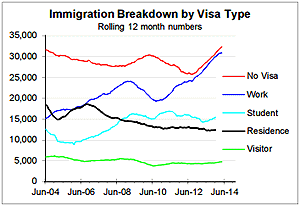 This issue is becoming more important with the growth in the work visa share of immigrants. The adjacent chart shows permanent and long-term immigrants broken down by visa types.
The no visa category will largely reflect Kiwis returning from OE. A decade ago immigrants with work visas matched immigrants arriving with residency visas, but in the last year there were 2.5x more immigrants with work visas than with residency visas.
This link is to the news section of the Immigration New Zealand website that includes lots of interesting info, including info on skill shortage lists (see, for example, this link). There is a Canterbury skill shortage list. The skill shortage lists will to some extent be relevant to all regions, but they will be more relevant to regions with larger urban centres that have a wider range of job opportunities.
This is better understood if we look at the Skilled Migrant Category which the Ministry says is:
"… the main pathway for skilled workers from overseas to become New Zealand residents. Points are awarded for factors such as a skilled job offer, qualifications, previous work experience, and age. A skilled job offer is usually critical to securing enough points to gain residence under the SMC." Source
A great example of this last week was accounting software firm Xero that has Auckland and Wellington offices announcing it is looking for 160 software developers in Britain (the first link below for this story). In a past Raving I looked at regional winners and losers from the evolving economy (use the second link below to access this report). Xero is a good example of a new economy firm that is playing an important part in driving new job creation.
For a range of reasons these firms mainly set up in large urban centres (e.g. proximity to large customers, a skilled labour pool and an international airport; the lifestyles offered by large urban centres that are favoured by higher skilled and higher paid workers in new economy firms; etc.).
From one perspective this means our skill-based immigration policy fits well with the evolving economy and makes sure new economy and other firms with skill shortages can attract the required workers from overseas to supplement local supply.
And maybe this is the best outcome even though it means most regions will be losers.
But if the criteria were relaxed to include hard-working people with lower formal qualifications, it would create a more balanced playing field from a regional perspective.
If this were done it would allow regions with smaller urban centres to better compete in part because they offer much more affordable housing costs compared to income levels than the large urban centres.
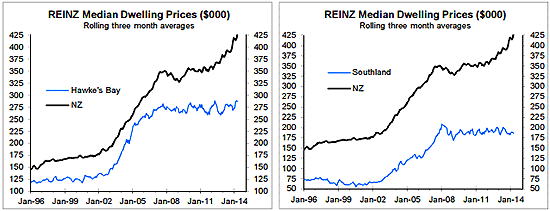
Take Hawke's Bay and Southland, for example. Neither has participated in the national upturn in existing house prices over the last couple of years, as shown in the two charts below, while both are underperformed in immigration shares. Both now offer much more affordable housing relative to incomes than the national average and dramatically so when compared to Auckland.
If the focus of immigration policy was less skill-qualification-oriented and more honest-hardworking-orientated the likes of Hawke's Bay and Southland would have a much better chance of competing for immigrants with the major urban centre, aided by the more affordable housing offered in these regions.
Wide-ranging insights into regional and city/district prospects are covered in the Regional Barometer reports we launched this quarter or contact me for info on these sharply-priced reports.
-----------------------------------------------------------------------------------
*Rodney Dickens is the managing director and chief research officer of Strategic Risk Analysis Limited.
We welcome your comments below. If you are not already registered, please register to comment
Remember we welcome robust, respectful and insightful debate. We don't welcome abusive or defamatory comments and will de-register those repeatedly making such comments. Our current comment policy is here.