

Here's my edition of Top 10 links from around the Internet today.
We have a Monday-Wednesday-Friday schedule for Top 10. Bernard will be back with his version this Wednesday. We will have another guest posting on Friday.
As always, we welcome your additions in the comments below or via email to david.chaston@interest.co.nz.
See all previous Top 10s here.
1. Motherhood penalty / Fatherhood bonus
Today's NY Times has a useful review of a key gender pay issue. It challenges old-fashioned notions about parenthood.
“Employers read fathers as more stable and committed to their work; they have a family to provide for, so they’re less likely to be flaky,” Ms. Budig said.
“That is the opposite of how parenthood by women is interpreted by employers. The conventional story is they work less and they’re more distractible when on the job.”
Despite our country having had women Prime Ministers, Supreme Court judges, head of state, these old fashioned views linger even here.
I doubt regulation ['affirmative action'] will fix anything. In fact that is likely to undermine confidence in leadership. The solution will come from attitude changes when successful women leaders push themselves forward. We have some great examples in New Zealand, but they are 'undiscovered'. Why is that? And why the continuing discrepancies when in fact most HR people are women?
One of the worst career moves a woman can make is to have children. Mothers are less likely to be hired for jobs, to be perceived as competent at work or to be paid as much as their male colleagues with the same qualifications.
For men, meanwhile, having a child is good for their careers. They are more likely to be hired than childless men, and tend to be paid more after they have children.
These differences persist even after controlling for factors like the hours people work, the types of jobs they choose and the salaries of their spouses. So the disparity is not because mothers actually become less productive employees and fathers work harder when they become parents — but because employers expect them to.
The data about the motherhood penalty and the fatherhood bonus present a clear-cut look at American culture’s ambiguous feelings about gender and work. Even in the age of “Lean In,” when women with children run Fortune 500 companies and head the Federal Reserve, traditional notions about fathers as breadwinners and mothers as caregivers remain deeply ingrained. Employers, it seems, have not yet caught up to the fact that women can be both mothers and valuable employees.
2. New champion?
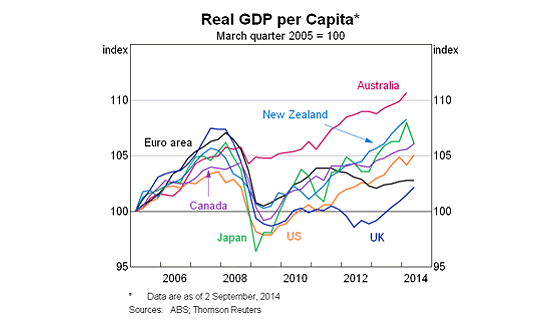
We don't impress the Aussies, but we do impress the Europeans. Last Wednesday, RBA governor Glenn Stevens gave a speech in Adelaide explaining his recent no-change policy rate decision. He talked up the virtues of Australia's 'modest growth' - and he mentioned New Zealand. He sees our 'progress' only as a consequence of "the task of re-building much of their second largest city [as it] gets into full swing".
Actually, as we know, it is a much broader story than that. We will get our own update to Q2 economic growth next week and it is unlikely the line in the chart Stevens highlighted below will slip. Our story is about dairy and meat and China as much as Christchurch. As such it won't be until Q4 or even 2015 that the sinking dairy prices come to bear on our GDP and the GDP-per-capita.
But Stevens' chart is interesting all the same. It helps put our economic performance into perspective - although some people as far away from here as you can get got their analysis a bit twisted, I think:
Could the meat and dairy superpower finally displace Australia as the reigning rich-world growth champion?
3. "Eating our seed corn"
Credit growth in the US has been expanding at about $1 tln per year over the past five years. Over the past year its been growing at about double that rate. That is a lot, helped along by 'massive' Fed interventions.
But Bill Gross points out, that is nowhere near enough.
He thinks it should be growing at at least $2.5 tln per year just to hold its own and twice that level to get it out of the doldrums.
Gross's star has dimmed a lot since he fired Mohammad El-Erain - and his funds haven't been doing very well - but his views are interesting all the same.
A credit-based financial economy (as opposed to pure cash) depends on an ever-expanding outstanding level of credit for its survival. Without additional credit, interest on previously issued liabilities cannot be paid absent the sale of existing assets, which in turn would lead to a vicious cycle of debt deflation, recession and ultimately depression. It is this expansion of private and public market credit which the Fed and the BOE have successfully engineered over the past five years, while their contemporaries (the ECB and BOJ) have until now failed, at least in terms of stimulating economic growth.
Put simply, if credit needs to expand at 4.5% per year, then the private and public sectors in combination must create approximately $2.5 trillion of additional debt per year to pay for outstanding interest. They are underachieving that target in the U.S., which is the reason why GDP growth struggles at 2% real or lower and nominal GDP growth seems capped at 4.5% or lower. Credit creation is essential for economic growth in a finance-based economy such as ours. Without it, growth stagnates or withers. Its velocity/turnover is critical as well.
4. What to do with the cash
Mario Draghi's latest stimulus program creates a big problem for bankers. Mark Gilbert explains:
So you're a European bank with some loans on your balance sheet that you made to companies not too long ago. The loans are of good quality, paying interest at the rates that prevailed in recent years. The European Central Bank would like you to bundle those loans into a shiny new asset-backed bond, which it will purchase from you (provided it isn't a sausage stuffed with derivatives, in ECB President Mario Draghi's evocative term). In return, you will have a pocket full of fresh cash.
What exactly you will do with that cash, though, is problematic at best. The ECB wants you to find new borrowers eager for money to invest in their businesses, so they will start hiring from Europe's army of unemployed young adults. It’s probable, though, that your new loans will either be riskier than the ones you offloaded to the ECB, or at much lower interest rates, or (more likely) both, with corporate borrowing costs at record lows.
5. A recent history of household budgets
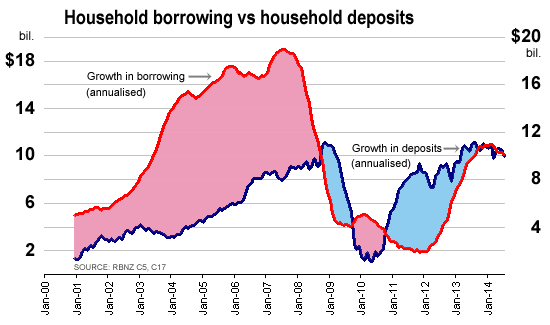
From 2000 to 2008 New Zealanders went on a borrowing splurge. It was substantial. Households took on $106 billion in new debt in those 9 years. Since then we have been more restrained; in the subsequent six years household debt has increased 'only' $33 billion.
The period of exceptional debt growth coincided with the raising of the top tax rate to 39c (and maybe we caught the housing bug to shelter from that policy change).
But the pace could not be sustained. The GFC intervened, and households deleveraged. They started saving more than the spent.
The ratio of household debt levels to household deposit levels in 2000 was 175%. By 2008 that had grown to 195%. By 2014 it had fallen back to 158%. On that score, we are better off now than we were in 2000.
It's a trend that is notable mainly because it happened. But the level of net saving has been far less than the level of net borrowing that preceded it. We have a legacy of debt and the consequences that flow from it.
Remarkably, now we are in balance on a month-by-month basis.
Over the past year new savings have equalled new borrowing. The banking system hasn't needed to fund any extra offshore, although it still needs to service what was built up prior to 2008.
6. An independent Scotland?
Scotland is about to vote on independence. That is a huge opportunity for the country, a huge risk for the "United Kingdom", and a likely spur for other regions, especially in Europe, to also seek to break away. Starting a new wave of instability in Europe is entirely possible. A lot is riding on the September 18 (September 19 in New Zealand) vote.
Anatole Kaletsky thinks there could be "costs to the world" in a 'yes' vote. Here is a sampler of his opinion:
Until this week almost nobody outside Scotland took very seriously the possibility that Europe’s most stable and durable nation, the only big country on earth not to have suffered invasion, revolution or civil war at any time in the past 268 years, might soon be wiped off the map. It now seems quite conceivable, however, that the United Kingdom of Great Britain and Northern Ireland will cease to exist after the referendum on Scottish independence to be held on September 18.
The problems would begin immediately after the referendum, since a vote for independence victory would probably trigger a rebellion against David Cameron by right-wing members of his own party, whose historic name is the “Conservative and Unionist Party.” Another reason to expect mutiny is ironically that Conservatives would to win elections in England easily in the future, after Scotland’s Labour members of Parliament are permanently gone from Westminster. This confidence would, in turn, allow party activists to opt for a leader more in line with their own euro-skeptical and right-wing views than the moderate Cameron.
... political instability looks like becoming a permanent fact of life in Britain unless the unionists can win the Scottish referendum by a decisive margin. Since such a clean-cut outcome now looks unlikely, the volatility this week in sterling and other British assets is probably a portent of things to come.
7. Nagging doubt
OK, I admit it. I came late to the global warming narrative. The key for me was insurance. That is, if I was an insurance company would I take a lower premium rate because AGW isn't going to happen? I doubt it.
I came to this position despite my own observations that little seems to actually changing in the climate I experience. Sea levels aren't rising that I can see (over 50+ years), the seasons come and go as they always have, sometimes wetter, sometimes drier. And temperatures don't seem warmer or colder to me. Still "other people" have convincing argument. Even Bjorn Lomberg has said his review of the data shows that climate change is real too.
But then comes along Matt Ridley, an author whose books I really admire, with a simple observation.
This is all that's left of the global-warming emergency the U.N. declared in its first report on the subject in 1990. The U.N. no longer claims that there will be dangerous or rapid climate change in the next two decades. Last September, between the second and final draft of its fifth assessment report, the U.N.'s Intergovernmental Panel on Climate Change quietly downgraded the warming it expected in the 30 years following 1995, to about 0.5 degrees Celsius from 0.7 (or, in Fahrenheit, to about 0.9 degrees, from 1.3).
Even that is likely to be too high. The climate-research establishment has finally admitted openly what skeptic scientists have been saying for nearly a decade: Global warming has stopped since shortly before this century began.
First the climate-research establishment denied that a pause existed, noting that if there was a pause, it would invalidate their theories. Now they say there is a pause (or "hiatus"), but that it doesn't after all invalidate their theories.
Alas, their explanations have made their predicament worse by implying that man-made climate change is so slow and tentative that it can be easily overwhelmed by natural variation in temperature—a possibility that they had previously all but ruled out.
However, I am going to go on making personal decisions on the basis that AGW will likely cause future trouble and do my bit to mitigate. Because even if it doesn't turn out the shrill way some think, my actions won't make it worse (I hope). Yes, I know. We run a lot of climate related stuff on interest.co.nz. But personally, I am not 100% convinced. I'm still a sceptic at some level. (I distrust prothletising certainty, of any stripe.)
8. New fees, new transaction clipping
In 2013, according to Google's "Our Mobile Planet", New Zealand had more than 50% penetration of smartphones. No doubt it is higher in 2014. Most of the new ones will have a NFC chip (NFC = near field communications). My Samsung has that now. And the new iPhone6 is likely to have that linked to a payments system. In an instant, phones will be able to be your wallet, using them to tap-and-pay, just like your latest credit card. Better still, you will be able to leave your phone in your pocket and do it with the new iWatch on your wrist.
Don't worry about the security aspects; no-one else is. Adoption of tap-and-pay has been incredibly fast.
But the coming phone-as-a-wallet - although tried before to mixed success - will get a huge boost via Apple. You might even wonder what you would need your bank for. The regulator will be thinking hard about these issues, no doubt. Apple and Google don't like regulators. But because Apple seems to have made its plans with most of the credit card giants on board, expect there to be a huge momentum for their type of system. (And expect to pay the Visa or MasterCard toll, something Kiwis have largely avoided).
Pray the local alternative gets off the ground. The big banks (Westpac and ANZ) are withdrawing their support. The lure of the fees that a Kiwi-style eftpos system prevents them from accessing is just too great.
9. Getting the rules right
The main question confronting us today is not really about capital in the twenty-first century. It is about democracy in the twenty-first century, according to Joseph Stiglitz.
Markets, of course, do not exist in a vacuum. There have to be rules of the game, and these are established through political processes. High levels of economic inequality in countries like the US and, increasingly, those that have followed its economic model, lead to political inequality. In such a system, opportunities for economic advancement become unequal as well, reinforcing low levels of social mobility.
Thus, Piketty’s forecast of still higher levels of inequality does not reflect the inexorable laws of economics. Simple changes – including higher capital-gains and inheritance taxes, greater spending to broaden access to education, rigorous enforcement of anti-trust laws, corporate-governance reforms that circumscribe executive pay, and financial regulations that rein in banks’ ability to exploit the rest of society – would reduce inequality and increase equality of opportunity markedly.
If we get the rules of the game right, we might even be able to restore the rapid and shared economic growth that characterized the middle-class societies of the mid-twentieth century.
10. Trapped in our backwards policies
Here is a press release note that I found interesting last week. It is from an American solar electricity company, First Solar:
First Solar is building Silver State South, which is the company's fifth utility-scale solar power plant in development, construction or operation in southern Nevada. It also positions First Solar as the largest solar developer in the state with approximately 750MW of projects in various stages of development, construction and operation.
750 MW is a lot and that is just their projects in Nevada. To put that in perspective, NZ has about 9,600 MW of generating capacity and 75% of that is hydro. So our fossil energy electricity generation is about 2,400MW. That one company in that one state is generating about a third of our total fossil-energy needs. Seems like a practical thing for NZ to consider, especially distributed on all the roofs of homes, offices and factories. The only problem is it would undermine the 'public investment' in existing generation. That conflict-of-interest is holding us back. The Government needs to get right out of the electricity business - except to regulate it to encourage innovation.
We welcome your comments below. If you are not already registered, please register to comment
Remember we welcome robust, respectful and insightful debate. We don't welcome abusive or defamatory comments and will de-register those repeatedly making such comments. Our current comment policy is here.