

Today's Top 10 is a guest post from interest.co.nz's very own Jenée Tibshraeny.
As always, we welcome your additions in the comments below or via email to david.chaston@interest.co.nz. And if you're interested in contributing the occasional Top 10 yourself, contact gareth.vaughan@interest.co.nz.
See all previous Top 10s here.
1) Chinese using foreigners to entice locals to invest in property developments
Housing developers in China are hiring ordinary foreigners to pose as celebrities, to boost flagging property sales. This fascinating short documentary, made by the New York Times, follows a Chinese woman on her quest to recruit foreigners, give them impressive fake credentials, and parade them around flashy events aimed at promoting the empty housing developments, China’s real estate bubble has created. The woman says;
The real value of the house or any product doesn’t really matter. As long as there is a good image, people will be willing to buy. For the time being, the image has become the reality.
2) How to reduce your power bill by 80%
Mr Money Mustache, a thirty-something-year-old who blogs about retiring early by living frugally, writes about how he cut his power bill by 80%. He uses a metre (the Efergy Elite Combo), which he clamps around the main input wires in his circuit panel, to monitor his power consumption right down to the watt. He writes:
By watching the display, I can see how much power it takes when the fridge kicks on, or when I run the dishwasher, or flip on a bank of lights in the kitchen. It also helps me find phantom loads: when you think everything is off, but your household consumption is still over 100 watts, something is wrong. I tracked down three faulty smoke detectors that were burning over 5 watts each and replaced them with units that use under 1 watt.
Then I discovered that my Yamaha amplifiers burn 25 watts each if you leave them on, even when there is no music playing. This was bad, because I was often forgetting them overnight. The benefit of the Efergy is its ability to measure even direct-wired devices: alarms, dishwashers, your central a/c system, or the unwanted pipe heater that the previous owner installed in your crawlspace to prevent frozen pipes... but then left on for 12 months of the year regardless of temperature.
3) World’s leading peer-to-peer lender struggles to make profit
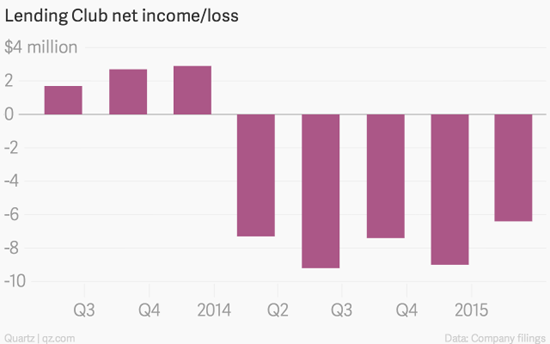
Despite all the hype about how online lending’s going to topple traditional banking, a company that enables money lending over the internet in the US is still losing more money than it’s making. Lending Club, the world’s largest online marketplace lender, this week announced it’s still unprofitable, even after more than doubling its revenue and its number of loan originations.
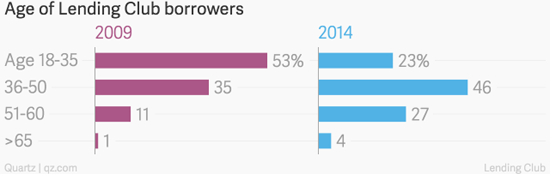
The company’s essentially spending more on improving its technology, hiring engineers and attracting new customers through sales and marketing, than it’s making by originating loans. On the upside, Lending Club’s getting a more mainstream customer base. Quartz has provided these graphs:
4) “Accountants just want to have fun”
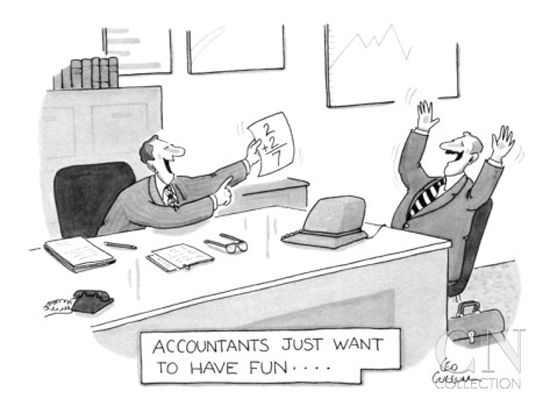
This seems to be the slogan behind Xero’s marketing campaign. Xero’s latest financial reports indicate it’s a in a similar position to Lending Club. It’s investing heavily in marketing its cloud-based accounting software to keep attracting new clients, even if it means making a loss.
Having attended Xero’s annual conference, Xerocon, last week, I can see where the company’s marketing dollar’s going… Xero-themed cupcakes, a photobooth, an impressive line-up of guest speakers, a slick PR operation, and tweets for Africa. What’s more, the accountants and bookkeepers attending the event appeared to be having a blast. Xero’s marketing campaign’s succeeded in putting the “fun” in accounting.
Apple Watch users are rallying together online, as their lack of friends who own Apple Watches means they don’t have people to share the gadget’s features with.
The watch allows you to get your heart rate reading and send it to other Apple Watch users. A page called “lonelyheartbeats” has started on the website Reddit, so Apple Watch owners who don’t have people to share their heart rates with, can share them with an online community. Go figure!
Apple's also admited tattoos can interfere with the watch’s sensors, giving you an inaccurate heart rate reading.
Here’s a video of people’s reactions to using the Apple Watch for the first time.
6) Chinese professionals work as Uber drivers to make friends
NPR reports the likes of accountants, airline pilots and engineers are working as Uber drivers for the social interaction.
Uber is a rapidly growing peer-to-peer taxi or ride-sharing service. Person X registers as a driver, and person Y needs a ride, so uses the GPS capabilities on their iphone/smartphone to book a driver. The payment is made automatically via credit card. There’s no middle man in the exchange. NPR reports:
Unlike in the U.S., most here say the main reason they drive is social. They want to chat with all sorts of people and — like Xu — try to make sense of this mega-city of 24 million. My Uber drivers have included a young airline pilot who picked me up at home one morning in his Land Rover. He said he spent all his time in the cockpit, so driving for Uber was his only way to talk to passengers of any kind. A retired factory worker picked me up another day and took me to a Starbucks. He said he was just looking for stimulating conversation and almost forgot to register the ride, adding that he didn't care if he got paid.
7) Viral politics narrows debate in UK election
A political blogger for UK’s Telegraph says he gets nervous when political memes – cartoons, videos, jokes etc – go viral on the internet. In addition to over-simplifying political issues to make them more polarising and marketable, he says viral politics narrows political discussion. He writes:
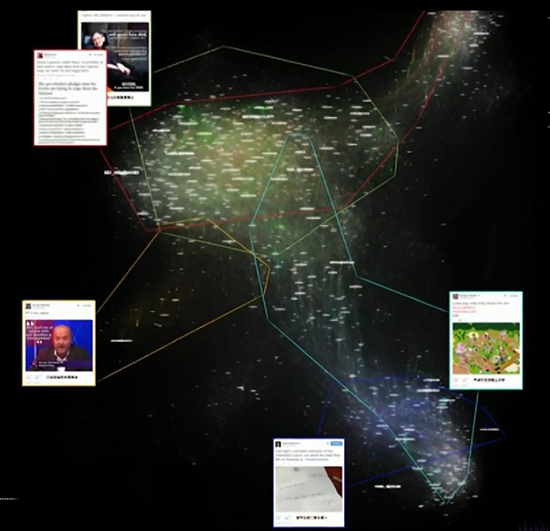
Virals tend to percolate within the same group: and that can close off discussion, making the converted more zealous, and more entrenched. We also took a look at how these virals spread on Twitter, by mapping them against the different political tribes.
What this slightly complicated map tells you is that virals circulate in their own little galaxies: Labour ones tend to be shared among Labour (top left), Tory ones around Tories (bottom right), and Galloway ones around Galloway. The only one that was cross party was Douglas Carswell’s peculiar tweet about Hello Kitty, which we later learnt came from his small child accidently tweeting from his account.
8) How to run a company with (almost) no rules
Brazilian businessman, Ricardo Semler, does a TED talk on the radical form of corporate democracy he’s implemented in the companies he’s founded. Semler has allowed employees to design their own jobs, select their supervisors and define their pay… without causing World War Three. He’s also applied the same principles to education, banking and hospitality. He says:
And so, the question we were asking was, how can we be taking care of people? People are the only thing we have. We can't have a department that runs after people and looks after people… We've come from an age of revolution, industrial revolution, an age of information, an age of knowledge, but we're not any closer to the age of wisdom. How we design, how do we organize, for more wisdom?
9) 2015 expected to be the year of cheap food
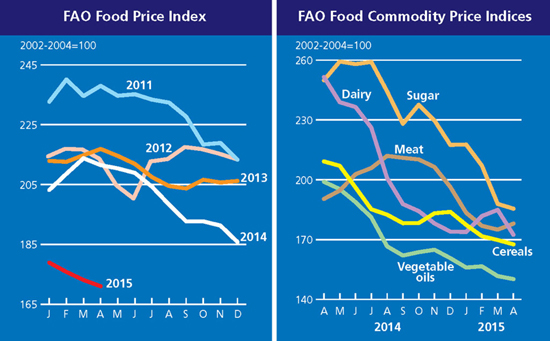
The biannual report published by the UN Food and Agriculture Organisation, Food Outlook, says the world food import bill is forecast to reach a five-year low in 2015.
International food prices are likely to stay under downward pressure due to large supplies, low freight rates and a strong US dollar, with import volumes of the five commodities little changed or even rising. The reduction in import bills is likely to benefit low income countries.
Dairy prices fell the most, buoying imports in Africa, while the abolition of the European Union’s (EU) milk quota system was also one of the main drivers of the 6.7 percent monthly drop. Sugar, cereals and vegetable oils prices also declined. By contrast, meat values rose in April, which was their first increase since August 2014.
10) Ponytail for sale on Trade Me
While the #ponytailgate scandal was “so last month”, the jokes around the Prime Minister’s inappropriate ponytail tugging are continuing to roll in. Someone is selling a genuine ponytail, “cut from a New Zealand woman on the evening of May 4 2015” on Trade Me.
The nice wispy-looking piece of hair has been described by the seller as “politician bait”, which is “perfect for café workers wanting to attract the attention of middle-aged man-child politicians”. Another selling point; the ponytail is “fresh from the scalp, never been pulled”.

We welcome your comments below. If you are not already registered, please register to comment
Remember we welcome robust, respectful and insightful debate. We don't welcome abusive or defamatory comments and will de-register those repeatedly making such comments. Our current comment policy is here.