

By Bernard Hickey
The Government's pre-Budget announcement of its 2-year 'bright line' tax on capital gains by property traders surprised a few people and was the major focus in the ensuing coverage.
But the accompanying news that any non-residents buying property here would have to first open a bank account here, get an IRD number and then declare their own passport and home tax details when they bought the property may actually have more of an impact.
The Government is privately pointing to this measure as having the most potential to reduce some of the foreign demand for Auckland properties and Prime Minister John Key has indicated the information gathered on non-resident buying would be gathered and published. Mr Key made clear on the day after the announcement that New Zealand tax authorities would be happily sharing these details with foreign tax authorities too.
The message was unmistakable. If the money you're using to buy New Zealand property was not earned legitimately in your home country and it's being stashed in the form of a two-bedroom brick and tile in Pakuranga or an Epsom villa then expect your government at home to find out about it.
The elephant in the room of Auckland's property debate is whether some of the money pouring into Auckland from China in particular is effectively money laundering of ill-gotten funds. Without any data, the debate is fuelled by anecdote and rumour, but it is an issue capturing more and more attention around the world.
Mr Key was personally made aware of it by the most knowledgeable source in China -- President Xi Jinping.
Last November the Chinese leader asked for Mr Key's help to track down a number of Chinese nationals who had fled to New Zealand with corruptly obtained funds. This was part of President Xi's now famous campaign to crack down on the 'tigers and flies', the officials and their cronies who have obtained funds corruptly. His first campaign was called 'Operation Foxhunt' and the latest version, Operation Sky Net, was ramped up in April with publication of a list of China's 100 most wanted.
New Zealand was the third most popular destination on the list, which estimated between 11 and 20 were hiding here with their funds.
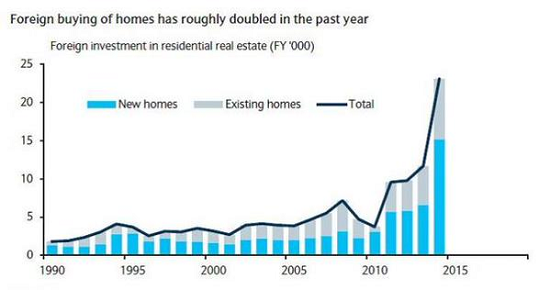
The issue of money laundering from China is heating up in Australia too, where data on how much property is bought by non-residents is actually collected (see graph below). Over 25% of all new and existing homes sold last year in Sydney and Melbourne were sold to non-residents and many are asking where the money came from. It has sparked calls for tougher laws governing money laundering.
This is where the money laundering issue becomes more topical and direct for New Zealanders, and in particular the real estate agents, solicitors and accountants who are currently handling any money flowing out of China and into New Zealand.
New Zealand introduced tough new anti-money laundering rules for banks, insurers, finance companies, share brokers, fund managers and even loan sharks in 2013 that means they have to ask much tougher questions about who they open accounts for and where the money comes from. It was a big deal for them and cost tens of millions to retrain staff and rebuild systems. It's part of an international effort led by the G7, which developed a Financial Action Task Force to push the measures along.
But a second phase of the anti-money laundering crack-down has stalled. It was designed to pull real estate agents, solicitors, auctioneers and accountants into the net so they would also have to verify the source of the funds being used to buy property and other assets here. There was initial talk it could be introduced last year, but the Justice Ministry is still only talking about doing policy work on the options for phase two.
The Government needs to crack on with phase two of the money laundering reforms to follow up its good work forcing non-resident property buyers to say who they are and to obtain an IRD number. It's another great way of reducing demand without having to introduce a politically and diplomatically difficult tax on non-residents. And it makes us a better global citizen in the eyes of the G7's taskforce, which has already had to hurry us along once before for being too slow to introduce the first phase of anti-money laundering rules.
----------------------
A version of this article also appeared in the Herald on Sunday. It is here with permission..
We welcome your comments below. If you are not already registered, please register to comment
Remember we welcome robust, respectful and insightful debate. We don't welcome abusive or defamatory comments and will de-register those repeatedly making such comments. Our current comment policy is here.