

Consumer confidence has taken a big knock, with sentiment "likely affected by recession headlines", according to results of the latest ANZ-Roy Morgan consumer confidence survey for March.
During the period of the latest survey, GDP results for the December quarter were released showing that the NZ economy had contracted by 0.1%, giving two consecutive quarters of negative GDP (after a 0.3% drop in September) and therefore producing what is referred to as a 'technical recession'.
As a result what had been steadily improving consumer confidence took a blow.
"News that the economy re-entered recession in the second half of last year appears to have hit consumer confidence hard," ANZ chief economist Sharon Zollner said.
"Only around half of the week 4 survey responses will have come in after GDP data was released on 21 March, but the responses for that week overall were notably lower. That said, the preceding weeks were also softer than February, so the monthly fall in confidence isn’t just about recession headlines."
Zollner said while the GDP data has likely caused some volatility in surveyed confidence, "in the bigger picture, the economy really struggled in the second half of last year, especially on a per capita basis, and the labour market is increasingly showing the impact of that".
She said even if in GDP terms the economy is now past the worst, "as we expect it is", the labour market will continue to soften for some time yet, given the usual lags in the dynamics between overall activity and the labour market.
Consumers continue to report ongoing extreme wariness about purchasing major household items, Zollner says.
"This perception has been strongly inversely correlated with inflation in recent years, to the extent of breaking the usual reliable relationship with retail sales. To be sure, retail sales have been very weak, ask any shopkeeper, but the fall in this indicator was extreme as inflation took off."
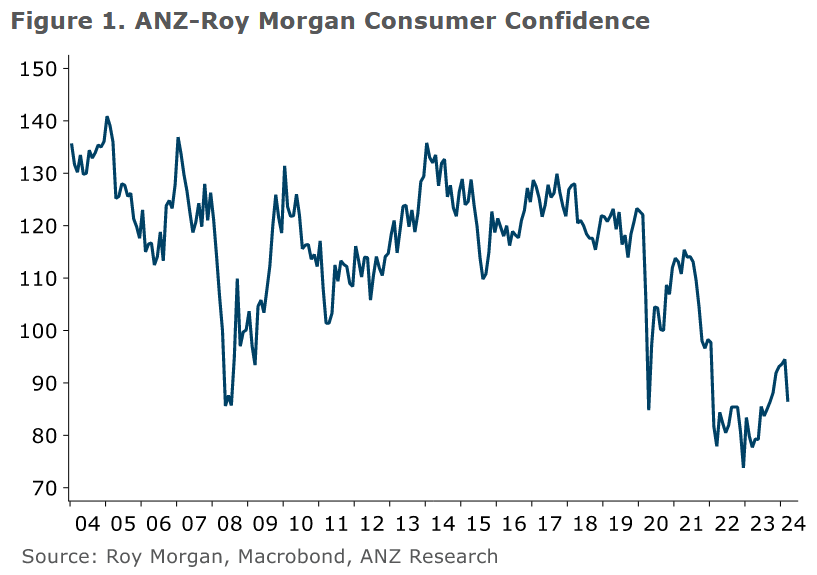
This was the detail of the latest survey results:
• The future conditions index made up of forward-looking questions fell 8 points to 93, while the current conditions index fell 9 points to 76.
• Perceptions of current personal financial situations fell 11 points to -23%, back where it was in September last year.
• A net 19% expect to be better off this time next year, up 1 point.
• A net 24% think it’s a bad time to buy a major household item, down 6 points, bringing to an end a steady run of improvement.
• Perceptions regarding the economic outlook in 12 months’ time dropped a sharp 14 points to -34%. The 5-year-ahead measure dropped 10 points to -5%.
• House price inflation expectations fell from 4.1% to 3.4% y/y. They are strongest in Canterbury (3.9%) and weakest in the rest of the South Island (2.7%).
• Two-year-ahead CPI inflation expectations were unchanged at 4.5%.
We welcome your comments below. If you are not already registered, please register to comment
Remember we welcome robust, respectful and insightful debate. We don't welcome abusive or defamatory comments and will de-register those repeatedly making such comments. Our current comment policy is here.